HUB 04 · Cable Management & Accessories
EV Charger Cable Length: How Much Do You Actually Need?
The most common regret after mounting a charger is a cable that will not reach. Here is how to get it right before you buy.
We earn a commission when you buy through our Amazon links, at no extra cost to you. It never affects our rankings, and we say so when the cheaper product is the better buy. How this works.
When in doubt, buy the 25-foot cable. Most home chargers ship with 18 to 25 feet of cable, and the extra reach costs little while a cable that comes up short forces you to remount the charger or reposition the car every single time. The catch is that the length you need is almost never the straight-line distance you picture in your head.
Measure the path, not the line
The cable does not travel in a straight line from the charger to the car. It drops from the wall unit to the ground, runs along the floor or the wall, and then reaches up to the vehicle's charge port — which may be at the front, the rear, or the far side depending on the car. Add up the real path:
- the drop from the charger down to floor level (often 3 to 4 feet on its own);
- the run across the garage or driveway to where the car parks;
- the reach from the ground up to the charge port, plus a little slack so the cable is not taut.
A charger mounted 15 feet from the port in a straight line can easily need 22 to 25 feet of cable once the drops and slack are counted. This is exactly why the reviews on our best home EV chargers roundup call out cable length on every unit.
When a shorter cable is fine
If the charger mounts within a few feet of a consistent parking spot and the charge port is on the near side, a shorter cable is tidier and cheaper — and a shorter cable is also a little stiffer to wrangle in the cold, so less of it is genuinely nicer to handle. The problem is that a short cable removes all flexibility: park a foot too far, add a second car, or buy a vehicle with the port on the opposite corner, and it no longer reaches.
Longer cable, better management
The trade-off with a long cable is that the slack has to go somewhere. Twenty-five feet of cable pooled on the floor is a trip hazard and wears the jacket where it drags. That is what a holster and J-hook solve — they dock the connector and loop the slack up off the ground, so you get the reach without the mess. If you are buying a long-cable charger, budget for cable management at the same time.
Where the charger goes matters as much as the cable
Cable length and mounting position are one decision, not two. Mounting the charger centrally — so it can reach either side of the garage — often does more than buying a longer cable, and it keeps the run short. Just remember the charger also has to reach your electrical panel or the NEMA 14-50 outlet; a longer wire run from the panel adds to the installation cost. Balance the two before you drill. Height is part of the same decision — every inch up is paid for twice, going down to the ground and back up to the port — and how high to mount an EV charger covers the code minimum and the reach trade-off. If you want the most cable to work with in the first place, the units that ship 25 feet are ranked in the best long-cable chargers.
The gear
Recommended gear for this guide
The products this guide refers to, with prices pulled live from Amazon and dated on each card.
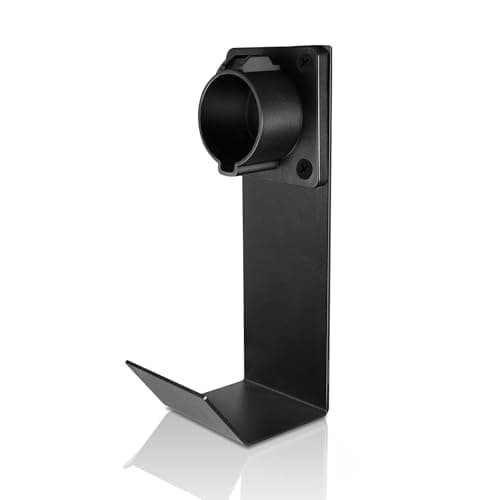
Docking a J1772 connector
Lectron J1772 Holster + J-Hook
A connector dock and cable hook in one — the tidiest, cheapest fix for a J1772 plug that otherwise sits on the floor.
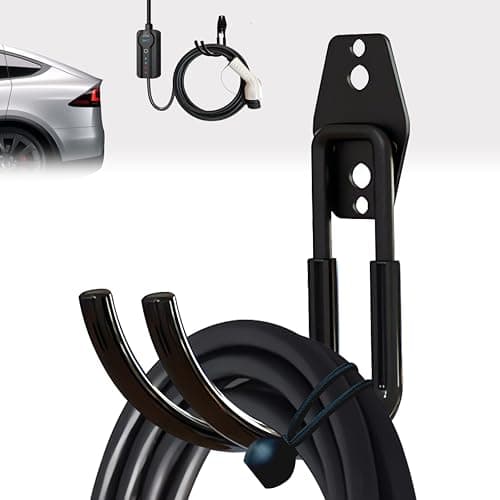
Looping the cable, any connector
Nexoroot Steel J-Hook Wall Mount
A heavy-duty steel hook for looping a charging cable — the single cheapest thing you can do to stop wrecking a cable on the floor.
#ad · As an Amazon Associate we earn from qualifying purchases.
Questions
Frequently asked
What length of EV charger cable do I need?
Is a 25-foot EV charging cable too long?
Can I use an extension cord to reach farther?
Does a longer cable charge more slowly?
Keep reading
Related
- Best EV Charger Cable OrganizersDock the connector and loop the slack a long cable leaves.
- Best EV Charger Extension CablesWhen the measurement says you are a few feet short.
- Best Home EV ChargersCable length is called out on every unit in the roundup.
- Level 2 Installation CostWhy the run from the panel affects what you pay.
Receipts
Sources
We do not run a testing lab, and we do not pretend to. Where a measured number came from someone else's lab, we name them and link them. Where we could not verify something, we say so on the page rather than quietly leaving it out. Read our full method.