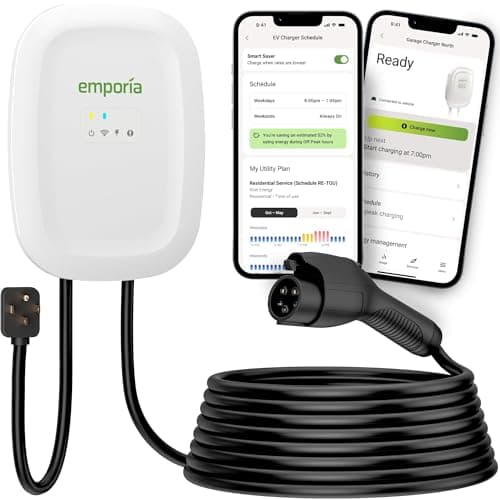
The Emporia Level 2 is the home charger we recommend to most people, because it does something rare: it delivers 48-amp speed and real smart features for roughly what a plain plug-in charger costs. You are not paying a premium for the software — you are getting it more or less for free.
In our best home EV chargers roundup the Emporia takes the top spot, and this is the longer look at why. As always, we compile the published specs and do the math rather than bench-testing hardware, so read this as documented research on a very well-regarded unit, not a lab teardown.
Who it is for
The Emporia fits the buyer who wants the fast option and the smart features, but resents paying twice for both. That is a large share of EV owners. If you are on a time-of-use electricity plan, the app scheduling alone can pay back the difference over a dumb charger by moving your charging to cheaper overnight hours. It is the wrong charger for exactly one person: the buyer who never wants to open an app at all. For that person, see our app-free roundup.
The specs that matter
Emporia rates this unit at up to 48 amps / 11.5 kW when hardwired, with a J1772 connector, a 25-foot cable, and Wi-Fi with app control. Two of those numbers do real work:
- 48 amps, but only hardwired.The plug-in NEMA 14-50 version is capped at 40 amps, like every plug-in charger, because a 14-50 plug lives on a 50-amp circuit and the continuous-load rule limits draw to 40. To get the full 48 amps you have to hardwire it on a 60-amp circuit. That is not an Emporia quirk — it is physics and code — but it is the detail that catches buyers out. Our wire and breaker guide walks through the sizing so you know which version to buy.
- 25-foot cable. Long enough to reach across a two-car garage and park either direction, which is more useful day to day than most people expect.
What is good
The headline is value: 48-amp capability plus genuine energy monitoring and scheduling, at a price that undercuts most smart rivals. The energy monitoring is not a gimmick — seeing what each charge costs, and being able to schedule it for off-peak hours automatically, is the feature set that actually saves money on a time-of-use plan. The 25-foot cable is generous, and the unit slots neatly into Emporia's broader home-energy app if you already use their monitoring products. For a single box that covers speed, smarts and reach without a premium, little else in the category matches it.
Where it falls short
The Emporia's weaknesses are the flip side of its strengths. First, the 48-amp figure requires hardwiring; if you want plug-in convenience you are living with 40 amps, same as the cheaper units. Second, the app and Wi-Fi are central to the experience, so setup is more involved than a plug-and-go charger, and the value proposition partly depends on you actually using the software. If your Wi-Fi is unreliable or you simply do not want an app in the loop, much of what makes the Emporia special is lost on you, and a sealed box is the better spend.
Installation notes
Decide hardwired versus plug-in before you order, because it changes which version you buy and what circuit you need. Plug-in wants a properly rated NEMA 14-50 outlet on a 50-amp circuit; hardwired at 48 amps wants a 60-amp circuit with appropriately sized wire. Either way, have a licensed electrician confirm your panel can support the load and handle the connection to code. If you are going plug-in, do not skimp on the receptacle — an industrial-grade, listed 14-50 outlet is the part that survives a continuous 40-amp draw.
Alternatives
If you want the same money to buy a no-app charger instead, our app-free roundup is the honest alternative. The old no-app favorite, the Grizzl-E Classic, is discontinued on Amazon, but our Grizzl-E vs Emporia comparison is kept for reference if you are weighing a sealed box against a smart one. If you want one app that also covers public charging, step to the ChargePoint Home Flex. And if your budget is tighter, the EVIQO delivers a certified smart charger at 40 amps for less.
Bottom line
The Emporia is the default recommendation because it removes the usual compromise: you do not have to choose between fast, smart and affordable. Hardwire it for the full 48 amps, use the scheduling if you are on a time-of-use rate, and it is hard to out-argue for most homes. The only buyers who should look elsewhere are the ones who never want an app — and for them the app-free roundup is right there.