For most people shopping for a portable EV charger, the WOLFBOX Portable is the one to get. It ships with both a 240-volt NEMA 14-50 plug and a 120-volt 5-15 plug, so one unit charges at full Level 2 speed at home and still works from an ordinary wall outlet on the road. It packs into a trunk, its current is adjustable so you can dial it down for a weaker circuit, and it costs less than most hardwired wall boxes. If you already have (or can add) the right outlet, that combination is hard to beat.
Why a portable is often the smarter buy
The buying guides that steer everyone toward a hardwired wall unit skip the most useful fact in this category: a portable charger that plugs into a NEMA 14-50 outlet does the same job as a fixed wall unit. It pulls the same 240 volts, tops out at the same 40 amps, and adds range at the same rate. The only real differences are that a portable lives on a hook instead of being bolted to the wall, and that you can unplug it and take it with you.
That last point is the whole argument. A hardwired charger is a fixture: if you move, it stays behind. A portable comes with you, doubles as a travel charger at any home or rental with a 14-50 receptacle, and can be stowed in the trunk for a road trip. For renters, for anyone who might move, and for people who want one charger instead of two, the portable is not the compromise choice - it is frequently the correct one. The picks on this page assume a known 14-50 at home; if the point is to keep one in the trunk, the selection changes to units with adjustable current, because on the road the outlet is the unknown — see the best portable chargers for road trips. We break the trade-offs down in full in portable vs hardwired EV charger.
The catch is the outlet. A portable is only as good as the receptacle it plugs into, and a continuous 40-amp draw is more than a bargain-bin outlet is built to handle. Before you buy any of these, read how NEMA 14-50 plug-in chargers work and put your money into an industrial-grade NEMA 14-50 outlet rather than the cheapest one on the shelf. Do that and the running cost is genuinely low; at typical residential electricity rates, charging at home comes in well under the cost of gas, and we show the arithmetic in what it costs to charge an EV at home.
The shortlist, ranked
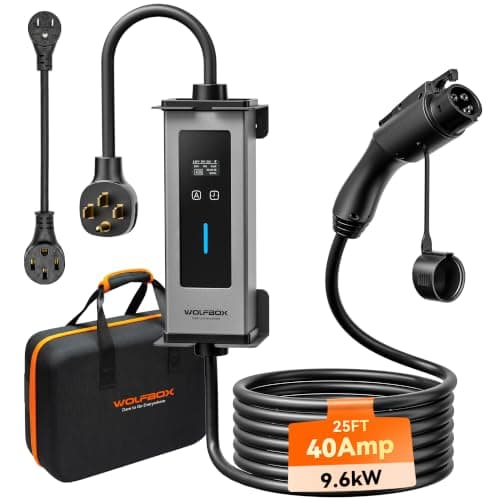
1. WOLFBOX Portable - one charger for home and travel
The WOLFBOX wins because it removes the reason you would own two chargers. The 14-50 plug delivers full Level 2 speed at home, and the included 5-15 plug lets it fall back to a standard 120-volt outlet when a 240-volt one is not available - a genuinely useful thing at a relative's house or an older motel. Its amperage is adjustable from 6 up to 40 amps, so you can turn it down to match a smaller circuit instead of tripping a breaker, and a built-in delay timer lets you start on cheaper overnight rates without an app. It is a brick that lives on the floor or a hook rather than a mounted unit, and running it flat out at 40 amps demands a properly rated 14-50 receptacle, but for flexibility per dollar nothing else here touches it. We go deeper in the full WOLFBOX portable review.
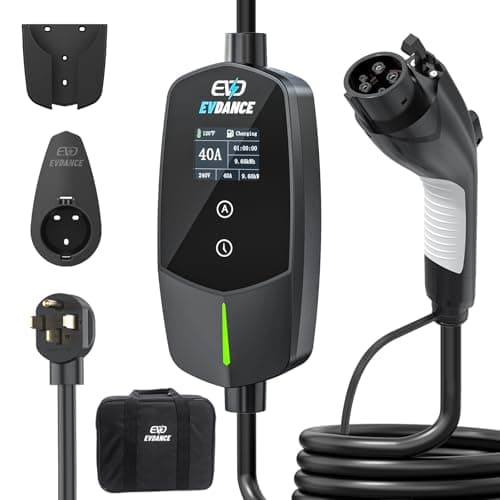
2. EVDANCE 40A Portable - off-peak charging without an app
The EVDANCE is the pick if your utility charges less for overnight power and you do not want to fuss with a phone. It carries a built-in delay timer, so you can set it to start on cheaper late-night rates with no app, no Wi-Fi, and no account. Its current is adjustable like the WOLFBOX's, and it runs on a long 25-foot cable that reaches across a two-car garage. What you give up is smart monitoring - the timer is the extent of the scheduling - and it is a newer, value-brand name. If you want to shift charging to off-peak hours and keep things simple, it is an easy call.
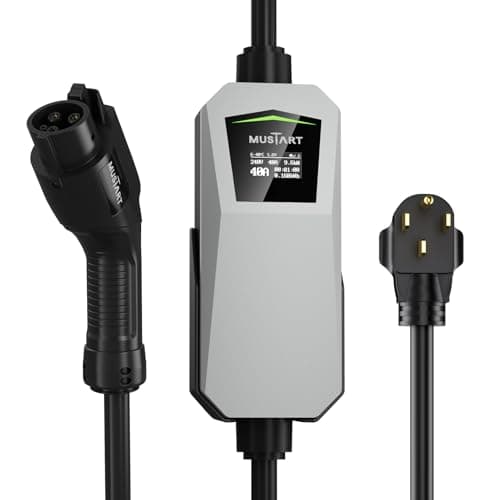
3. MUSTART 40A Portable - the cheapest capable option
The MUSTART exists to answer one question: what is the least I can spend and still get real 40-amp, 240-volt charging that moves. It is one of the least expensive true 40-amp portables on Amazon, and it adds an LCD readout that shows charging status and faults at a glance. The trade-offs are a shorter 21-foot cable and no 120-volt plug in the box, so it is less flexible than the WOLFBOX. But if budget is the deciding factor and you have a 14-50 outlet already, it does the core job without drama.
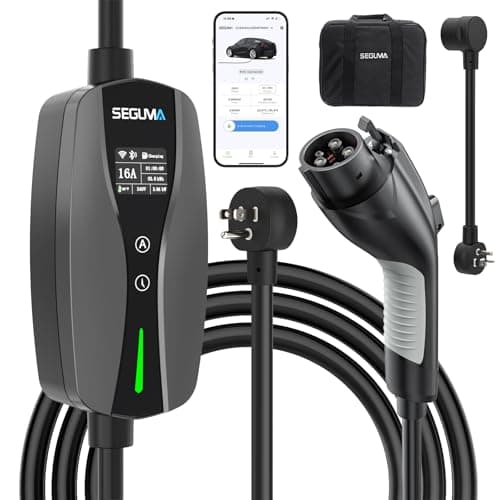
4. SEGUMA Wi-Fi Level 1/2 - a 120-volt emergency backup, not a daily driver
The SEGUMA is the odd one out here on purpose. On a household outlet it is a Level 1charger: the NEMA 5-15 plug is on the cord itself, so it goes into any ordinary 120-volt socket with no special circuit, which is exactly why it is worth keeping in the trunk. But Level 1 adds only about 3 to 5 miles of range per hour, against roughly 25 for a Level 2 unit. The included NEMA 6-20 adapter lifts it to 16 amps and roughly 10 to 12 miles per hour if you happen to have that outlet, but most garages do not. Buy it as a backup cord, not as your everyday charger.
One of these is not like the others. On a household outlet the SEGUMA is Level 1 - 120 volts, roughly 3 to 5 miles of range per hour. It shares this list because it is a legitimate emergency backup, but it will not keep up with real daily driving. If it is going to be your only charger, buy a Level 2 portable instead and keep the SEGUMA as a spare, if at all.
Every portable here needs a 240-volt receptacle to be a Level 2 charger, and that receptacle is a circuit an electrician has to pull — which is the real comparison against a wall unit. EV charger vs 240V outlet works through both routes on total cost, and explains why a cheap receptacle is the most expensive saving in the whole install.
How to choose a portable EV charger
A portable charger is a simple thing wrapped in confusing marketing. Ignore the badges and the app screenshots and decide on four things: your outlet, the amperage, the cable and plugs, and whether you actually need Level 2. Here is how each one shakes out.
Start with your outlet, not the charger
The single most important decision happens before you pick a charger at all: what are you plugging it into. Almost every Level 2 portable here uses a NEMA 14-50plug, the same 240-volt receptacle used by an electric range. If you already have one in the garage, you are most of the way there. If you do not, adding one is an electrician's job, and the receptacle itself is the part that quietly fails when you cheap out on it. Read how these plug-in chargers work first, then buy a listed industrial-grade 14-50 outlet rather than a residential-grade one - the contacts on the cheap ones are not built for a continuous 40-amp load.
Amperage: why 40 amps is the portable ceiling
Every Level 2 portable on this page tops out at 40 amps, and that is not a coincidence. EV charging counts as a continuous load under standard electrical code, so a circuit must be rated to 125% of the charger's draw. A 14-50 outlet sits on a 50-amp circuit, and 50 divided by 1.25 is 40 - so 40 amps is the most a plug-in charger can safely pull. That is roughly 9.6 kilowatts, or about 25 miles of range per hour for most EVs, which is plenty to refill overnight. The only way past 40 amps is to hardwire, which is a different decision covered in our portable vs hardwired comparison. For a portable, treat 40 amps as the number and pick on everything else.
Adjustable current is the feature that matters more than a couple of amps of headroom. The WOLFBOX and EVDANCE both let you dial the draw down, which means the same charger can run safely on a smaller circuit or an older outlet you are not sure about. If you are ever going to plug into an unfamiliar receptacle - the point of a travel charger - being able to reduce the current is worth more than a spec sheet's peak number.
Cable length and the plugs in the box
Cable length is boring until it is 4 feet short of your charge port. A 25-foot cable, like the EVDANCE's, reaches across a two-car garage and lets you park either way around; a 21-foot cable, like the MUSTART's, saves money but limits where you can park. Check the distance from your outlet to where the car's port sits before you buy.
The plugs in the box decide how portable the charger really is. A unit that ships with both a 14-50 and a 5-15 plug, like the WOLFBOX, is a true dual-level charger - full speed at home, and a slow trickle from any wall socket when that is all you can find. A charger with only a 14-50 plug is a Level 2 unit that happens to be unmounted; it still needs a 240-volt outlet everywhere it goes.
Level 1 versus Level 2
This is the fork the SEGUMA sits on. Level 1 means 120 volts from a normal household outlet, adding about 3 to 5 miles of range per hour. Level 2 means 240 volts and roughly 25 miles per hour. For a car that drives typical daily distances, Level 1 cannot refill overnight what a commute uses, so it works as a backup and not a primary charger. If a portable is going to be the charger you rely on, it needs to be Level 2. Keep a Level 1 cord in the trunk for emergencies if you like, but do not make it the plan.
When to skip the portable and hardwire
A portable is the right answer for renters, for anyone who might move, for households that want a travel charger, and for anyone who already has a 14-50 outlet and does not want to pay an electrician to hardwire. Skip it and hardwire instead if you want the fastest possible charging - a hardwired unit can run at 48 amps, above the 40-amp plug-in ceiling - or if you want the tidiest permanent install with no brick on the floor. That head-to-head is laid out in full in portable vs hardwired EV charger.