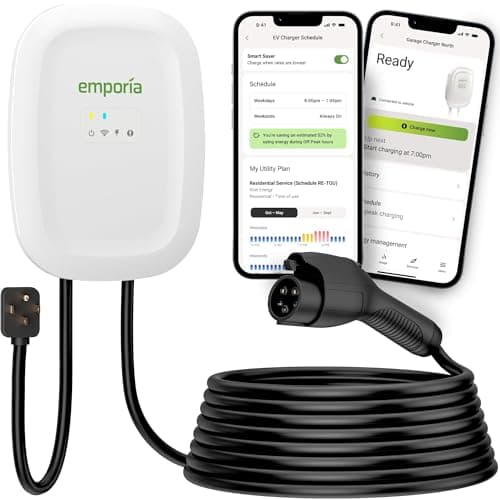
For most people, the Emporia Level 2 is the home charger to buy. It is 48-amp capable when hardwired, it has genuine energy monitoring and scheduling in the app, and it costs about what a plain plug-in charger does — you are not paying a smart-charger premium for the software. If you would rather never touch an app, the honest alternative is no longer a wall unit at all: see our app-free roundup, since the rugged no-app wall chargers have been discontinued or replaced by Wi-Fi versions.
A Level 2 charger is the single upgrade that makes living with an EV effortless. On 240 volts it adds roughly 25 miles of range per hour — and up to around 40 at higher amperage — against the roughly 5 miles per hour you get from a standard 120-volt wall outlet, so it turns overnight into a full battery instead of a trickle. The catch is that the category is a fog of amperage numbers, hardwired-versus-plug-in arguments, and app features almost nobody uses. This roundup cuts through it. We compile the published manufacturer specs, do the wiring and cost math, and tell you which charger fits which house. We have not bench-tested these units, and we say so; what follows is documented research, not a lab report.
One scoping note before the picks: every charger here uses the J1772 connector, which fits the great majority of EVs on North American roads. If your car came with a Tesla-style NACSport instead — a Tesla, or one of the 2025-onward models that adopted the standard — the same class of hardware is sold with a native NACS cable, and we rank those separately in best NACS home chargers.
The short version
If you want one recommendation and no reading: buy the Emporia. It is the rare smart charger that does not charge you extra for being smart, and its 48-amp ceiling is faster than the 40-amp default most plug-in units top out at. Beyond that, the picks split cleanly by what you value:
- Emporia Level 2 — best for most people. Fast, genuinely smart, and priced like a dumb charger. Read the full Emporia review.
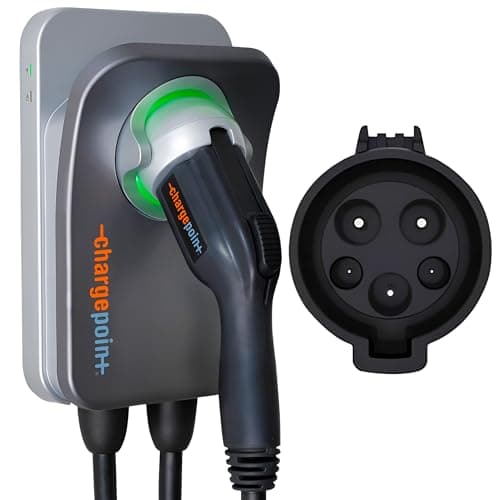
- ChargePoint Home Flex — best established brand. Adjustable up to 50 amps and tied to the largest public charging app in North America.
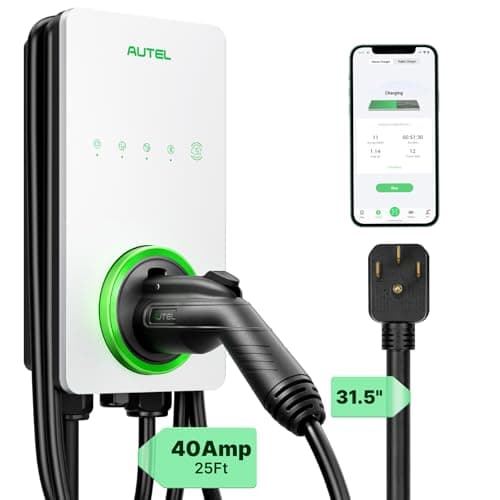
- Autel MaxiCharger — best feature set out of the box. Wi-Fi and Bluetooth, plus a holster in the box for a tidy install.
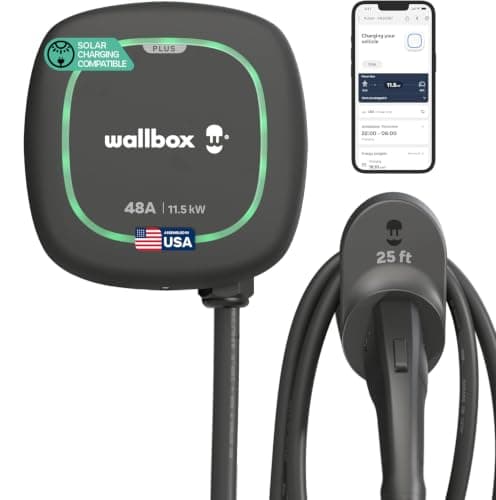
- Wallbox Pulsar Plus — best compact 48A unit. One of the smallest full-speed hardwired chargers you can mount.
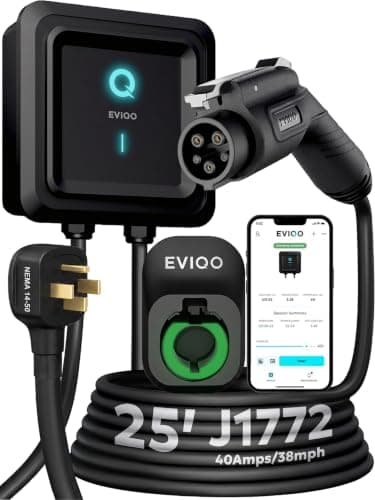
- EVIQO Level 2 — best budget smart charger. UL and ETL listed with a weatherproof rating, usually at the bottom of the price band.
First, the rule that decides everything: your panel sets your speed
The number on the box — 40 amps, 48 amps, 50 amps — is a ceiling, not a promise. What you can actually use is set by the circuit and breaker your electrical panel can support, and by code, not by the charger. EV charging counts as a continuous load, so the circuit has to be sized to 125% of the charger's current. That single rule is where most of the confusion lives.
- A 40-amp charger needs a 50-amp breaker(40 × 1.25 = 50) and typically 6 AWG copper wire.
- A 48-amp charger needs a 60-amp breakerand 6 AWG copper — often heavier 4 AWG on a long run.
So a charger rated for 48 amps only delivers 48 amps if you have a 60-amp circuit to give it. Buy a fast unit and wire it to a 40-amp breaker and you have bought speed you cannot use. This is the most common way people waste money in this category. If a 40-amp breaker is what you can spare, 32 amps is your working ceiling and the adjustable units built for it are in the 32-amp roundup; if the charger is going into a property you rent out, the host-specific picks are in chargers for an Airbnb. Before you choose an amperage, find out what your panel can spare — the full breaker-and-wire breakdown, including gauge and long-run derating, is in our wire size and breaker guide. Treat those figures as standard NEC continuous-load practice and confirm the specifics with a licensed electrician and your local code before any work happens.
The practical takeaway: match the charger to the breaker you can realistically install, not to the biggest number on the shelf. For a lot of homes a 40-amp charger on a 50-amp circuit is the sweet spot; a 48-amp unit only pays off if your panel has the headroom for a 60-amp circuit. If 40 amps is your target, our best 40-amp EV chargers roundup ranks the top picks.
Hardwired or plug-in? The NEMA 14-50 question
There are two ways to connect a Level 2 charger. A plug-in unit ends in a NEMA 14-50 cord and plugs into a 240-volt outlet, the same receptacle an electric range uses. A hardwired unit is wired straight into the circuit with no plug. The choice matters for both speed and flexibility:
- Plug-in is capped at 40 amps.A NEMA 14-50 plug lives on a 50-amp circuit, and the continuous-load rule limits it to 40 amps of draw. If you want the full 48 amps from the Emporia or the Wallbox, you have to hardwire it. Plug-in's advantage is that you can unplug and take the charger with you, which is the right call for renters and anyone who might move.
- Hardwiring unlocks 48 ampsand looks cleaner on the wall, but it is a fixture — it stays with the house. It also needs an electrician either way, whereas a plug-in unit can go in yourself only if a properly rated 14-50 outlet already exists.
If you go plug-in, the outlet itself matters more than people expect. Buy an industrial-grade, listed NEMA 14-50 receptacle — the cheap ones are the part that overheats and fails under a continuous 40-amp draw. We cover that in the NEMA 14-50 outlet guide. For what the whole job actually costs — hardware, labor, permit, and a possible panel upgrade — see our installation cost breakdown. It runs from a few hundred dollars to a couple of thousand depending on your panel and how far the run is.
The picks, in order
1. Emporia Level 2 — the one to buy
The Emporia is the value default because it collapses the usual trade-off. It is 48-amp capable when hardwired, so it is faster than the 40-amp plug-in crowd, and it still has real energy monitoring and scheduling in the app — at a price that undercuts most smart rivals. The 25-foot cable reaches across a two-car garage. Its one honest caveat is that the software is central to the experience, so if you never want to open an app you are paying for something you will not use. Everyone else should start here. Full Emporia review.
2. ChargePoint Home Flex — the established brand
The Home Flex is the polished, well-supported option. Its amperage is adjustable in the app up to 50 amps to match whatever breaker you install, and it plugs into the same ChargePoint app that runs a huge chunk of North America's public network — one app for home and away. You pay for that brand maturity and unified app; the Emporia matches most of what it does for less. Full ChargePoint Home Flex review.
3. Autel MaxiCharger — the feature-dense install
The Autel is for buyers who want everything and a clean setup. It ships with a separate holster for tidy cable management, and it carries both Wi-Fi and Bluetooth, so app control still works if your garage Wi-Fi is weak. Its ceiling is 40 amps, so it is not the speed champ if your panel could do 48, but the breadth of features and the in-box holster are the draw. Full Autel MaxiCharger review.
4. Wallbox Pulsar Plus — the compact 48A unit
If you want full 48-amp speed on the smallest possible wall footprint, the Pulsar Plus is one of the tiniest 48-amp chargers you can buy, and it is Energy Star and UL certified. It is hardwired only at 48 amps, though, so there is no plug-in convenience if you might move it. For a permanent, fast, tidy install it is excellent; for anyone who rents or travels with the charger, a plug-in or portable unit makes more sense.
5. EVIQO Level 2 — the budget smart pick
The EVIQO regularly sits at the bottom of the price band while still carrying both UL and ETL listings and an IP66 / NEMA 4 weatherproof rating, with a Wi-Fi app and a long 25-foot cable. It tops out at 40 amps and comes from a newer brand with a shorter track record than ChargePoint or Wallbox. If your priority is the most certified hardware for the least money, it is a lot of charger; if brand history reassures you, step up to the ChargePoint.
What it costs to run
The running cost is the happy surprise of EV ownership. Charging at home is generally well below what a comparable gas car costs to fuel — the electricity to cover a couple hundred miles is a few dollars at typical residential rates. The exact figure depends on your utility rate and your car's efficiency, and we show the full arithmetic (rate per kWh, miles per kWh, and off-peak scheduling) in our cost to charge an EV at home guide. Every charger here does the same job on the energy bill; the smart units just let you shift charging to cheaper overnight hours automatically.
Two newer pages narrow this list by car rather than by amperage. If you drive a BMW— i4, iX, i5 or i7 — the 11 kW onboard charger genuinely uses 48 amps, which moves the hardwired units up this ranking. If you drive a Jeep 4xe or another plug-in hybrid, the car caps at 7.2 kW and the cheapest well-certified charger here is the right one. And if your electrician has told you the panel cannot take the circuit, the load-managed chargers are the ones that can change that answer.
How to choose a home charger
Once you know what your panel can support, the decision comes down to five things. Here is how we weighted them, and how to read them for your own house.
Amperage: match it to the breaker, not the marketing
Speed scales with amperage, but only up to what your circuit allows. If your panel can spare a 60-amp circuit, a 48-amp charger like the Emporia or Wallbox adds range noticeably faster. If a 50-amp circuit is all you can reasonably run — or you are going plug-in — a 40-amp unit is the ceiling anyway, and paying for a 48-amp charger buys headroom you cannot reach. Decide the circuit first, then buy the charger that matches it.
Smart features that matter, and the ones that do not
The features worth having are the ones that save money or prevent problems: scheduling so charging starts on cheaper off-peak rates, energy monitoring so you can see what a full charge actually costs, and, for a two-EV household, load sharingso two units can split one circuit safely. The features that mostly add cost are novelty dashboards, social sharing, and anything that only works while a company's cloud is up. A dumb charger does none of this and is completely fine for a single-car home on a flat electricity rate; a smart charger earns its keep on a time-of-use plan.
Cable length
Measure before you buy. A 25-foot cable, which the Emporia, Autel and EVIQO all carry, reaches across a typical two-car garage and lets you park either way around. A shorter cable is fine if the charger mounts close to the charge port, but nothing is more annoying than a cable that will not reach when you park nose-in one day and tail-in the next. Longer is almost always the safer choice, and a cable organizer keeps the extra length off the floor.
Weatherproofing and build
If the charger lives in a sealed garage, almost any unit is fine. If it mounts outside or in a carport, look for a stated weatherproof rating — the EVIQO's IP66 / NEMA 4 rating is built for it. A weather rating is also just a proxy for how seriously the unit is built; the ruggedly sealed boxes tend to age better wherever they hang.
Certification is not optional
A home charger pushes 40 to 48 amps continuously for hours, often unattended overnight. That is not a place to save money on an uncertified box. Look for a UL or ETL listing — the Wallbox is Energy Star and UL, the ChargePoint is UL listed, and the EVIQO carries both UL and ETL. It is the one spec we would not compromise on.
So, which one?
Buy the Emporiaunless you have a specific reason not to — it is fast, smart, and priced like a plain charger, which is why it wins for most people. If you never want an app in the loop, the app-free options are now portables — see our dumb charger roundup. Want the biggest brand and one app for home and public charging? The ChargePoint. Want every feature and a holster in the box? The Autel. Need full speed on the smallest footprint? The Wallbox. On the tightest budget but still want smart features? The EVIQO. Every one of them is a genuinely good charger; the trick is buying the one whose strengths match your house and skipping the features you will never touch.