HUB 05 · Guides & Buying Advice
How Much Does It Cost to Charge an EV at Home?
The running-cost math no spec sheet shows you, worked out across three electricity rates so you can plug in your own.
We earn a commission when you buy through our Amazon links, at no extra cost to you. It never affects our rankings, and we say so when the cheaper product is the better buy. How this works.
Charging an EV at home is cheap, and the math is simpler than most sites make it look. The cost of a charge is just your battery's energy times your electricity rate. At the roughly 10.7 cents per kWh the US Department of Energy uses as an example, filling a 200-mile (about 54 kWh) EV runs roughly $6 — and even at higher residential rates it stays well under what a comparable gas car costs to fill. Below is the exact formula and a worked table so you can drop in your own numbers.
Almost nobody publishes this arithmetic, which is odd, because it is the number that actually decides whether an EV saves you money. The chargers get all the attention; the running cost is where the payoff lives. So here is the whole thing, worked out, with every assumption on the table.
The formula
There are two costs worth knowing: what a full charge costs, and what a mile of driving costs. Both come from the same two inputs — how much energy you use and what you pay per unit.
Cost of a full charge = battery size (kWh) × your electricity rate ($/kWh). A 60 kWh battery at $0.16 per kWh is 60 × 0.16 = $9.60 for the energy stored. That is the entire calculation. Your electricity rate is printed on your utility bill, usually as a number of cents per kilowatt-hour.
Cost per mile = energy use per mile (kWh/mile) × your rate ($/kWh).If a car covers 200 miles on a 54 kWh charge, it uses 54 ÷ 200 = 0.27 kWh per mile. At $0.16 per kWh that is 0.27 × 0.16 = about 4.3 cents per mile. Equivalently, if you prefer miles per kWh, cost per mile is just your rate divided by your efficiency: 0.16 ÷ 3.7 mi/kWh is the same 4.3 cents.
Where to find your two inputs.Battery size (in kWh) is in your car's spec sheet. Your electricity rate is on your utility bill — look for the per-kWh charge, and remember it may change by season or time of day. Everything below is an example; swap in your own two numbers and the answer is yours.
What a full charge costs, worked out
Here is the cost of the energy in a full charge across five battery sizes and three electricity rates. The rates — $0.11, $0.16, and $0.24 per kWh — span a realistic low, middle, and high for US residential power; use whichever is closest to your bill. Every cell is simply battery size times rate.
| Battery size | At $0.11/kWh | At $0.16/kWh | At $0.24/kWh |
|---|---|---|---|
| 40 kWh | $4.40 | $6.40 | $9.60 |
| 54 kWh (~200 mi) | $5.94 | $8.64 | $12.96 |
| 60 kWh | $6.60 | $9.60 | $14.40 |
| 77 kWh | $8.47 | $12.32 | $18.48 |
| 100 kWh | $11.00 | $16.00 | $24.00 |
Read the 54 kWh row against the Department of Energy's own example: at about 10.7 cents per kWh, that 200-mile charge lands near $6, which sits right between the $5.94 low-rate and $8.64 mid-rate cells here. The figures line up because it is the same one-line multiplication.
Two honest caveats on the table.First, you rarely charge from truly empty to truly full — most people top up from, say, 30% to 80% each night, so a real session costs a fraction of these full-charge numbers. Second, some energy is lost as heat during charging, so the reading on your meter is modestly higher than the battery's rated capacity. Build in a little headroom; do not treat these as to-the-penny figures.
What a mile costs, and how that compares to gas
Cost per mile is the number that makes the gas comparison honest. Using an efficient EV that gets about 3.7 miles per kWh (the 54 kWh / 200-mile car above), here is the per-mile cost at each rate:
| Electricity rate | Cost per mile (at ~3.7 mi/kWh) | Cost per 1,000 miles |
|---|---|---|
| $0.11/kWh | ~3.0 cents | ~$30 |
| $0.16/kWh | ~4.3 cents | ~$43 |
| $0.24/kWh | ~6.5 cents | ~$65 |
Now the gas side, kept deliberately as a plug-in-your-own example rather than a claim: say gasoline is $3.50 a gallon and a comparable gas car gets 30 miles per gallon. That is 3.50 ÷ 30 = about 12 cents per mile, or roughly $120 per 1,000 miles. Against every row above, the EV is cheaper per mile — often by half or more. Use your own local gas price and your own car's real mpg; the point is not the specific figures but that home electricity is a fundamentally cheaper fuel, which is exactly what the Department of Energy's benefits data shows. If you want to see the same comparison run from the gas side, The Charge Curve works through the EV vs gas cost math with its own worked figures.
A fully worked example, start to finish
Numbers land better when you watch them move once. Take a driver with a 66 kWh battery who pays $0.15 per kWh on a flat rate, drives about 900 miles a month, and gets roughly 3.5 miles per kWh. Every figure below is the same two-input formula pointed in a slightly different direction:
- Energy per mile:1 ÷ 3.5 = about 0.286 kWh per mile.
- Cost per mile:0.286 × 0.15 = about 4.3 cents.
- Monthly energy:900 ÷ 3.5 = about 257 kWh.
- Monthly cost:257 × 0.15 = about $39.
- Full-charge cost, for reference:66 × 0.15 = $9.90 — though this driver rarely runs the pack from empty to full.
Swap the battery size, the rate, the efficiency, or the mileage for your own, and the method does not change. There is no hidden variable and no magic in a pricier charger; it is arithmetic you can redo on the back of your utility bill.
What actually changes your rate
The single biggest lever on your cost is the rate itself, and you have more control over it than you might think.
- Time-of-use plans. Many utilities offer cheaper overnight rates specifically because EV owners charge while everyone else sleeps. Shifting your charging to those hours can drop your effective rate below the flat number on a standard plan.
- Tiered pricing. Some utilities charge more once your monthly usage crosses a threshold. Adding an EV can push you into a higher tier, so it is worth checking whether an EV-specific rate plan is available.
- Season. Rates in many regions rise in summer. Your winter and summer cost per mile may not match.
This is why the honest answer to "what will it cost me" is always "take your rate off your bill and multiply." The formula does not change; only the rate does.
Does the level or the charger change the cost?
No — and this trips people up. A kilowatt-hour is a kilowatt-hour. Charging the same energy on Level 1 versus Level 2 costs the same; Level 2 just delivers it faster. A pricier charger does not make electricity cheaper. What the charger affects is convenience and speed, not the running cost. For a walk-through of the levels, see types of EV chargers.
The one place hardware meets money is the up-front install, which is a separate, one-time cost from the per-charge running cost. If you want the real numbers there, we break them down in the Level 2 installation cost guide. And when you are ready to choose the unit itself, the shortlist is at best home EV chargers.
A realistic monthly estimate
Put it together for a typical driver. Say you drive 1,000 miles a month in that ~3.7 mi/kWh EV. That is about 270 kWh a month. At the three example rates:
- $0.11/kWh: about $30 a month.
- $0.16/kWh: about $43 a month.
- $0.24/kWh: about $65 a month.
Those figures assume you do all your charging at home, which is the point of installing a charger in the first place. Public DC fast charging costs more per kWh, so the more you charge at home, the closer your real bill sits to the low end of these estimates. The same arithmetic answers a question short-term-rental hosts ask: one guest arriving at 30% and leaving full on a 75 kWh battery is about 52 kWh, so roughly $9 at the national average rate — we work the host case through in the best EV chargers for an Airbnb.
Where public charging changes the math
Everything above assumes the electron came from your own wall, and that assumption is doing a lot of work. Public charging — especially DC fast charging on the road — is priced well above home electricity per kWh, and some networks bill by the minute rather than by the kWh. That is convenience pricing for speed when you are far from base, and it is the reason home charging is where the savings actually live.
The practical takeaway is a ratio: the higher the share of your miles you charge at home, the lower your true blended cost per mile. A driver who charges at home almost every night and only fast-charges on the occasional road trip lands near the cheap end of the tables above. A driver who leans on public fast charging pays a premium that can erode much of the EV's fuel-cost advantage. If you can charge at home, do — it is the single biggest thing you control after your rate plan.
Why the meter reads more than the battery holds
One detail keeps the simple formula honest: not all the energy you pay for reaches the battery. A little is lost as heat in the cable, the onboard charger, and the pack itself during a session, so your electric meter records slightly more than the battery's rated capacity. It is a modest gap, but it means the tidy "battery kWh times rate" figure is a floor, not a ceiling. For budgeting, treat the table numbers as a touch optimistic and give yourself a small cushion. It does not change the conclusion — home charging is cheap — it just keeps you from being surprised by a bill a few percent above the clean arithmetic.
What if you cannot charge at home?
Not everyone has a driveway or a garage outlet, and it changes the whole calculation. If you rely on public charging — workplace, curbside, or DC fast — your cost per mile is set by those networks' pricing, not your home rate, and it is generally higher. Workplace or destination Level 2 charging that is free or cheap can get you close to home-charging economics; a routine built around DC fast charging will not. Before you assume the low numbers in this guide, be honest about where your electrons will actually come from. The math here is the best case, and the best case needs a place to plug in overnight.
Estimate your own cost in three steps
Forget averages. Your number comes from your car and your bill, and it takes about a minute to work out.
1. Get your rate off your bill
Find the per-kWh charge on your electricity statement. If you are on a time-of-use plan, note the overnight rate too, since that is when you will charge. This one number does most of the work.
2. Decide what you are measuring
For a full-charge cost, multiply your battery size (kWh) by your rate. For a per-mile cost, multiply your rate by your car's energy use per mile (or divide your rate by its miles-per-kWh). For a monthly cost, multiply your monthly miles by cost per mile.
3. Sanity-check against the table
Find the row closest to your battery size and the column closest to your rate. If your own math lands near that cell, you did it right. If it is wildly off, re-check whether you used your battery's kWh (not its range) and your rate in dollars (not cents).
The number that matters most:your electricity rate. A charger's price, brand, or amperage does not change what a kWh costs. Shopping your utility's EV rate plans will move your monthly bill far more than shopping chargers ever could.
The gear
Recommended gear for this guide
The products this guide refers to, with prices pulled live from Amazon and dated on each card.
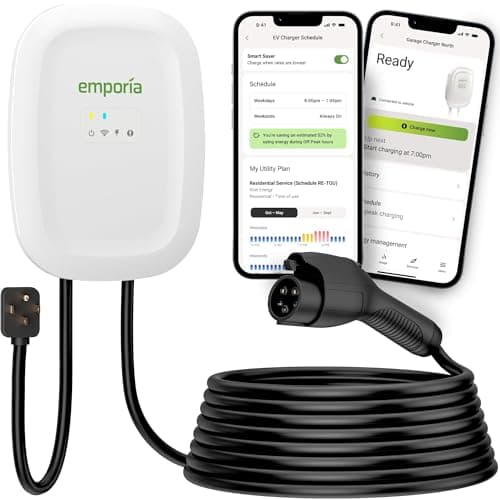
Most people who want the smart features too
Emporia Level 2 (48A)
The smart charger that does not charge a smart-charger premium — 48-amp capability and real energy monitoring for the price of a dumb one.
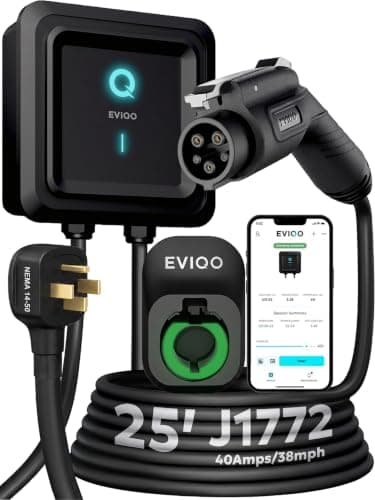
Budget-conscious buyers who still want smart features
EVIQO Level 2 (40A)
A weatherproof, UL-and-ETL-listed smart charger that regularly sits at the bottom of the price band — a lot of charger for the money.
#ad · As an Amazon Associate we earn from qualifying purchases.
Questions
Frequently asked
How much does it cost to fully charge an EV at home?
Is charging an EV at home cheaper than buying gas?
Does a Level 2 charger cost more to run than Level 1?
Why is my real charging cost a little higher than the battery math?
How can I lower what I pay to charge?
Keep reading
Related
- Best Home EV ChargersThe Level 2 units worth installing, ranked with live prices.
- Level 2 Installation CostThe one-time install bill, separate from the per-charge running cost.
- Types of EV ChargersLevel 1 vs 2 vs 3, and why the level does not change the running cost.
- Charging in an ApartmentThe renter's options when these low home-charging numbers need a place to plug in.
- Home vs Public Charging CostHow this home number stacks up against public and DC fast charging.
- Black Friday EV Charger Deals 2026Once you know the running cost, when to buy the hardware — what discounts in November and what does not.
Receipts
Sources
- US DOE Alternative Fuels Data Center — charging at home
- US DOE AFDC — electricity benefits
- US DOE / fueleconomy.gov — EV charging basics
We do not run a testing lab, and we do not pretend to. Where a measured number came from someone else's lab, we name them and link them. Where we could not verify something, we say so on the page rather than quietly leaving it out. Read our full method.