HUB 05 · Guides & Buying Advice
Types of EV Chargers: Level 1 vs 2 vs 3
What AC and DC charging actually mean, how fast each level adds range, and which one earns a spot in your garage.
We earn a commission when you buy through our Amazon links, at no extra cost to you. It never affects our rankings, and we say so when the cheaper product is the better buy. How this works.
For a car you park at home, Level 2 is the one that matters. Level 1 trickles about 5 miles of range an hour from a standard wall outlet, Level 2 adds roughly 25, and DC fast charging is a road-trip tool you will almost never use at your own house. Match the level to the job and the rest of the decision gets simple.
"EV charger" is a single phrase covering three very different machines. They differ in the voltage they run on, whether they hand your car alternating current (AC) or direct current (DC), and how many miles of range they can push into the battery per hour. Understanding those three axes is all it takes to know which one you need — and, just as useful, which ones you can ignore.
The three levels at a glance
The industry sorts charging into three tiers. The speeds below are typical figures published by the US Department of Energy; your car's real numbers depend on its onboard hardware and battery, but these are the right ballpark to plan around.
| Level | Power | Typical range added | Where you use it |
|---|---|---|---|
| Level 1 | 120V AC | ~5 miles per hour | Any standard household outlet |
| Level 2 | 240V AC | ~25 miles per hour (up to ~40 at higher amperage) | Home, workplace, public stations |
| DC fast (Level 3) | 400V+ DC | ~100–200+ miles per 30 minutes | Highway and public stations only |
AC vs DC: what your car is actually doing
Every EV battery stores and uses direct current, but the grid delivers alternating current. Something has to convert AC into DC before it reaches the pack. Where that conversion happens is the whole difference between home charging and fast charging.
With Level 1 and Level 2, the wall unit passes AC straight through to the car, and the car's built-in onboard charger does the AC-to-DC conversion. That onboard charger has a fixed size — often 7.7 kW or 11 kW — and it is the real speed limit at home. A 48-amp wall unit cannot push more into a car whose onboard charger tops out at 7.7 kW. DC fast charging skips the onboard charger entirely: the station itself is a large, expensive rectifier that converts AC to DC and feeds the pack directly. That is why it is so fast, and also why you do not have one in your garage — it needs industrial-grade power and hardware that costs many times what a home charger does.
Level 1: the cord in the trunk
Level 1 uses the ordinary 120-volt outlet you already have. Almost every EV ships with a Level 1 cord in the trunk, so the hardware cost is zero. The trade-off is speed: about 5 miles of range per hour, which works out to roughly 40 to 50 miles over a long overnight stretch.
That is genuinely enough for two kinds of driver: plug-in hybrid owners, whose battery is small, and low-mileage commuters who drive well under 40 miles a day and can top up every night. If that is you, do not let anyone talk you into hardware you do not need. If you drive more than that, Level 1 will slowly fall behind, and you will want to step up.
Level 2: the home-charging sweet spot
Level 2 runs on a 240-volt circuit — the same kind of supply a clothes dryer or electric range uses. It adds around 25 miles of range per hour, and up to roughly 40 at higher amperage, which means a battery that arrives home near empty is full by morning. For the vast majority of EV owners, this is the correct answer and the only home upgrade worth making.
Level 2 comes in two flavors: hardwired units bolted straight to the circuit, and plug-in units that connect through a NEMA 14-50 outlet. Both charge at the same speed for a given amperage. If you want the shortlist, start with the best home EV chargers; if you move often or want to keep a unit in the trunk for travel, a portable Level 2 charger does the same job and comes with you. Either way, what a full charge costs to run is set by your electricity rate, not the charger — the arithmetic is in our cost-to-charge-at-home guide.
The speed limiter you cannot see.A charger's amperage rating is a ceiling, not a promise. Your real charging speed is the lowest of three numbers: the charger's output, your car's onboard charger, and what your electrical panel can safely supply. Buying a 48-amp unit does nothing for a car that accepts 32.
DC fast charging (Level 3): not a home device
DC fast charging — often called Level 3, though the two terms are used interchangeably — adds roughly 100 to 200+ miles in about 30 minutes. It is public infrastructure: the chargers you see at highway plazas, big-box parking lots, and dedicated charging depots. You use it on road trips, not for the daily top-up.
You cannot practically install one at home, and you would not want to. The hardware is expensive, it demands a commercial power service, and repeatedly fast-charging is harder on a battery than the gentle overnight AC charging you get at home. Think of DC fast charging as the EV equivalent of a gas station: great when you are far from base, irrelevant to your driveway.
How to pick the right level for your situation
You are really answering one question: can an overnight charge keep up with how you drive? Work through these in order and the level chooses itself.
1. Count your daily miles
Add up a normal day of driving. Under about 40 miles a day with a place to plug in every night, and Level 1's ~5 miles per hour can quietly keep pace — no upgrade required. Above that, or if your schedule is unpredictable, Level 2 removes range anxiety from the equation.
2. Check what you are driving
A plug-in hybrid has a small battery and is happy on Level 1. A full battery-electric vehicle with a 60 kWh-plus pack really wants Level 2 so it can refill overnight instead of over a weekend.
3. See what your home can support
Level 2 needs a 240-volt circuit, which means either a spare 240V outlet or an electrician adding one. That install — and whether your panel has room — is the real gating factor, and it is worth pricing before you buy anything. We break the numbers down in the running-cost guide, and the shortlist of units lives at best home EV chargers.
Short version: plug-in hybrid or short commute, Level 1 is fine. Full EV or real daily mileage, install Level 2. Nobody installs DC fast at home.
The gear
Recommended gear for this guide
The products this guide refers to, with prices pulled live from Amazon and dated on each card.
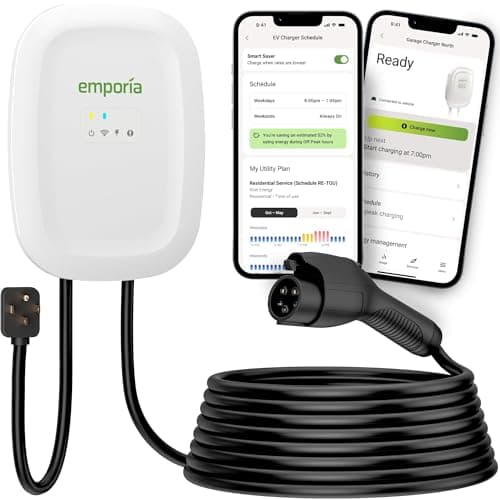
Most people who want the smart features too
Emporia Level 2 (48A)
The smart charger that does not charge a smart-charger premium — 48-amp capability and real energy monitoring for the price of a dumb one.
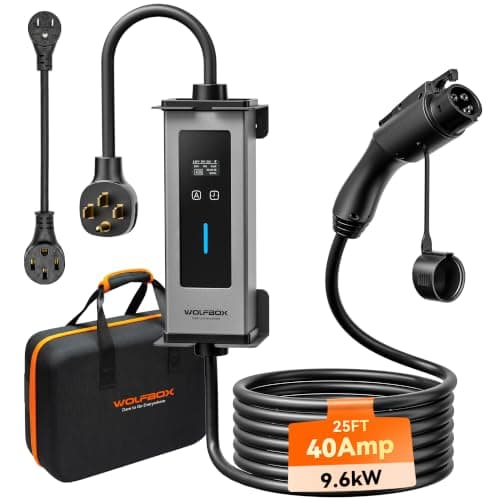
One charger for home and travel
WOLFBOX Portable (Level 1/2)
A dual-level portable that charges on both 120V and 240V, ships with both plug adapters, and adds a delay timer for off-peak charging — a genuine take-anywhere charger.
#ad · As an Amazon Associate we earn from qualifying purchases.
Questions
Frequently asked
Is Level 1 charging enough for a full EV?
Can I install a DC fast charger at home?
How many miles does Level 2 add overnight?
What is the difference between Level 3 and DC fast charging?
Do I need Level 2 for a plug-in hybrid?
Keep reading
Related
- Best Home EV ChargersThe Level 2 units worth installing, ranked with live prices.
- Best Portable EV ChargersLevel 2 speed that plugs into a 240V outlet and travels with you.
- Cost to Charge an EV at HomeThe running-cost math, worked out across three electricity rates.
- NACS vs J1772 ConnectorsWhich plug your car uses and why adapters exist.
- DC Fast Charging ExplainedThe road-trip charging level, and why it isn't home gear.
- Can You Use a Regular Outlet?How far Level 1 charging from a wall outlet gets you.
- How to Charge an EV at HomeThe beginner's walkthrough, if you are new to all of this.
- How Long Does It Take to Charge an EV?The charging-time formula and real numbers by level.
- 120V vs 240V EV ChargingThe real speed gap between Level 1 and Level 2 outlets.
Receipts
Sources
- US DOE / fueleconomy.gov — EV charging basics
- US DOE Alternative Fuels Data Center — charging at home
We do not run a testing lab, and we do not pretend to. Where a measured number came from someone else's lab, we name them and link them. Where we could not verify something, we say so on the page rather than quietly leaving it out. Read our full method.