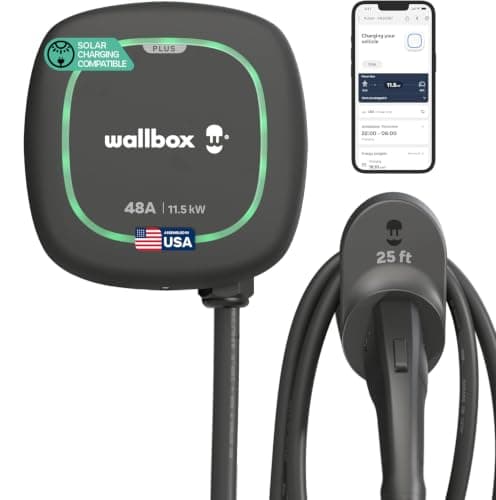
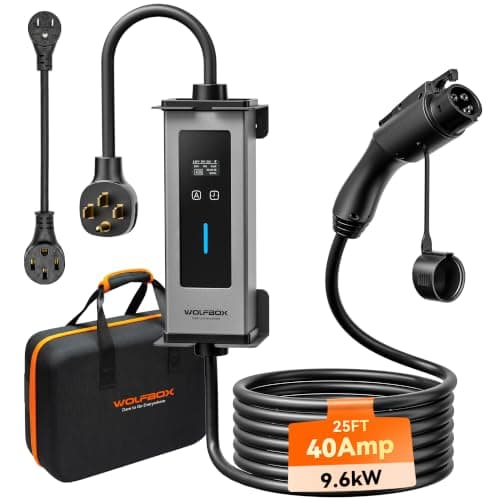
Buy a portable, plug-in charger if you rent, might move, want a travel charger, or already have a NEMA 14-50 outlet. Hardwire a wall unit if you want a permanent, tidy install at the fastest speed - 48 amps, above what any plug-in can do. Both charge the same cars; the decision is about your living situation and how fast you actually need to charge. We put the WOLFBOX Portable against the hardwired Wallbox Pulsar Plus because they are the clean extremes of each approach.
The core difference
A portable charger plugs into an outlet like an appliance; a hardwired charger is wired permanently into a circuit inside a junction box. That single difference drives everything else. The plug-in unit can be unplugged, moved, taken on a trip and installed by a renter who cannot touch the house wiring. The hardwired unit is a fixture: it is fixed in place, it has no plug to come loose, and it can run at a higher amperage because it is not limited by an outlet.
Cost
On the charger alone, portables usually cost less than comparable hardwired wall units, and they can cost far less overall because they may need no electrician at all. If you already have a suitable NEMA 14-50 outlet, a portable is close to plug-and-go: buy it, plug it in, done. A hardwired install always involves an electrician, a permit in most places, and labor to run and connect the circuit - the hardware is only part of the bill. We break the full install picture down in Level 2 charger installation cost. The counterpoint: if you do not have a 14-50 outlet yet, you are paying an electrician either way, and the cost gap between adding an outlet and hardwiring narrows.
Mobility and install
This is where the portable wins outright. It moves. If you rent, you can charge without altering the property and take the charger when you leave. If you move house, it comes with you instead of staying bolted to someone else's garage. And it doubles as a travel charger at any home or rental with a 14-50 receptacle. The hardwired unit gives all of that up in exchange for being permanent and out of the way - no brick on the floor, no plug hanging out of an outlet, just a clean box on the wall. If a tidy, finished look matters to you and you are not going anywhere, that is a real benefit.
Max amperage: 40 vs 48
The one thing a portable cannot do is match a hardwired unit's top speed. A plug-in charger is capped at 40 amps, because it sits on a 50-amp circuit and code limits a continuous load to 80% of the circuit rating. A hardwired charger like the Wallbox Pulsar Plus can run at 48 amps on a 60-amp circuit - roughly 11.5 kilowatts against the plug-in's 9.6. In practice, 40 amps already refills overnight for almost everyone, so the extra speed matters mainly for large batteries, short charging windows, or two cars sharing time on one charger. But if maximum speed is a priority, only hardwiring gets you there. The wiring behind that faster circuit is heavier too - a 48-amp charger needs a 60-amp breaker - and we cover the gauge details in EV charger wire size and breaker.
The verdict
Choose the portable if you rent or might move, if you want one charger that travels, or if you already have a 14-50 outlet and 40 amps is plenty - which, for most drivers, it is. Choose hardwired if you own your home, want the cleanest permanent install, and want the full 48-amp speed a plug-in cannot reach. Neither is a compromise; they solve different problems. If you are leaning hardwired, compare the fixed wall units in the best home EV chargers; if you are leaning portable, the ranked field is in the best portable EV chargers.
If what you are really weighing is whether to pay an electrician for a wall unit or just for a receptacle, that is the same decision from the wiring side and we have worked it through separately: EV charger vs 240V outlet compares total cost, speed and the GFCI requirement that can swing the comparison.