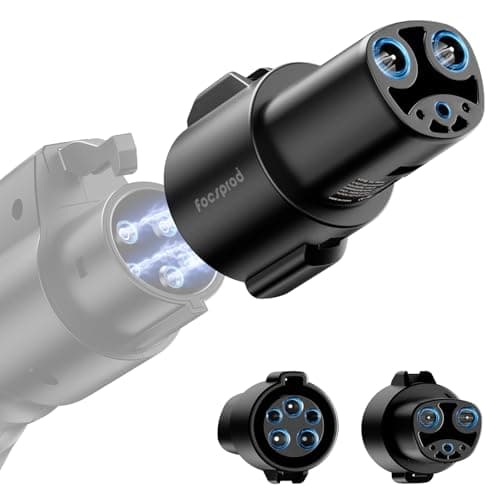
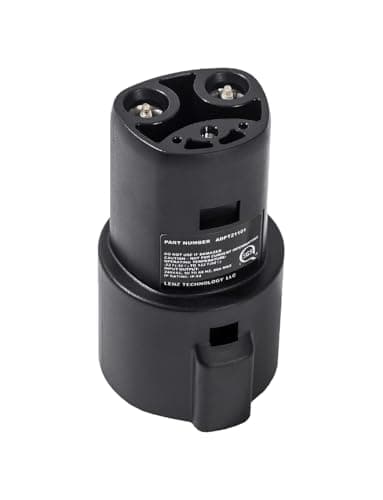
If you drive a Tesla or one of the new NACS-port EVs, the LENZ J1772-to-NACS adapter is the pick, because it is explicitly certified to UL 2251, the connector-safety standard that matters most for a part carrying full current. The FOCSPROD J1772-to-Tesla adapter is the budget alternative, listed to UL 2252. Both let your NACS-port car charge at the enormous installed base of J1772 stations, and both are AC only.
Most of North America's home and public Level 2 chargers are still J1772, even as new cars ship with the Tesla-style NACS port. That mismatch is why this adapter exists: it lets a NACS-port car keep using the chargers that are already everywhere. We compile the published specs and safety listings and explain what they mean; we have not bench-tested either adapter.
Which direction does this adapter go?
Read it literally: a J1772-to-NACS adapter goes from a J1772 charging source toa NACS car. One end is a socket that fits over a standard J1772 connector; the other end is a NACS plug that goes into your car's Tesla-style port. So the charger is the ordinary J1772 one, and the car is the Tesla or NACS-port EV.
This is the opposite of a NACS-to-J1772 adapter. If instead you drive a non-Tesla car with a J1772 port and want to use a Tesla-style charger, you need the other direction, covered on our best NACS-to-J1772 adapterspage. The two are not interchangeable, so match the adapter to your car's port, not to the charger you happen to be standing at.
If the connector names still run together, the NACS vs J1772 guide lays out the shapes and the history in plain terms.
Who needs a J1772-to-Tesla adapter
Two groups of drivers, and the group is growing quickly:
- Tesla owners. Your car has a NACS port. Away from Superchargers, a lot of hotels, workplaces, and public lots still have J1772 Level 2 chargers. This adapter lets you use them.
- Drivers of new NACS-port EVs. Automakers including Hyundai, Kia, and Rivian have begun shipping cars with built-in NACS ports, with more brands adding them, per Consumer Reports. Those cars can Supercharge natively, but the everyday J1772 charger at a mall or an apartment garage needs this adapter to connect.
In both cases the point is the same: the J1772 network is the biggest one out there, and this small part keeps it available to you.
The NACS transition is why this adapter is becoming standard kit
North America is in the middle of a connector changeover. Hyundai, Kia, and Genesis began shipping cars with built-in NACS ports in 2025, and Ford, GM, BMW and Mini, Rivian, and Mercedes have been adding factory NACS ports through 2025, according to Consumer Reports. Tesla's connector, now also standardized as J3400, is on track to become the default plug on new EVs.
Here is the catch that keeps this adapter relevant: the installed base of home and public charging equipment is still overwhelmingly J1772. New cars are switching connectors faster than the millions of chargers already bolted to walls and parking lots can. So a NACS-port car that wants to use the equipment that exists today needs a way to bridge back to J1772, and that is exactly what this adapter does. Until the public network catches up, it is close to essential kit for a NACS-port driver.
One place you can now skip the adapter entirely is your own garage. A growing number of Level 2 wall units ship with a factory NACS cable, so a NACS-port car plugs straight in at home and keeps the adapter in the frunk purely for public J1772 chargers. Those units are ranked in our best NACS home chargers roundup.
The two picks at a glance
1. LENZ J1772-to-NACS — the pick
The LENZ earns the top spot on its safety listing. It is explicitly certified to UL 2251, the standard written for EV charging attachment plugs and receptacles, which is precisely the listing you want on a part that carries the whole current. It is rated to 80 amps, works for Level 1 and Level 2 AC charging, and is inexpensive and pocketable enough to keep clipped in the frunk. For a Tesla or a NACS-port EV, it is the confident default.
2. FOCSPROD J1772-to-Tesla — the budget option
The FOCSPROD is one of the least expensive ways to open the J1772 network to a Tesla. It is listed to UL 2252 for the Tesla/NACS side of the connection and rated to 80 amps and 250 volts, well above any AC circuit it will meet. It is a value brand, so inspect it for a snug, rattle-free fit before you rely on it. If price is the priority and the listing checks out, it does the same job as the LENZ.
LENZ or FOCSPROD: how to decide
Both carry a safety listing and both are rated far above any AC circuit, so the choice is short:
- Buy the LENZ if you want the reassurance of UL 2251, the standard written specifically for EV charging attachment plugs. That listing is why it is our default, and it is still inexpensive.
- Buy the FOCSPROD if you want the lowest price and are satisfied with its UL 2252 listing. It is a value brand, so inspect it for a snug, rattle-free fit before you depend on it, but it does the same job.
AC only: no Supercharging through this adapter
Like every passive charging adapter, these handle AC only. For a Tesla or NACS-port car, that is a subtle but important point: your car can already DC fast charge at Superchargers natively, and it does not need this adapter to do so. This adapter is strictly for the AC J1772 chargers, the Level 2 units at homes, hotels, workplaces, and public lots. Expect roughly 25 miles of range per hour at a healthy Level 2 J1772 charger, in line with US Department of Energy figures, the same as any AC Level 2 session.
If you are also equipping a garage, note that a household mixing connector types can sometimes skip the adapter shuffle with a dual-connector wall unit; we compare that approach in EV charger vs Tesla Wall Connector.
Where you will use it
The J1772 chargers this adapter unlocks are in all the places the Supercharger network is not: apartment and condo garages, workplace lots, shopping centers, municipal parking, and the older public stations that predate the NACS switch. For a Tesla or NACS-port driver, that is the difference between being tied to Superchargers and being able to top up almost anywhere there is a Level 2 charger. Keep the adapter in the car so it is with you the moment you find a J1772-only spot; it is small enough to live in the frunk or a door pocket.
What about charging at home?
This adapter earns its keep away from home, but it also answers a common home question. If you already own a J1772 Level 2 charger, or you are buying one because they are the most common and often the best value, a Tesla or NACS-port car can use it every night with this adapter. You do not have to replace a perfectly good J1772 wall unit just because your next car has a NACS port. A dual-connector wall unit only pays off in a household that genuinely mixes both connector types; our best home EV chargers roundup covers the J1772 units worth pairing with the adapter.
How to choose a J1772-to-Tesla adapter
This is a small purchase, but it carries real current, so a few things are worth getting right.
Safety listing: UL 2251 vs UL 2252
Both listings you see here are legitimate. UL 2251 covers the attachment plugs and receptacles used in EV charging; UL 2252 is a closely related EV connector standard. Our top pick, the LENZ, states UL 2251 certification, which is why it leads; the FOCSPROD states UL 2252. A clearly published listing is exactly what you want on a current-carrying adapter, so we rank the one that names the connector-safety standard first. Whatever you buy, confirm the listing on the live product page rather than assuming it.
Amperage rating
Both picks are rated to 80 amps, far above the ceiling of AC home and public charging, so amperage is not a differentiator here. The rating simply gives you margin; the real charge speed is set by your car and the J1772 charger you plug into.
Fit for your specific port
The NACS side of the adapter has to seat cleanly in your car's port, and the J1772 side has to lock onto the station's connector. Teslas and the newer NACS-port EVs share the connector shape, but it is still worth a quick test-fit at home before you depend on it at a public charger. A snug, wobble-free connection at both ends is the whole game; a loose joint means heat.
Where to keep it
These adapters are small enough to lose. The frunk, glovebox, or a door pocket keeps it with the car, which is where it needs to be the moment you pull up to a J1772-only location. Buying one and leaving it on a shelf at home defeats the purpose.
Direction check, one more time. This page is for cars with a NACS (Tesla-style) port that want to use J1772 chargers. If your car has a J1772 port, you are on the wrong page; you want the NACS-to-J1772 adapter instead.