HUB 05 · Guides & Buying Advice
Tethered vs Untethered EV Chargers
Attached cable or a bare socket? The trade-off is real, and it is why nearly every US home charger comes with the cord already on it.
We earn a commission when you buy through our Amazon links, at no extra cost to you. It never affects our rankings, and we say so when the cheaper product is the better buy. How this works.
A tethered charger has the charging cable permanently attached; an untethered (or socketed) charger is just a wall box with a socket, and you supply your own cable for each session. In the US, the vast majority of home Level 2 chargers are tethered, because for a one-car driveway the attached cable is simply more convenient. Untethered units exist mainly to handle mixed connector standards or shared use.
This is a genuine fork in the road when you buy a home charger, and it is decided almost entirely by convenience versus flexibility. Neither is more powerful; they charge identically for a given amperage. The difference is whether the cable lives on the wall or in your trunk.
What each one is
- Tethered: the cable and connector are built into the unit. You walk up, take the plug off its holster, and plug it into the car. The cable is always there, always the right one for the box.
- Untethered (socketed): the wall unit has a socket instead of a fixed cable. You bring a separate charging cable, plug one end into the wall unit and the other into the car, and unplug both when you are done. One box can serve any connector, as long as you have the matching cable.
The trade-off, honestly
Tethered wins on daily convenience. There is no cable to fetch, carry, or store, and no second connection to make — grab the plug and go. The connector matches the unit by design, so there is nothing to mismatch. The costs are that the cable length is fixed at whatever the unit ships with, a damaged cable is a bigger deal because it is attached, and the connector type is locked in.
Untethered wins on flexibility. Because you supply the cable, one wall unit can serve cars with different connectors — useful in a shared driveway, a duplex, or a household straddling the NACS and J1772 transition. You can also swap in a longer or shorter cable as needed. The costs are the daily hassle of handling and storing a heavy cable, the need to buy a good cable separately, and two connection points instead of one.
| Consideration | Tethered | Untethered |
|---|---|---|
| Daily convenience | Best — grab and plug in | Extra step — fetch and connect the cable |
| Connector flexibility | Fixed to the unit's connector | Any connector, with the right cable |
| Cable length | Whatever it ships with | Choose your own |
| If the cable is damaged | Bigger fix — it is attached | Just swap the cable |
Why most US home chargers are tethered
The US home-charging market skews heavily tethered, and it is a rational default. Most American homes charge a single car in a private garage or driveway, where the flexibility of an untethered unit buys little and its daily inconvenience is felt every night. When the same car parks in the same spot and needs the same connector every time, an attached cable is the obvious choice. Untethered chargers are far more common in places and situations with shared or mixed-connector charging, which is less the norm for a US single-family home.
There is a catch worth naming: with the connector standards in flux, a tethered unit ties you to whatever connector it ships with. If your household mixes connector types, an adapter usually solves it more cheaply than going untethered — the directions and safety listings are on the adapters hub. For most US buyers, a tethered charger with the right connector (plus an adapter if a second car needs the other standard) is the simplest, cheapest setup.
Do not overlook cable length
Whichever way you go, reach matters more than people expect. A tethered charger ships with a fixed cable length, so before you buy, measure from where the unit will mount to where your car's charge port sits when parked — and add slack for parking a little short or backing in the other way. A cable that is a foot too short is a daily annoyance you cannot fix without swapping the whole unit. An untethered charger sidesteps this by letting you pick the cable, which is a genuine point in its favor if your parking geometry is awkward. Either way, plan the run before you commit to a unit.
Keeping the cable tidy either way
A charging cable is heavy, and leaving it pooled on the floor is a trip hazard and a slow way to wear it out. Tethered units usually include a holster or dock for the connector, so the cable stays off the ground between sessions; with an untethered unit you are storing your own cable each time, so a wall hook or reel is worth adding. Neither approach is inherently tidier — it just decides whether the cable-management job is built in or something you set up yourself.
Rule of thumb:one car, one parking spot, one connector — go tethered for the daily convenience. Shared driveway or genuinely mixed connectors — untethered earns its keep. Most US drivers are the first case, which is why the shortlist at best home EV chargers is mostly tethered units.
Which one is right for you
Three questions settle it. Answer them honestly about how your household actually charges.
1. How many cars, and which connectors?
One car with one connector points straight at tethered. Two cars with different connectors, or a plan to switch brands soon, is where untethered flexibility — or, more often, a tethered unit plus an adapter — comes into play.
2. Is the parking spot fixed?
If the same car parks in the same place every night, a fixed cable is pure upside. If you juggle vehicles in and out of one charging spot, the ability to bring your own cable can matter.
3. How much does the nightly handling bother you?
A charging cable is heavy and a little unwieldy. If routing and storing it every single night sounds like a chore, tethered removes that chore entirely. If you would rather store the cable away between sessions, untethered lets you.
Most people should buy tethered and, if a second car needs the other standard, add an adapter rather than switching to an untethered unit. It is the cheaper, more convenient path for a typical US home. Compare the actual units at best home EV chargers.
The gear
Recommended gear for this guide
The products this guide refers to, with prices pulled live from Amazon and dated on each card.
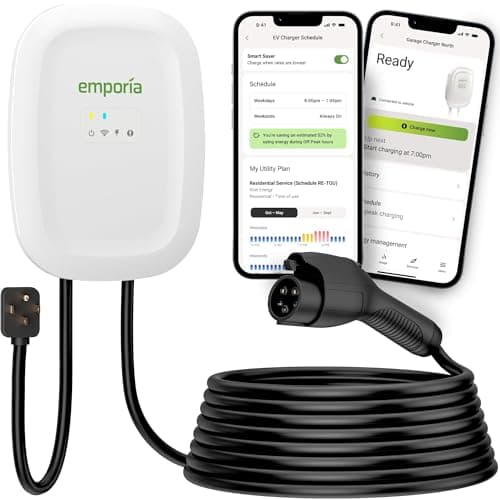
Most people who want the smart features too
Emporia Level 2 (48A)
The smart charger that does not charge a smart-charger premium — 48-amp capability and real energy monitoring for the price of a dumb one.
#ad · As an Amazon Associate we earn from qualifying purchases.
Questions
Frequently asked
What is the difference between tethered and untethered EV chargers?
Is a tethered or untethered charger better for a home?
Why are most US home chargers tethered?
Can I use a tethered charger with two cars that have different connectors?
Keep reading
Related
- Best Home EV ChargersThe shortlist of Level 2 units, mostly tethered, ranked with live prices.
- EV Charging AdaptersThe cheaper fix when a second car uses a different connector.
- NACS vs J1772 ConnectorsWhy connector standards make the tethered-vs-untethered call matter.
- Types of EV ChargersLevel 1 vs 2 vs 3 before you pick a specific unit.
Receipts
Sources
- US DOE Alternative Fuels Data Center — charging at home
- US DOE / fueleconomy.gov — EV charging basics
We do not run a testing lab, and we do not pretend to. Where a measured number came from someone else's lab, we name them and link them. Where we could not verify something, we say so on the page rather than quietly leaving it out. Read our full method.