HUB 01 · Level 2 Home Chargers
Grizzl-E Classic Review
The cast-aluminum no-app favorite is discontinued on Amazon. Here is what it was, why it earned its reputation, and the app-free charger we now recommend instead.
We earn a commission when you buy through our Amazon links, at no extra cost to you. It never affects our rankings, and we say so when the cheaper product is the better buy. How this works.
Update, August 2026: the Grizzl-E Classic is discontinued on Amazon. The listing we linked has been removed, and every 40-amp Grizzl-E still sold there is a Wi-Fi model — the Classic Connect and the Grizzl-E Smart — so there is no longer an app-free Classic to buy. We have left this review up because the reasoning still explains what to look for, but we no longer recommend trying to find one. If you came here for a charger with no app, buy the WOLFBOX Portable, which is ETL listed, IP66 rated and runs at up to 40 amps with a hardware delay timer instead of an app. If you want a mounted 40-amp wall unit and will accept software, the Autel MaxiCharger now tops our 40-amp roundup.
What follows is our original assessment, kept for reference. We compile published specs and owner reports and do the math — we have not bench-tested the unit — so treat this as documented research on a charger with a strong reputation for durability.
Who it is for
This is the charger for the buyer who is suspicious of software — and, honestly, that is a reasonable thing to be. A smart charger is only as reliable as the company behind its app; a dumb charger is reliable as long as the electricity flows. If you charge a single car on a flat electricity rate and do not need scheduling or energy tracking, you are the target buyer, and you will likely never wish you had spent the extra on features. If you want load sharing between two cars or off-peak automation, the Grizzl-E is the wrong tool and you should look at the Emporia instead.
The specs that matter
Grizzl-E rates the Classic at 40 amps / 9.6 kW, with a J1772 connector, a NEMA 14-50 plug, and UL certification. The two specs that define it are the build and the amperage:
- Cast-aluminum enclosure, UL certified.The box is rated for indoor and outdoor use and is genuinely rugged — the kind of build that shrugs off a carport winter. Not every budget charger on Amazon can claim a UL certification, and on a device pushing 40 amps for hours unattended, that listing is the spec we would not skip.
- 40 amps on a 50-amp breaker.As a plug-in unit it tops out at 40 amps, which needs a 50-amp circuit under the continuous-load rule (40 × 1.25 = 50) and typically 6 AWG copper wire. There is no 48-amp option here, and for most daily driving that is completely fine. The full sizing detail is in our wire and breaker guide.
What is good
The Grizzl-E's whole case is longevity and simplicity, and it makes that case well. The cast-aluminum enclosure is built to outlast plastic-bodied rivals, the UL certification is real reassurance on a high-current device, and the absence of an app means there is nothing to update, nothing to lose cloud support, and nothing to troubleshoot on a bad-Wi-Fi day. You plug in and it charges. For a lot of owners that is exactly the relationship they want with a piece of garage infrastructure.
Where it falls short
The trade-offs are deliberate. There is no smart scheduling or energy monitoring, so if you want to automate off-peak charging or split a circuit between two cars, you cannot — look at a smart unit. And the stock cable is stiff in cold weather, a recurring owner complaint; in a cold climate you will wrestle it a little on the worst mornings. Neither is a defect so much as the cost of a rugged, no-frills design, but both are worth knowing before you buy.
Installation notes
As a plug-in unit, the Grizzl-E wants a properly rated NEMA 14-50 outlet on a 50-amp circuit. If that outlet already exists, installation is genuinely simple; if it does not, adding one is a job for a licensed electrician who can confirm your panel has the capacity. Do not pair it with a bargain-bin receptacle — a continuous 40-amp draw is exactly what makes a cheap outlet overheat, so buy an industrial-grade, listed 14-50.
Bottom line
The Grizzl-E Classic was the anti-gadget charger, and that was a compliment. It gave up smart features on purpose and spent the budget on a build that outlasted several app redesigns. That case still holds — but the unit is no longer sold on Amazon, so it is no longer a pick. To buy the same idea today, the app-free choice is the WOLFBOX Portable in our dumb charger roundup; if you would rather have a mounted wall unit and can live with an app, the Autel MaxiCharger tops our 40-amp roundup.
The gear
Recommended gear for this guide
The products this guide refers to, with prices pulled live from Amazon and dated on each card.
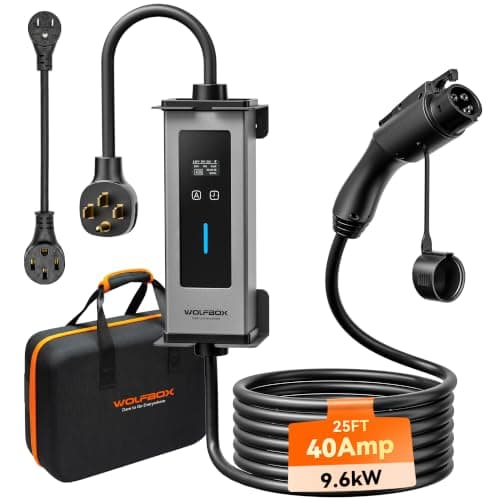
One charger for home and travel
WOLFBOX Portable (Level 1/2)
A dual-level portable that charges on both 120V and 240V, ships with both plug adapters, and adds a delay timer for off-peak charging — a genuine take-anywhere charger.
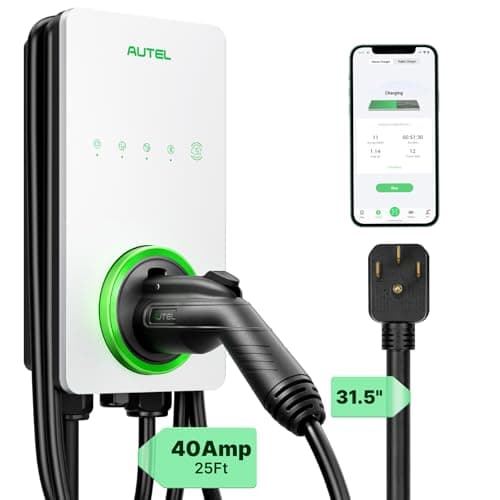
Feature-maximalists who want a tidy install
Autel MaxiCharger (40A)
A feature-dense smart unit with Wi-Fi, Bluetooth and a separate holster in the box — strong if you want everything and a clean install.
#ad · As an Amazon Associate we earn from qualifying purchases.
Questions
Frequently asked
Does the Grizzl-E have an app?
No, and that is the point. There is no mandatory app, Wi-Fi or cloud service — the Classic charges the moment it has power and does not depend on any company's servers staying online. If you want scheduling or energy monitoring, you want a smart charger like the Emporia instead.
Is the Grizzl-E weatherproof — can it go outside?
Yes. The cast-aluminum enclosure is rated for both indoor and outdoor use, which is one of the unit's main selling points. It is built to handle a carport or an exterior wall better than most plastic-bodied chargers.
What breaker does the 40-amp Grizzl-E need?
A 50-amp breaker. EV charging is a continuous load, so the circuit is sized to 125% of the charger's current (40 × 1.25 = 50), typically on 6 AWG copper wire. See our wire and breaker guide for the full sizing rules, and confirm the specifics with a licensed electrician.
Grizzl-E or Emporia?
Choose the Grizzl-E for a sealed, no-app box that prioritizes durability, and the Emporia for 48-amp speed plus smart scheduling and monitoring. Our Grizzl-E vs Emporia comparison settles it spec by spec.
Keep reading
Related
- Best home EV chargersThe smart units we rank now.
- Grizzl-E Duo reviewThe two-cable version, for charging two EVs on one circuit.
- Best 40-amp EV chargersThe Autel MaxiCharger now tops our 40-amp roundup.
- Best dumb EV chargersThe app-free chargers you can actually buy today.
- Grizzl-E vs EmporiaNo-app durability vs smart-feature value.
- ChargePoint vs Grizzl-EThe no-app box against the connected smart charger.
- Wire size & breaker guideThe 50-amp circuit a 40-amp charger needs.
- Wallbox Pulsar Plus vs Grizzl-E ClassicThe compact 48-amp smart box against the sealed no-app tank.
Receipts
Sources
- US DOE AFDC — EV charging infrastructure & Level 2 basics
- US DOE / fueleconomy.gov — EV charging basics
We do not run a testing lab, and we do not pretend to. Where a measured number came from someone else's lab, we name them and link them. Where we could not verify something, we say so on the page rather than quietly leaving it out. Read our full method.