HUB 02 · Portable & Travel Chargers
NEMA 14-50 Plug-In EV Chargers
What the plug is, which chargers use it, and why the outlet and its install matter more than the charger.
We earn a commission when you buy through our Amazon links, at no extra cost to you. It never affects our rankings, and we say so when the cheaper product is the better buy. How this works.
A NEMA 14-50 EV charger is any charger that ends in a NEMA 14-50 plug - the same four-prong, 240-volt connector an electric range uses - so you can plug it into a matching outlet instead of hardwiring it to the wall. It is the most common way to get Level 2 charging at home without permanently wiring the charger in, and it is the standard plug on nearly every portable and many wall-mounted units. The charger is the easy part; the outlet and the circuit behind it are where the money and the safety actually live.
What a NEMA 14-50 plug-in charger is
NEMA 14-50 is a naming standard, not a brand. The "14" describes the prong configuration - three current-carrying poles plus a ground, delivering 240 volts - and the "50" is the 50-amp rating of the outlet. It is the receptacle most people already associate with an electric stove or an RV hookup, which is why it became the default for home EV charging: a lot of homes either have one or can get one added without exotic work.
A plug-in charger with a 14-50 cord is the opposite of a hardwired one. Instead of the charger's wires being connected permanently inside a junction box, the charger simply plugs into the outlet like an appliance. That is what makes portables portable and what lets a renter install charging without altering the house wiring - so long as a suitable outlet exists. The charging electronics are identical either way; the plug is just a removable connection point.
Why the outlet and its install matter more than the charger
Here is the part the marketing skips: a plug-in EV charger draws a heavy, continuous current for hours at a time, and that is a harder job for an outlet than almost anything else you plug in. A stove pulls its full load in short bursts; an EV charger holds 40 amps steady all night. Cheap, residential-grade 14-50 receptacles are built for the occasional range or the intermittent RV, and their contacts can loosen, overheat and char under a sustained EV load. This is a well-documented failure point, and it is almost always the outlet - not the charger - that fails.
The fix is not complicated: use an industrial-grade, safety-listed receptacle, and have it installed correctly. We cover the specific part to buy in the right NEMA 14-50 outlet, and the short version is that the outlet is the cheapest place to be generous and the worst place to economize. A properly rated receptacle on a properly sized circuit, torqued to spec by a licensed electrician, is the whole game.
The receptacle is not the same as the wiring behind it. Buying a good outlet does not fix an undersized circuit or a loose connection inside the panel. A NEMA 14-50 install for EV charging is licensed electrical work - confirm your circuit, breaker and wire gauge with an electrician and your local code before anything gets plugged in.
Which chargers use a NEMA 14-50 plug
Two families of charger use this plug. The first is portable and travel chargers, nearly all of which end in a 14-50 connector so they can move between outlets - that is the entire category in the best portable EV chargers. The second is plug-in versions of wall-mounted units: many Level 2 home chargers are sold in a plug-in trim that also uses a 14-50, sitting alongside a hardwired option. You will see both in the best home EV chargers.
The practical upshot is that the plug does not lock you into portable-only. It is a convenience choice: a 14-50 plug means no electrician is needed to connect the charger itself, and the charger can be swapped or moved later. The trade-off is a ceiling on speed, which is where the amperage math comes in.
The breaker and wire math
EV charging is a continuous load, and standard electrical code requires a circuit to be sized to 125% of a continuous load's current. Turn that around and a 50-amp circuit can safely carry a continuous 40 amps (50 divided by 1.25). That is why a NEMA 14-50 plug-in charger is capped at 40 amps: the 50-amp outlet and its circuit set the limit, not the charger. Forty amps is about 9.6 kilowatts, or roughly 25 miles of range per hour for most EVs - enough to fully refill overnight for almost anyone.
Working the other direction, a 40-amp charger needs a 50-amp breaker and, in typical residential runs, 6 AWG copper wire. If you want to charge faster than 40 amps you cannot do it on a 14-50 plug at all - you have to hardwire onto a larger circuit, and a 48-amp charger needs a 60-amp breaker. We walk through gauge and breaker sizing, including longer runs, in EV charger wire size and breaker. Treat the specifics as standard practice to confirm with an electrician, not a substitute for one.
Setting up a 14-50 charger safely
If you have decided a plug-in charger is the route, the work is mostly in doing the outlet properly. A short checklist keeps you out of the common failure modes.
Confirm the circuit before you buy the charger
A 14-50 outlet is meaningless if the circuit behind it is not a dedicated 50-amp run with the right wire gauge. Do not assume an existing range or RV outlet is EV-ready; have an electrician verify the breaker, the wire, and that the circuit serves only the charger. This is the step that gets skipped and the step that matters most.
Buy the outlet, not just the charger
Budget separately for an industrial-grade, listed receptacle. It is a small line item against the charger and the labor, and it is the component under the most sustained stress. The outlet we recommend is the kind built for a continuous EV load rather than an occasional appliance.
Match the plug to the charger you want
If your charger of choice is a portable, it almost certainly uses a 14-50 already. If it is a wall unit, check whether you are buying the plug-in trim or the hardwired one - some models sell both, and only the plug-in version uses a 14-50. Getting this wrong means an outlet you cannot use or a charger you cannot plug in.
Know when to hardwire instead
If you want more than 40 amps, or you want the charger permanently fixed and out of the way, a 14-50 plug is not your path - hardwiring is. That is a real decision with real trade-offs, and it is worth reading before you commit. The plug-in route wins on flexibility and cost; hardwiring wins on top speed and tidiness.
The gear
Recommended gear for this guide
The products this guide refers to, with prices pulled live from Amazon and dated on each card.
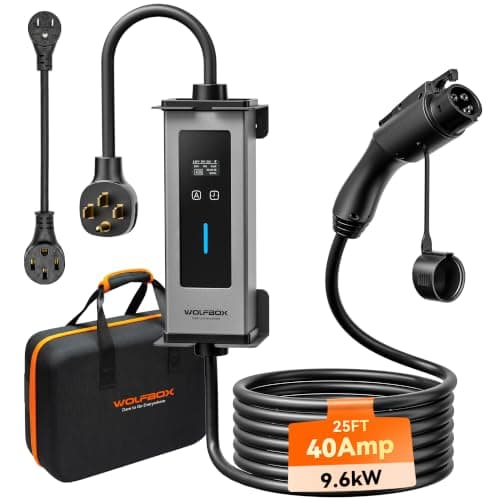
One charger for home and travel
WOLFBOX Portable (Level 1/2)
A dual-level portable that charges on both 120V and 240V, ships with both plug adapters, and adds a delay timer for off-peak charging — a genuine take-anywhere charger.
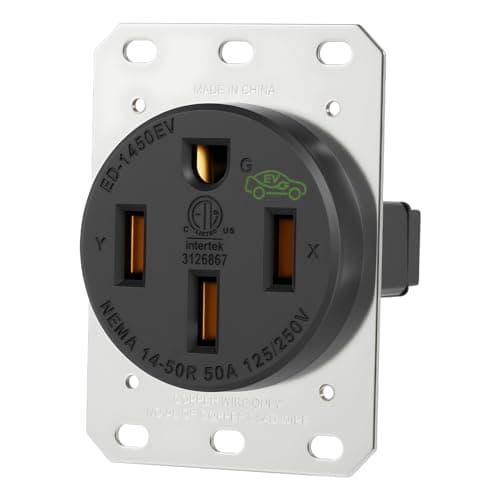
The outlet a plug-in charger needs
Industrial NEMA 14-50 Outlet
The receptacle a plug-in charger actually plugs into — buy the industrial-grade, listed version, because the cheap ones are the part that fails.
#ad · As an Amazon Associate we earn from qualifying purchases.
Questions
Frequently asked
Can I use my existing electric-range outlet for EV charging?
Sometimes, but do not assume it. The plug may match, yet the circuit behind an older range outlet may not be a dedicated, correctly sized run for a continuous EV load, and the receptacle itself may be residential grade. Have an electrician verify the breaker, wire gauge and receptacle rating before you rely on it.
How fast does a NEMA 14-50 charger charge?
Up to 40 amps, which is about 9.6 kilowatts, or roughly 25 miles of range per hour for most EVs. That is the ceiling for any charger on a 50-amp circuit because code caps a continuous load at 80% of the circuit rating. It is enough to fully recharge overnight for the vast majority of drivers.
Is a 14-50 plug-in charger safe?
Yes, when the outlet and circuit are done right. The charging electronics are the same as a hardwired unit. The risk lives in a cheap receptacle or a loose, undersized circuit, not the plug concept itself. Use an industrial-grade listed outlet, size the circuit correctly, and have a licensed electrician do the install.
Do I need a 14-50 outlet, or can I just hardwire?
You only need the outlet if you want a plug-in charger - a portable, or a wall unit in plug-in trim. Hardwiring skips the receptacle entirely and connects the charger straight to the circuit, which is required if you want to run above 40 amps. Choose the outlet for flexibility, hardwiring for top speed and a permanent install.
What breaker does a 40-amp 14-50 charger need?
A 50-amp breaker, with 6 AWG copper wire in typical residential runs. EV charging is a continuous load, so the circuit is sized to 125% of the 40-amp draw, which lands on 50 amps. Confirm the exact gauge for your run and local code with an electrician.
Keep reading
Related
- The right NEMA 14-50 outletThe industrial-grade receptacle a plug-in charger should plug into.
- Best portable EV chargersThe chargers that use this plug, ranked with live prices.
- Best home EV chargersPlug-in and hardwired wall units compared side by side.
- Wire size and breakerThe gauge and breaker math for 40- and 48-amp circuits.
Receipts
Sources
- US DOE AFDC — EV charging infrastructure & Level 2 basics
- US DOE / fueleconomy.gov — EV charging basics
We do not run a testing lab, and we do not pretend to. Where a measured number came from someone else's lab, we name them and link them. Where we could not verify something, we say so on the page rather than quietly leaving it out. Read our full method.