HUB 05 · Guides & Buying Advice
Level 2 EV Charger Installation Cost: A Reality Check
What the wall unit costs is the easy part. Here is where the rest of the bill comes from, and how to keep it down.
We earn a commission when you buy through our Amazon links, at no extra cost to you. It never affects our rankings, and we say so when the cheaper product is the better buy. How this works.
A typical Level 2 charger installation runs somewhere between roughly $749 and $2,500, with a standard job landing around $1,700. Most of that is not the charger — it is the labor, permit, and wiring to get 240 volts from your panel to the wall. If your panel needs upgrading, that alone can add $1,500 to $3,000. Knowing which parts drive the number lets you get an accurate quote instead of a surprise.
The wall unit is the part everyone shops for and the part that varies least. The install is where the money actually moves, and it swings widely from house to house because it depends on your specific electrical panel and the distance to where you park. These figures come from installer-network data published by Qmerit; treat them as planning ranges, and get a real quote for your home.
The three parts of the bill
Break any install quote into three buckets and it stops being a mystery:
| Cost bucket | Typical range | What it covers |
|---|---|---|
| Charger hardware | $300–$900 | The Level 2 wall unit itself |
| Labor + permit | $500–$1,200 | Electrician time, materials, and the local permit/inspection |
| Panel upgrade (only if needed) | $1,500–$3,000 | Upgrading to a 200-amp service when there is no capacity to spare |
Add the first two buckets and you land in that roughly $749 to $2,500 range, clustering near $1,700 for a straightforward job. Consumer Reports has cited lower national averages — in the neighborhood of $551 to $1,385 — which reflects the many homes where the panel is already capable and the charger sits close to it. The panel upgrade is the wild card that turns an average job into an expensive one.
What actually drives the cost
Two houses can get quotes that differ by thousands for the same charger. Here is why.
Panel capacity
A Level 2 charger needs a dedicated 240-volt circuit, and that circuit needs spare capacity in your electrical panel. If your panel is full, or the service coming into the house is too small to add a 40- or 60-amp circuit, you are looking at a panel or service upgrade — the $1,500 to $3,000 line item that dominates the bill when it applies. An older home with a 100-amp service and no free breaker slots is the classic case.
Distance from the panel
The farther your parking spot is from the panel, the more wire and conduit the electrician runs, and heavier-gauge wire over a long distance is not cheap. A charger on the garage wall right next to the panel is the easy, low-cost case; a charger at the far end of a detached garage or across the yard is the expensive one. The wire gauge for the run is set by the charger's amperage under standard NEC rules — we cover that in the wire size and breaker guide. The detached-garage case has its own arithmetic, because the existing feeder to the building is usually the binding constraint: putting a charger in a detached garage works through the feeder, the sub-panel and the voltage-drop math.
Permit and inspection
Most jurisdictions require a permit and an inspection for a new 240-volt circuit, and that cost varies by location. It is not optional — skipping the permit risks your insurance and your safety — so a legitimate quote includes it. Beware a quote that is suspiciously low because it quietly leaves the permit out. What the application involves, what the inspector actually checks, and the one install that needs no permit at all are covered in do I need a permit for an EV charger.
Plug-in vs hardwired
A hardwired charger is wired directly into the circuit; a plug-in charger connects through a NEMA 14-50 outlet. If the outlet already exists, a plug-in charger can be a near-zero-install purchase — you just plug it in. If the outlet has to be added, that is its own small install. The trade-offs between the two approaches are in our portable vs hardwired comparison.
The cheapest install is often no install.If you already have a 240-volt NEMA 14-50 outlet where you park — common in garages built for a welder, dryer, or RV — a plug-in Level 2 charger sidesteps most of the labor cost entirely. Check your walls before you book an electrician.
What the install actually involves
Knowing the steps helps you read a quote and notice a shortcut that should not be there. A proper Level 2 install runs roughly like this:
- Assessment:the electrician checks your panel's capacity and free slots and measures the run to where the charger will mount. This is where the panel-upgrade question gets answered.
- Permit: most jurisdictions require a permit pulled before the work begins.
- Circuit:a dedicated 240-volt circuit is run from the panel, with the breaker and wire gauge sized to the charger's amperage under standard code rules.
- Mount and connect: the charger is mounted and either hardwired to the circuit or connected through a NEMA 14-50 outlet.
- Inspection: the jurisdiction inspects the finished work before it is signed off for regular use.
If a quote is cheap because it quietly skips the permit or inspection, that is not a saving — it is a liability that can surface at an insurance claim or a home sale. Every legitimate quote includes both, done by a licensed electrician to your local code.
How to keep the number down
You cannot change your panel, but you can shop the job intelligently:
- Get more than one quote. Install pricing varies a lot between electricians, and the panel and distance assessment is where they differ most.
- Mount close to the panel.If you have any choice in where the charger goes, closer is cheaper — shorter wire runs, less conduit, less labor.
- Consider a plug-in unit. If you have or can cheaply add a NEMA 14-50 outlet, a plug-in charger avoids a hardwire labor charge and moves with you if you relocate.
- Right-size the amperage. A 48-amp charger needs a heavier, costlier circuit than a 32- or 40-amp unit and does nothing for a car that cannot accept the extra current. Do not pay to wire headroom you will never use.
A note on incentives
State and utility incentives for home charging equipment and installation exist, but they change frequently — programs open, close, and change their terms year to year. We are not going to quote you a specific credit or a deadline, because those numbers go stale and out-of-date figures cost people real money. Before you buy, check the current programs directly: your utility's website and your state energy office. Factor in only what you can confirm is live today.
The federal picture is settled, and it changes the arithmetic above: the section 30C credit for home charging equipment applied only to property placed in service through June 30, 2026, and has not been extended, so there is no federal credit to subtract from a new install. Our EV charger tax credit page sets out what is still claimable for earlier installs and which utility and state programs remain — those are now where the money is. If the install cost is the obstacle, EV charger vs 240V outlet covers the cheaper route.
We are not electricians. Everything here is planning guidance from published installer data. The actual panel assessment, circuit sizing, permit, and installation must be done by a licensed electrician working to your local code. Treat these ranges as what to expect on a quote, not a substitute for one.
How to get an accurate quote the first time
Vague quotes come from vague information. Give an electrician the four facts that drive the price and you will get a number you can trust.
1. Know your panel
Note your service size (often 100A or 200A, printed on the main breaker) and whether there are free breaker slots. This is the single biggest factor in whether you face a panel upgrade, and having it ready lets an electrician quote accurately, sometimes before even visiting.
2. Measure the run
Roughly measure the distance from your panel to where the charger will mount. A long run means more wire and conduit; a short one keeps labor and materials down. This is the second-biggest cost driver.
3. Pick plug-in or hardwired
Decide whether you want a hardwired unit or a plug-in one on a NEMA 14-50 outlet. If a suitable outlet already exists where you park, say so — it can cut the install to almost nothing. See the portable vs hardwired breakdown to choose.
4. Confirm the permit is included
Ask explicitly whether the quote includes the permit and inspection. A legitimate install has both. Once you have settled the install, the unit itself is the fun part — the shortlist is at best home EV chargers.
The gear
Recommended gear for this guide
The products this guide refers to, with prices pulled live from Amazon and dated on each card.
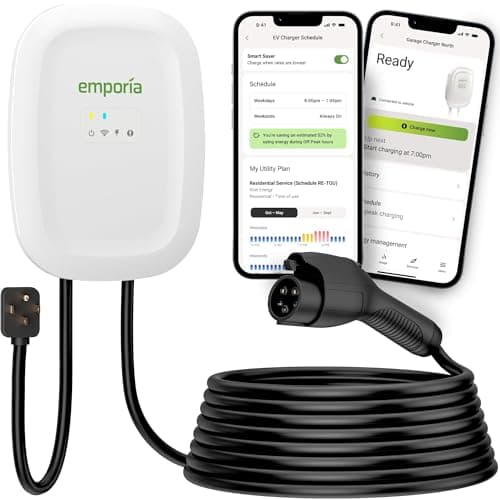
Most people who want the smart features too
Emporia Level 2 (48A)
The smart charger that does not charge a smart-charger premium — 48-amp capability and real energy monitoring for the price of a dumb one.
#ad · As an Amazon Associate we earn from qualifying purchases.
Questions
Frequently asked
How much does it cost to install a Level 2 EV charger?
Why is my install quote so much higher than the charger price?
Do I need a panel upgrade to install a home charger?
Is a plug-in charger cheaper to install than a hardwired one?
Are there tax credits or rebates for installing a home charger?
Keep reading
Related
- Best Home EV ChargersThe Level 2 units worth installing, ranked with live prices.
- Wire Size and Breaker GuideThe circuit sizing that sets your wire run and labor cost.
- Portable vs HardwiredWhether a plug-in unit can skip most of the install cost.
- Cost to Charge at HomeThe per-charge running cost, separate from the one-time install.
- Can I Install It Myself?Where DIY ends and a licensed electrician begins.
- Best EV Chargers for a 100-Amp PanelLoad management and smaller circuits — the ways to avoid paying for a service upgrade.
Receipts
Sources
We do not run a testing lab, and we do not pretend to. Where a measured number came from someone else's lab, we name them and link them. Where we could not verify something, we say so on the page rather than quietly leaving it out. Read our full method.