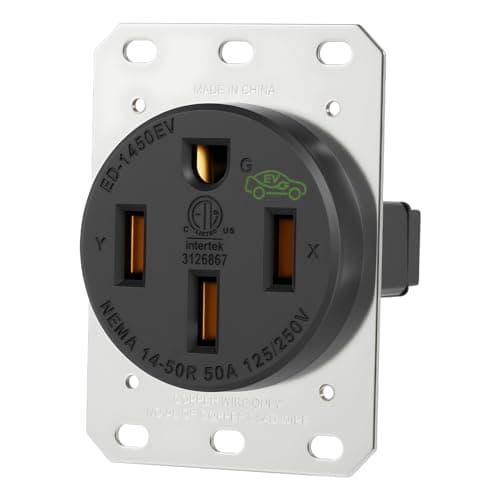
If your EV charger plugs in rather than hardwires, buy an industrial-grade, ETL-listed NEMA 14-50 receptacle — not the cheapest one on the shelf. The outlet is the single component carrying your charger's full current for hours at a time, and a flimsy receptacle is the part that heats up, loosens, and fails under that load. The small price difference between a bargain outlet and a proper industrial one is the best money you can spend on the whole install — and the install itself is a job for a licensed electrician on a correctly rated circuit, not a weekend project.
A NEMA 14-50 is a 240-volt, 50-amp receptacle — the same four-prong outlet a large electric range uses. It became the default for EV charging because most plug-in Level 2 chargers and every portable in our portable charger roundup ship with a matching 14-50 plug. Install one on the wall of the garage and your charger simply plugs in, no electrician needed each time you want to move it. That convenience is exactly why the quality of the receptacle matters so much: this one part is quietly doing the hardest job in the setup.
Why the cheap receptacle is the failure point
Here is the piece most buyers miss. A household outlet is designed for intermittent loads — you run a toaster or a drill for a few minutes and stop. EV charging is a continuous load: a 40-amp charger can pull 40 amps steadily for hours, overnight, night after night. Under standard code, that is why the circuit has to be sized to 125% of the charger's current — a 40-amp charger sits on a 50-amp breaker precisely because the load never lets up. The receptacle lives at the end of that same continuous draw.
A budget NEMA 14-50 uses thinner contacts and a lighter internal grip on the plug blades. Carry 40 amps through weak contacts for hours and they heat up; heat loosens the connection; a looser connection has more resistance, which makes more heat. That feedback loop is how a cheap receptacle discolors, melts, or scorches over time — and it is why so many owners and installers recommend either an industrial-grade outlet or hardwiring the charger outright. An industrial-grade receptacle uses heavier contacts and a firmer grip built to carry sustained current without cooking itself.
The rule of thumb: if you are going to plug a charger in, treat the receptacle as a safety component, not a commodity. An ETL or UL listing on the outlet tells you it was tested for this kind of duty. The pattern is standardized, so a good 14-50 fits every plug-in charger in our roundups — you are paying for the metal inside, not a different shape.
The install is a licensed-electrician job
A NEMA 14-50 is only as safe as the circuit behind it, and that circuit is where an amateur install goes wrong. The receptacle should sit on a properly rated 50-amp circuit with the correct wire gauge — typically 6 AWG copper for a 40-amp continuous charging load — landed on correctly torqued terminals, in a box that can dissipate the heat. Get the wire size, the breaker, the grounding, or the terminal torque wrong and the receptacle you carefully bought becomes the weak link anyway.
We are enthusiasts who compile the specs and do the math, not electricians — so the honest advice is to hire a licensed electrician and follow your local code and permit requirements. If you want to understand what they should be doing before you get quotes, our guide to EV charger wire size and breakers walks through the continuous-load math, and the Level 2 installation cost guide covers what a permitted job realistically runs and where a panel upgrade pushes it higher.
Outlet or hardwire? Decide before you buy
A receptacle only makes sense if you are running a plug-in charger. The reasons to plug in are real: you can unplug and take a portable to a second property, swap the charger without an electrician, and satisfy some local rules that require a GFCI-protected receptacle for a plug-in EVSE. The reasons to hardwire are also real: a hardwired charger has no plug-and-receptacle junction to heat up at all, and hardwiring is what unlocks 48-amp charging on units that support it.
If you have already chosen a plug-in unit — say one of the NEMA 14-50 chargers we cover — then the receptacle is not optional and it is worth doing right. If you are hardwiring, skip the receptacle entirely: the charger lands straight on the circuit and there is no outlet to buy or to fail.
The pick: an industrial-grade, ETL-listed NEMA 14-50
The receptacle we point people to is a standard 14-50R rated for 50 amps at 125/250 volts, in a three-pole, four-wire configuration, with an ETL listing. The important word is industrial-grade: the contacts are built to handle the continuous 40-amp draw of EV charging, which is exactly what the flimsy residential-priced versions are not built for. The ETL listing is the safety listing you want on a part carrying this much current for this long, and the standard 14-50 pattern fits every plug-in Level 2 charger and portable in our roundups.
The honest caveats are that it is a part, not a plug-and-play device, and it is only as safe as the install behind it — a licensed electrician on a properly rated circuit is not optional. And if you decided to hardwire after all, you do not need this at all. But for anyone plugging a charger into the wall, spending up for the industrial version is the cheapest insurance in the entire project.
How to choose a NEMA 14-50 receptacle
Every 14-50 looks the same from the front — four slots in the same pattern. The differences that matter are inside and on the label.
Industrial-grade over residential-grade
This is the whole decision. A residential-grade 14-50 is built for a range that draws its peak only while something is actually cooking. An industrial- or commercial-grade receptacle uses heavier internal contacts and a firmer blade grip designed to carry current continuously without overheating. For an EV charger pulling steadily for hours, pay the small premium for the industrial part. It is the single most important line item on this page.
Look for an ETL or UL listing
A safety listing means a recognized lab tested the receptacle for its rated duty. On a part that carries 40 continuous amps, that testing is worth insisting on — treat an unlisted bargain outlet as a non-starter for EV use. The listing mark is printed on the receptacle and its packaging.
Confirm the rating and configuration
You want a 14-50R rated 50 amps at 125/250 volts, three-pole and four-wire (two hots, a neutral, and a ground). That four-wire configuration is what modern code expects, and it is what your charger's plug is built for. The pattern is standardized, so any correct 14-50 fits any 14-50 charger — the grade and listing are what vary, not the shape.
Leave GFCI, torque, and wire sizing to the electrician
Local code may require the circuit feeding a plug-in EVSE to be GFCI-protected, the terminals have to be torqued to spec so they do not loosen under heat, and the wire has to be sized for a continuous 40-amp load — commonly 6 AWG copper on a 50-amp breaker. These are the details that make or break the install, and they are exactly why this is a licensed-electrician job. The wire size and breaker guide explains the math so you can follow along with what your installer specs.