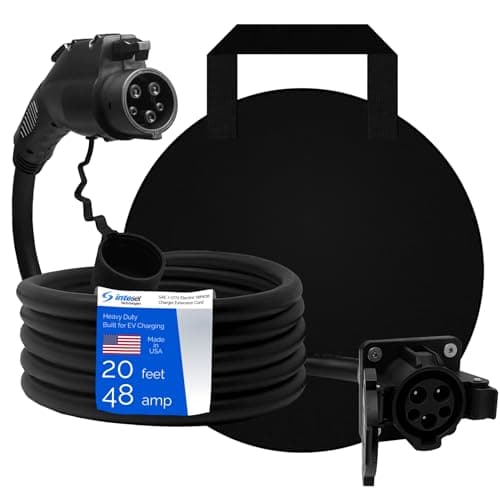
The best EV charger extension cable is the Inteset 48A 20-foot— 8-gauge copper, a published IP65 rating, and the only maker here that names the UL file its components are recognised under instead of printing a badge. If you want the same 20 feet for considerably less, the SEGUMA 50A 20-foot is the cheaper route; if you want the lowest price with a weather rating, the VEVOR 48A 21-foot is the value pick; and if your charger has a Tesla-style plug, the VEVOR NACS 48A is the version that actually fits.
Before any of that, the single most important thing on this page: an EV charger extension cableis not the orange cord in your garage. They solve superficially similar problems and they are wildly different objects, and confusing the two is how people melt receptacles. We compile published manufacturer specs, verify what the sellers actually claim, and check that every product is genuinely purchasable before we list it. We have not bench-tested these cables and we do not pretend otherwise — our research method spells out what our scores are and are not.
First: this is not an extension cord
A household extension cord goes on the wall side— between the outlet and the charger's plug. That is the arrangement our extension cord guide tells you never to create, and nothing on this page changes that advice. A household cord is built for intermittent loads, has no idea how much current is flowing through it, and adds an uninstrumented connection at exactly the point where EV charging generates heat.
The cables on this page go on the car side— between the charger's J1772 or NACS connector and your vehicle's charge port. They are built to the same connector standard as the charger itself, they carry the control pilot signal that lets the charger and the car negotiate current, and their conductors are sized for a continuous 40- to 50-amp draw for hours at a time. A J1772 extension has a J1772 plug on one end and a J1772 socket on the other; a NACS extension does the same with the Tesla-style connector. That is the entire product.
The one-line version: never extend the power side with a household cord; extend the chargingside with a purpose-built cable if you must extend anything at all. If you can solve the problem by moving the charger or adding an outlet instead, do that — it is always the better answer.
Rule 1: the cable must be rated at or above your charger's output
EV charging is a continuous load, which is why the electrical code sizes circuits to 125% of the draw and why chargers are set to 80% of the circuit. The same logic applies to anything you put in the path. A 48-amp charger pushing through a cable rated for 32 amps is the cable running at 150% of its rating, for hours, every night. It will get hot, and heat in a connector is how these failures start.
So the rule is simple and it is not negotiable: the extension's amperage rating must meet or exceed the amperage your charger is set to deliver.Amazon sells these cables in 16, 32, 40, 48 and 50-amp versions, and the 32-amp ones are conspicuously cheaper. Every pick in this roundup is rated 48 amps or 50 amps for exactly that reason — those ratings cover every mainstream home charger on the market with headroom left over, so the cable is never the weak link. If you are not sure what your charger is set to, our amperage guide and the wire size and breaker guide cover how the setting, the breaker and the wire relate.
One nuance worth knowing: the extension does not change what your car draws. Your charger's amperage setting and your car's onboard charger still set the rate. An extension cannot make charging faster, and a well-chosen one should not make it slower either — it should be invisible. If adding a cable makes your charging obviously slower or triggers faults, that is a sign the cable is marginal, and our slow charging guide walks through the other causes.
Rule 2: buy the shortest one that reaches
Length is the decision people get wrong, because the instinct is to buy extra "just in case." Resist it. Every foot of cable adds resistance, and resistance under a continuous 40-amp load means voltage drop and heat. A 40-foot extension is not a better version of a 16-foot one; it is a longer one with more of everything you do not want.
There is a code number that puts a useful boundary on this. NEC 625.17(C) caps the usable length of EV supply equipment cord at 25 feetunless the equipment comes with a cable management system — measured, for a portable unit, from the attachment plug to the vehicle connector. Most home chargers ship with 20 to 25 feet of cable, which means they are already at or near that limit before you add anything. Worth checking first, though, whether the charger itself is the cheaper fix: the units that ship a full 25 feet are ranked in the best long-cable chargers, and if the reach problem is really a mounting-position problem, lowering the box gives back 3 to 4 feet for free — see EV charger mounting height. That does not make an extension illegal to own, but it tells you what the code contemplates for a permanent installation, and itis the clearest argument going for keeping the extension short and occasional rather than treating it as part of the setup.
Measure the real path before you buy — not the straight line. Cable runs along the wall, down to the floor, around the car and up to the charge port, and that path is usually half again as long as the distance you eyeballed. Our cable length guide has the measuring method, and it is worth ten minutes before you spend anything.
Rule 3: an extension is not an adapter
This trips people up constantly. An extension cable has the same connector standard on both ends: J1772 to J1772, or NACS to NACS. It adds length and nothing else. An adapterchanges the standard — NACS to J1772, or the other way round — and adds essentially no length.
So work out what is on your wall, not what is on your car. If your charger has a J1772 connector, you need a J1772 extension, even if you drive a Tesla and use an adapter at the end of it. If your charger has a NACS connector, you need a NACS extension. Buying the wrong one is not a compatibility problem you can work around; the plug physically will not seat. If you are unsure which you have, our which adapter do I need explainer sorts out the connector on each end, and NACS vs J1772 covers why there are two standards at all.
Stacking is where this goes wrong. An extension plus an adapter plus a second extension is three extra connections in a path carrying 40 amps continuously. Each junction is a place heat can concentrate. One purpose-built cable, correctly rated, is a compromise; a chain of them is a hazard. Our take on whether charging adapters are safe applies doubly here.
About those "UL Listed" claims
Search Amazon for these cables and you will see "UL Listed" in a lot of titles. It is worth understanding what that almost always means, because two makers in this category are unusually honest about it and the rest are not.
Our top pick is the clearest example. Inteset's own title says "UL Listed Parts"— parts, not cable — and the listing then names them: the connector and receptacle are UL Recognized under file cRUus E364477, and the cable is built to UL 62. That wording matters. UL Recognized is a component certification, granted to a part destined to go inside something else; UL Listed certifies a finished product. Inteset is telling you it holds the first and not the second.
The cable specialist A2Z EV says the same thing at more length on its own site: its J1772 cord uses UL-certified cable (E341631) and connectors meeting UL 2251, and then "the fully assembled unit is not currently UL Listed, as a specific 'End-Product' category for EV extension cables is currently being finalized by industry regulators." That is the category in one sentence: the parts can be certified, the finished cable cannot yet be, because the end-product category does not exist.
That reframes every "UL Listed" badge you see on a competing listing. It is very likely a claim about components, not about the assembled cable, and most sellers do not tell you which. We have listed the SEGUMA cable's UL claim as exactly that — a claim in the listing — rather than as a verified end-product listing, because the listing does not say what carries it. Prefer the seller who tells you where the certification stops. That is a signal about the whole company.
What the manufacturers themselves say
Two data points worth having before you buy. First, Tesla's Mobile Connector owner's manual instructs owners not to use an extension cord, a multi-outlet adapter, a multi-plug, a conversion plug or a power strip to plug in the Mobile Connector. That warning is about the wall side — the same thing our extension cord guide warns against — but it is a clear statement of how the people who build this equipment feel about extra connections in the path.
Second, the cable specialist A2Z EV describes its own J1772 extension as designed for "portable, occasional, or emergency use," and notes that under NEC Article 625 extension cables generally need to be considered as part of the permanent charging installation, with compliance and the local inspector's interpretation being the owner's responsibility. A company that sells these for a living is telling you the product is a stopgap. Treat it that way: it is the right tool for a garage you rent, a car you park in a different spot twice a week, or a holiday at a relative's house. It is the wrong tool for a permanent daily setup, where moving the charger or the outlet is the real answer.
The picks, in order
1. Inteset J1772 Extension (48A, 20 ft) — best overall
Inteset publishes more about this cable than anyone else in the category publishes about theirs: 48 amps continuous, 20 feet, heavy-duty 8 gauge all-copper EV cable, machine-crimped pins, IP65for indoor and outdoor use, a UL Recognized connector and receptacle under file cRUus E364477 with UL 62 cable, assembly and support in the USA, and a two-year warranty. Every one of those is a checkable claim, and that is the whole reason it wins — in a category where most listings offer two words and a photograph, this one offers a specification.
The 8-gauge conductor is the part worth pausing on. It is the only cable in this roundup whose seller states a wire gauge at all, and gauge is precisely what decides whether 48 amps for four hours is comfortable or marginal. The 48-amp continuous rating covers every mainstream home charger with headroom, the IP65 rating means a driveway or carport is within spec, and Inteset specifies the cable as ultra-flex so it still coils in the cold — a small thing until the first January you own one.
The honest cons: it is the most expensive cable on this page, and at 20 feet the money buys documentation and conductor rather than reach. Forty-eight amps is a notch under the 50 amps two cheaper cables here claim, which will not matter to any mainstream charger but is not the biggest number on the page. Its parts are UL Recognized, not UL Listed — Inteset says so in the title, and no cable in this category holds an end-product listing. And Inteset excludes the Tesla Wall Connector from its compatibility statement, so if that is what is on your wall, the NACS cable below is your pick rather than this one plus an adapter.
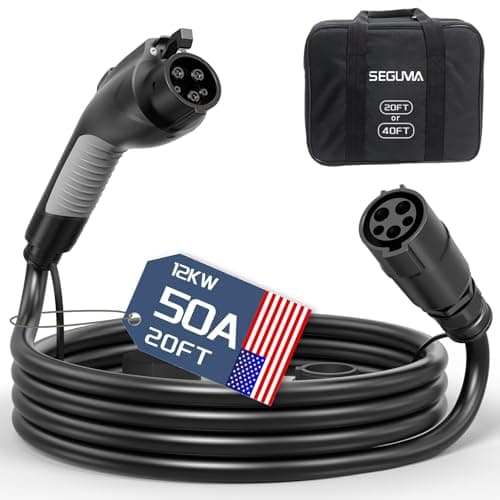
2. SEGUMA J1772 Extension (50A, 20 ft) — the same length for less
Exactly the same 20 feet as the Inteset, a 50-amp rating rather than 48, and a UL listing stated in the product title — for roughly two-thirds of the money. If the budget is the binding constraint this is the honest alternative, and 20 feet is comfortably in the range where voltage drop and heat stay modest, unlike the 30- and 40-foot cables sold right alongside it.
The reservation is the certification claim itself. The listing says "UL Listed" and stops there, without saying whether that describes the cable, the connectors or the finished assembly. Given what the specialists document about this category, the safe assumption is components rather than the whole cord. It publishes no IP rating either, so keep it out of standing water, and no conductor gauge, no country of assembly and no warranty term — which is the real difference between this and the pick above. You are paying less and checking less.
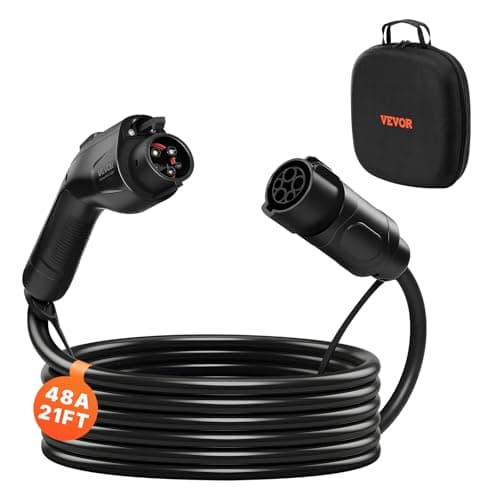
3. VEVOR J1772 Extension (48A, 21 ft) — best value, and best for outdoors
This is the price pick that does not compromise where it matters. It is rated 48 amps for both Level 1 and Level 2 at 120 to 240 volts, it is 21 feet long, and the listing claims IP66— the highest ingress rating anything in this roundup publishes. If the cable is going to lie on a driveway, get rained on, or live in a carport rather than a sealed garage, that rating is the most practically useful thing on this page. It comes with a carrying bag, which sounds like filler until you own a cable you only use twice a month.
What you give up is documentation. No UL or ETL listing is claimed anywhere in the listing, and VEVOR is a broad-catalog house brand rather than an EV specialist, so there is no certification detail to check. At 21 feet it is also the longest of the three short picks, adding marginally more resistance than the 20-foot options. If documented certification is your deciding factor, buy the Inteset; if weather exposure and price are, this is the one. Our outdoor charger setup guide covers the rest of the weather question.
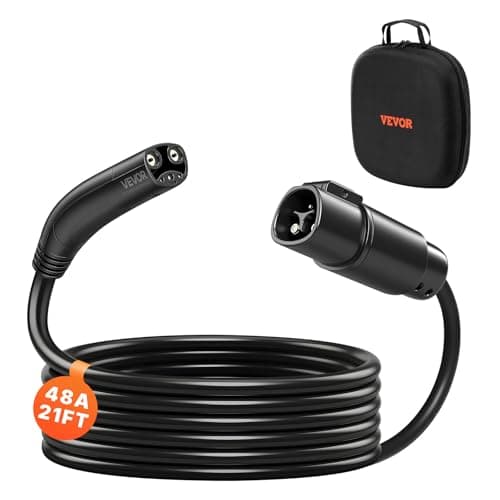
4. VEVOR NACS Extension for Tesla (48A, 21 ft) — best for a NACS charger
The NACS-to-NACS version of the same idea, and the pick if the connector on your wall is the Tesla-style plug rather than J1772. It is rated 48 amps and a maximum of 11.52 kW at 240 volts — which is exactly what a Tesla Wall Connector delivers on a 60-amp circuit, so the cable is not the bottleneck — and the listing names the Mobile Connector, Wall Connector and Destination chargers, plus Model S, 3, X and Y.
The cons are real and worth reading twice. No safety listing is claimed, and unlike the J1772 version, no IP rating is published for this one. Tesla's own Mobile Connector manual tells owners not to plug the connector into an extension cord or adapter — again, that is the wall side, but it is not a company that wants extra connections in the path. And 21 feet added to a Wall Connector's already long cable puts the total well past the 25 feet the NEC contemplates. This is the right cable for the NACS owner who genuinely needs one; it is not an upgrade to a working setup. For more on the connector itself, see CCS vs NACS.
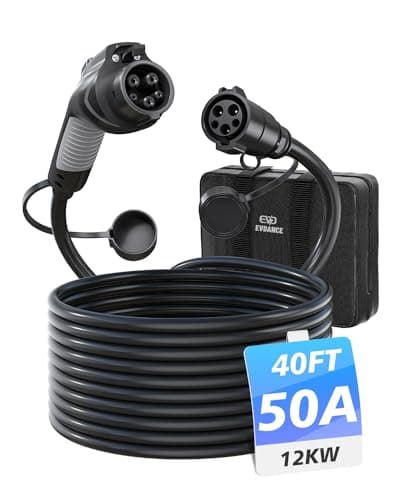
5. EVDANCE J1772 Extension (50A, 40 ft) — the long-reach option, with reservations
Forty feet of 50-amp J1772 cable, for the detached garage or far driveway corner that nothing shorter reaches. We include it because that problem is real and people buy something to solve it — and if you are going to buy 40 feet, buy 40 feet rated to 50 amps rather than one of the long, thin, cheap cables sold next to it. It works with any SAE J1772 charger at Level 1 or Level 2.
Now the honest part, because this is the pick we would most like to talk you out of. Forty feet of extension on top of a 20- or 25-foot charger cable is far beyond what NEC 625.17(C) sets as the usable length for EV supply equipment without a cable management system. More length means more resistance, more voltage drop and more heat. It is the hardest cable here to store, coil and keep off the ground, and it is one of the two most expensive. If you need 40 feet every single day, the money is better spent on an electrician moving the outlet — our installation cost guide has what that actually runs, and it is often less than people assume.
When not to buy one at all
Most reach problems are geometry problems, and geometry is fixable. Before you spend anything on a cable, check whether one of these is available to you:
- Move the charger, or where you park.Mounting the unit a few feet closer to the charge port, or turning the car around, solves an enormous share of "it will not quite reach" complaints for nothing.
- Buy a charger with a longer cable. If you are still shopping, several units in our home charger roundupship with 25 feet — one integrated cable, no added connections, and inside what the code contemplates.
- Have an electrician add or move the outlet. A properly installed NEMA 14-50 outlet in the right place is the permanent fix for a plug-in setup, and it is the only option on this list that improves the installation rather than working around it.
- Use a portable at a nearer outlet. A portable charger plugged into an existing closer receptacle beats stringing anything across a garage.
If none of those work — you rent, the outlet cannot move, the second car parks somewhere awkward twice a week — then a correctly rated, purpose-built extension is a reasonable tool, and the picks above are the ones we would buy. Add a hook to keep it off the floor while you are at it; our cable organizer roundup covers the cheap hardware that stops a long cable from wearing out early.
One safety note that applies to every option on this page: each extra plug and socket in the run is another connection that can loosen, and a loose connection under a continuous 40-amp draw is how things get hot. If anything in your setup is running warmer than you expect, EV charger breaker hot to touch explains what temperature is normal and the four signs that are not.
How to choose an EV charger extension cable
Four decisions, in this order. Get the first two right and the rest is preference.
Start with your charger's amperage, not the cable's price
Find what your charger is actually set to deliver — it is in the app for a smart unit, or on the DIP switches or label for a dumb one. Then buy a cable rated at or above that number. A 48- or 50-amp cable covers everything mainstream, which is why every pick here is one of those. The 32-amp cables sell because they are cheaper, and they are the wrong purchase for any 40- or 48-amp charger. If your charger is adjustable and you are tempted to dial it down to match a cheap cable, understand that you are choosing to charge more slowly forever to save twenty dollars once.
Measure the real path, then buy that length — not more
Run a tape measure along the actual route the cable takes: out of the charger, down the wall, around the car, up to the charge port. Subtract the length of the charger's own cable. That difference, plus a couple of feet of slack, is the extension you need. Buying longer is not insurance; it is more resistance, more heat and more cable to trip over. NEC 625.17(C) puts the usable length of EV supply equipment cord at 25 feet without a cable management system, and your charger's built-in cable has already used most of that.
Check the connector on both ends
The extension must match the connector on your charger: J1772 to J1772, or NACS to NACS. This is about the plug on the wall unit, not the port on your car — if you use an adapter at the car end today, you still need an extension matching the charger. An extension does not convert between standards and cannot be made to. See which adapter do I need if you are not certain what you have.
Weather rating, if the cable lives outside
Indoors, in a dry garage, an ingress rating barely matters. On a driveway, in a carport, or anywhere the connection can sit in a puddle, it matters a lot — and most of these cables publish nothing at all. Only two here do: the VEVOR J1772 cable's claimed IP66 and the Inteset's IP65. Whatever you buy, keep the coupling itself off the ground and out of standing water, and dry the connector before you plug it in. The outdoor setup guide covers the weatherproofing that applies to the rest of the installation.
How to use one without creating a problem
Uncoil it fully before charging — a coiled cable under load traps its own heat, which is the same mechanism that makes household extension cords dangerous. Keep both couplings up off the floor, ideally on a hook. Check the connectors by hand after the first long session: warm is normal, hot is not, and a connector you cannot comfortably hold means you should stop and reassess the rating. And keep it as an occasional tool. Every manufacturer that says anything on the subject describes these as portable or emergency equipment, not as a permanent part of a home installation.
What an extension cable will not fix
It will not make charging faster — your charger's setting and your car's onboard charger set that, and the best an extension can do is be invisible. It will not add smart features, it will not convert connector standards, and it will not make an undersized circuit safe. If your real complaint is speed or capacity, that is a charger and circuit decision: start with what amperage you need and the home charger roundup.