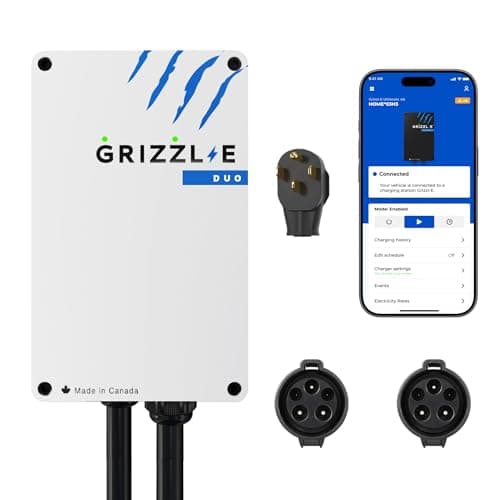
The Grizzl-E Duo is the honest answer to a specific problem: two EVs, one 240-volt circuit, and no appetite for a second electrical run. It is a single plug-in unit with two 24-foot J1772 cables that charges both cars at once, splitting the available current between them — built into the same rugged, UL-certified, NEMA-4 metal enclosure as the single-cable Grizzl-E Classic. If you only ever charge one car it is more charger than you need; if two EVs share a garage, it is often cheaper and simpler than wiring two separate chargers.
As two-car EV households become normal, "how do I charge both?" is the question the big buying guides still skip. There are only three real answers — one shared charger you swap between cars, two separate circuits, or a single dual-cable unit like the Duo — and this review is the closer look at the third. We compile the published manufacturer specs and owner reports and do the wiring math; we have not bench-tested the unit, so treat this as documented research on a charger with the Grizzl-E family's strong durability reputation.
Who it is for
This is a charger for a two-EV home that does not want to pay an electrician to run a second circuit. If both cars park in the same garage or driveway, the Duo lets one NEMA 14-50 outlet feed both of them from a single wall unit. It is a particularly good fit for renters or anyone whose panel has room for exactly one more 240-volt circuit and not two. If you charge a single car — now and for the foreseeable future — this is the wrong buy: you would be paying for a second cable you will never plug in. Buy the single-cable Grizzl-E Classic and keep the difference.
The specs that matter
Grizzl-E builds the Duo as a plug-in Level 2 EVSE with two J1772 connectors on two 24-foot cables, an adjustable output (16 / 24 / 32 / 40 amps), a NEMA 14-50 plug, and the same heavy-duty, NEMA-4 rated metal enclosure the Classic uses. It is made in Canada and UL certified. Two specs define how it behaves in daily use:
- Intelligent power sharing across two cables.The Duo does not give each car its own full circuit — it takes the current the outlet can supply and divides it between whichever cars are plugged in. Connect one car and it gets the whole allowance; connect the second and the unit splits the available amps between them.
- 40 amps total on a 50-amp circuit.As a plug-in unit on a NEMA 14-50 outlet, the whole Duo is capped at 40 amps of continuous draw under the code rule that sizes an EV circuit to 125% of its current (40 × 1.25 = 50). That 40 amps is the pool the two cables share — it is not 40 amps per car. The full breaker-and-wire detail is in our wire size and breaker guide.
The two-car speed, in plain numbers.With one car connected, the Duo delivers up to about 40 amps — roughly 9.6 kW, or on the order of 30–40 miles of range per hour depending on the car. Plug in the second car and that pool splits, so each vehicle charges at roughly half the rate — call it about 20 amps, or in the neighborhood of 15–20 miles of range per hour each. For most households that is a non-issue: two cars sitting from evening to morning have far more hours than they need to both top up, even at the shared rate. It only becomes a real limitation if both cars routinely arrive near empty and need a fast turnaround the same night.
What is good
The Duo's whole reason to exist is that it solves the two-EV problem with one circuit and one box, and it does that well. You avoid the cost and disruption of a second electrical run — and, on a tight panel, a possible service upgrade — because both cars pull from the circuit you already have. The two 24-foot cables are genuinely long, enough to reach both bays of most two-car garages without a fight, so you are not parking to the cable. And it carries the Grizzl-E hardware story: a sealed, NEMA-4, UL-certified metal enclosurerated for indoor and outdoor use. The current model — the Duo Connect— adds Wi-Fi and the Grizzl-E Connect app, so you can set charging schedules and choose which car gets priority; the older, app-free "dumb" Duo it replaces has been discontinued.
Where it falls short
The trade-offs are real and worth knowing before you buy:
- Two cars share the amps.This is the headline compromise. Plugging in the second car halves the rate to the first. It is fine for overnight charging and wrong for a household where both EVs regularly need a fast same-evening turnaround — that home wants two separate circuits.
- It costs meaningfully more than a single Classic, and every dollar of that premium buys the second cable and the sharing logic. If you only charge one car, that money is wasted.
- The smart features now depend on Wi-Fi and an app.The Duo Connect adds scheduling and per-car priority through the Grizzl-E Connect app — useful, but it means the older Duo's "nothing to fail" simplicity is gone, and the app is now part of the experience. If you want a purely app-free dual charger, that version is no longer sold; a single app-free unit like the Grizzl-E Classic is the closest option.
- 40 amps is the ceiling even before splitting. As a plug-in unit it is not a speed champion to begin with; the two-car math starts from 40 amps, not 48.
Installation notes
The plug-in Duo wants a properly rated NEMA 14-50 outlet on a 50-amp circuit. If that outlet already exists, the install is simply plugging in and mounting the box; if it does not, adding one is a job for a licensed electrician who can confirm your panel has the spare capacity. Do not pair a high-current charger with a bargain receptacle — a continuous 40-amp draw is exactly what makes a cheap outlet overheat, so buy an industrial-grade, listed 14-50 like the one in our NEMA 14-50 outlet guide. Where the DIY line sits, and when the job needs an electrician, is covered in can I install an EV charger myself?
Duo, one shared charger, or two circuits?
The Duo is one of three ways to handle two EVs, and the right choice depends on how hard both cars are driven:
- One charger you swap between cars. The cheapest option: a single wall unit and you move the plug from one car to the other, or stagger which charges when. It works if the cars rarely both need a big charge on the same night. Start with the best home EV chargers roundup.
- The Grizzl-E Duo. The middle path: both cables live at once on one circuit, at half speed when both cars are connected. Best when you want the convenience of never unplugging one car to charge the other, and overnight half-speed is plenty.
- Two separate chargers on two circuits.The most capable and most expensive: each car gets a full-speed circuit. The answer when both EVs are driven hard and need fast, simultaneous charging — if your panel and budget can carry it. Our best 40-amp EV chargers roundup is where to pick those units.
Bottom line
The Grizzl-E Duo is a purpose-built tool, and it is excellent at its one purpose: charging two EVs from a single circuit in one rugged, no-nonsense box. Buy it if you have two cars, one 240-volt circuit you would rather not duplicate, and you are comfortable that both cars share the amps when they are plugged in at the same time — which, for an overnight charge, almost nobody actually notices. If you only charge one car, buy the Grizzl-E Classic instead; if both cars need full speed every night, run two circuits. For the large middle ground of two-EV homes, the Duo is the simplest honest answer.