HUB 05 · Guides & Buying Advice
Charging Your EV at Work
For a car that sits in one place for eight hours, even slow charging adds up — workplace charging can do the job a home charger would.
We earn a commission when you buy through our Amazon links, at no extra cost to you. It never affects our rankings, and we say so when the cheaper product is the better buy. How this works.
Workplace charging is one of the most underrated setups in EV ownership: a car that sits parked for eight hours can gain a full day's range even on a modest charger. For some drivers — especially renters without a home charging option — charging at work can replace a home charger entirely.
The math is friendly because time, not power, does the work. A slow charger you sit on for eight hours can add more than a fast charger you visit for twenty minutes. Here is how to make workplace charging work.
Even Level 1 can be enough at work
A standard 120-volt outlet adds only 3–5 miles of range per hour, which sounds trivial — but over an eight-hour workday that is 25–40 miles, comfortably more than the average US commute. If your workplace has an ordinary outlet you are permitted to use and a car that isn't driven far, a simple Level 1 portable in the trunk can quietly cover your driving. Our regular-outlet guide runs the numbers.
Workplace Level 2 stations
Many employers install Level 2 stations in the lot, often free or subsidized. These add 20–30+ miles of range per hour, so a few hours plugged in is a full top-up. Some are networked and require an app or badge to start — the same payment methods as public charging, covered in how to pay for EV charging.
Etiquette: share the stations
Workplace chargers are usually shared and scarcer than parking spots, so etiquette matters. Move your car once it is charged if others are waiting, honor any time limits, and never unplug someone else's car without an agreed system. Our charging etiquette guide covers the norms that keep a shared lot civil.
What to ask your employer
If there is no charging yet, it is worth asking. Employers can access utility and, in some regions, tax incentives for installing stations, and even a couple of Level 2 units or a bank of dedicated outlets makes a real difference. Frame the ask around a growing number of EV-driving colleagues and the low cost of a few circuits versus a full DC installation.
The gear
Recommended gear for this guide
The products this guide refers to, with prices pulled live from Amazon and dated on each card.
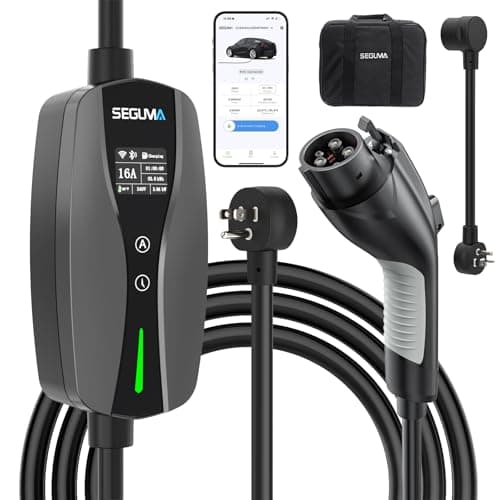
A 120V backup that is not dumb
SEGUMA Wi-Fi Level 1/2 (12A/16A)
A 120-volt cord that plugs into any household outlet and lives in the trunk — with app scheduling, a live display, and 16 amps on 240 volts if you have the outlet.

A J1772 car using NACS chargers
Lectron NACS → J1772 Adapter
The default adapter for a J1772 car to use a Tesla-style (NACS) home or destination charger — rated for the full 48 amps.
#ad · As an Amazon Associate we earn from qualifying purchases.
Questions
Frequently asked
Can charging at work replace a home charger?
Is Level 1 charging enough at work?
Do I need my own equipment to charge at work?
What are the etiquette rules for workplace charging?
Keep reading
Related
- Can You Use a Regular Outlet?Why Level 1 can be enough over a workday.
- EV Charging EtiquetteSharing scarce workplace stations fairly.
- Charging in an ApartmentWhen work charging fills the home gap.
- SEGUMA Level 1 ReviewA simple trunk unit for outlet charging at work.
- How to Pay for EV ChargingStarting a networked workplace station.
Receipts
Sources
We do not run a testing lab, and we do not pretend to. Where a measured number came from someone else's lab, we name them and link them. Where we could not verify something, we say so on the page rather than quietly leaving it out. Read our full method.