HUB 04 · Cable Management & Accessories
EV Charging Outlet Types Explained
NEMA 14-50, 6-50, 14-30, 10-30, 5-15 — the outlet alphabet soup, decoded, so you buy a charger that matches the outlet you actually have.
We earn a commission when you buy through our Amazon links, at no extra cost to you. It never affects our rankings, and we say so when the cheaper product is the better buy. How this works.
The outlet on your wall decides which plug-in charger you can use and how fast it charges. The EV default is the NEMA 14-50(240V, 50A) — the same outlet a big range uses — but you may also meet a 6-50, a dryer's 14-30 or 10-30, or a standard 5-15 wall outlet. Here is what each supplies and which charger fits.
"NEMA" is just the standards body that names outlet shapes. The numbers encode the configuration and amperage. You do not need to memorize them — you need to know which one you have and buy a charger (or plug) to match.
The EV default: NEMA 14-50
A NEMA 14-50 is a 240-volt, 50-amp, four-wire outlet (two hots, neutral, ground). It became the EV standard because most plug-in Level 2 chargers and every portable in our portable roundupship with a 14-50 plug, and a charger on it delivers a full 40 amps of continuous Level 2 charging. If you are adding an outlet for EV charging, this is almost always the one — buy the industrial-grade, listed version covered in our NEMA 14-50 outlet guide, because it carries a continuous load the cheap ones cannot.
NEMA 6-50
A 6-50is also 240V/50A but three-wire (two hots and ground, no neutral) — common in workshops for welders. Many chargers offer a 6-50 plug option, and it charges at the same 40-amp Level 2 rate as a 14-50. If your garage already has a welder outlet, a charger with a 6-50 plug can use it — confirm the circuit is properly rated first.
Dryer outlets: NEMA 14-30 and 10-30
A dryer outlet is 240 volts but on a 30-ampcircuit, so it charges more slowly than a 50-amp outlet — capped at 24 amps continuous. The modern four-wire version is the 14-30; older homes have the three-wire 10-30. Some portables offer a 14-30 plug or adapter, but you must never simply force a 50-amp charger onto a 30-amp circuit. Our dryer outlet guide covers doing this safely, and why sharing the laundry circuit needs care.
The standard wall outlet: NEMA 5-15
The ordinary three-prong household outlet is a 5-15 — 120 volts, and the home of Level 1charging. Every EV can charge from one with the included cord, adding about 3–5 miles of range per hour. It is slow but universal; our regular-outlet guide explains when that is enough. A 5-20 is its slightly higher-amperage cousin.
How to match a charger to your outlet
- Identify the outletyou have (or plan to install) by its shape and the breaker feeding it — the amperage matters as much as the shape.
- Buy a charger with the matching plug, or the right plug option. Many portables ship with, or offer, several plug types.
- Never exceed the circuit.A charger's current must sit within the outlet's circuit rating under the 125% continuous-load rule — 40A on a 50A circuit, 24A on a 30A circuit. The wire size and breaker guidehas the math.
- Adding a new outlet is electrician work. The outlet is a safety component under a continuous EV load, and the circuit behind it must be sized correctly.
The gear
Recommended gear for this guide
The products this guide refers to, with prices pulled live from Amazon and dated on each card.
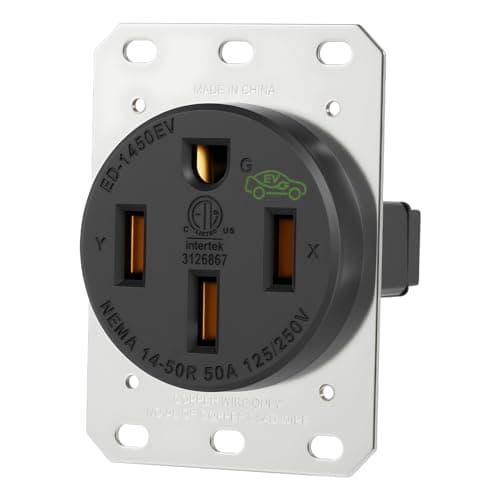
The outlet a plug-in charger needs
Industrial NEMA 14-50 Outlet
The receptacle a plug-in charger actually plugs into — buy the industrial-grade, listed version, because the cheap ones are the part that fails.
#ad · As an Amazon Associate we earn from qualifying purchases.
Questions
Frequently asked
What outlet do I need for an EV charger?
For fast home charging, a NEMA 14-50 — a 240-volt, 50-amp outlet that most plug-in Level 2 chargers and portables use, delivering a full 40 amps. A NEMA 6-50 works too. A dryer's 14-30 charges more slowly, and a standard 5-15 gives slow Level 1 charging.
What's the difference between NEMA 14-50 and 6-50?
Both are 240V/50A and charge at the same rate. The 14-50 is four-wire (with a neutral) and is the EV standard; the 6-50 is three-wire (no neutral), common for welders. Many chargers offer either plug, so use whichever outlet you have on a properly rated circuit.
Can I charge from a dryer outlet?
Sometimes, carefully. A dryer outlet (14-30 or older 10-30) is 240 volts but on a 30-amp circuit, so charging is capped at 24 amps — slower than a 14-50, and you must not overload the circuit or run the dryer at the same time. See our dedicated dryer-outlet guide before trying it.
Is a NEMA 5-15 outlet enough to charge an EV?
It works for Level 1 charging — about 3–5 miles of range per hour — which is fine for light drivers and plug-in hybrids but slow for daily high-mileage use. Plug directly into the wall, never through an extension cord.
Keep reading
Related
- NEMA 14-50 OutletsThe EV-default outlet, and which grade to buy.
- Can I Use a Dryer Outlet?Charging from a 30-amp 240-volt outlet safely.
- Can You Use a Regular Outlet?What the standard 5-15 outlet can do.
- Wire Size & BreakerThe circuit math behind each outlet.
- NEMA 14-50 ChargersThe chargers built for the standard outlet.
- NEMA 14-30 vs 14-50The dryer outlet vs the EV default, compared.
- NEMA 6-50 vs 14-50The welder outlet vs the EV default, compared.
Receipts
Sources
- US DOE AFDC — EV charging infrastructure & Level 2 basics
- US DOE / fueleconomy.gov — EV charging basics
We do not run a testing lab, and we do not pretend to. Where a measured number came from someone else's lab, we name them and link them. Where we could not verify something, we say so on the page rather than quietly leaving it out. Read our full method.