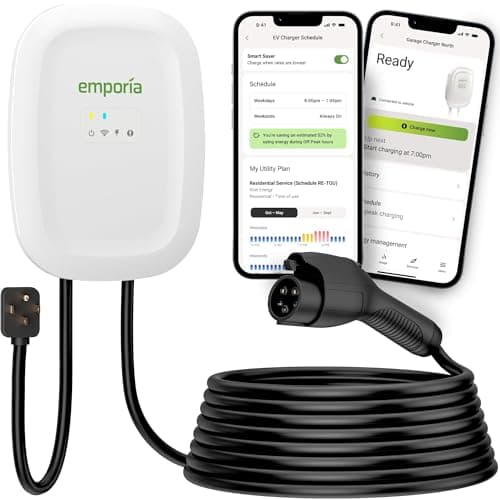
For most people who want the app, the Emporia Level 2 is the smart charger to buy. It has genuine energy monitoring and scheduling, it is 48-amp capable when hardwired, and it costs about what a plain plug-in charger does — you are not paying a smart-charger premium for the software. If you want one account for home and the road, the ChargePoint Home Flex ties into the largest public network in North America; the Autel MaxiCharger packs the most features out of the box; the EVIQO is the budget smart pick; and the Wallbox Pulsar Plus is the one to hardwire when wall space is tight.
A "smart" EV charger is a connected one: it has Wi-Fi (sometimes Bluetooth too), a smartphone app, and an account that lets you schedule charging, watch energy use, and start or stop a session from your phone. Under the enclosure it does the identical core job as a non-smart charger— safely hand your car 240 volts — because the power electronics are the same. What the software adds is control and data. The question is not whether smart chargers work; they all do. It is which connected features are genuinely useful, which are marketing, and which unit gives you the useful ones without charging a heavy premium for the rest. That is what this roundup sorts out. We compile published manufacturer specs, verify the safety listings, and do the wiring and cost math; we have not bench-tested these units and we do not pretend to.
One scoping note before the picks: every charger here uses the J1772 connector, which fits the great majority of EVs on North American roads. If your car has a Tesla-style NACSport instead — a Tesla, or a 2025-onward model that adopted the standard — the same connected hardware is sold with a native NACS cable, and several of the smartest options (including Emporia's PowerSmart load-management unit) live in our best NACS home chargers roundup.
What "smart" actually buys you
Before you pay extra for connectivity, it helps to know which features earn the money. In our reading of the category, four do real work and the rest are nice-to-have:
- Scheduled / off-peak charging.The single most valuable smart feature. If you are on a time-of-use electricity rate, telling the charger to run only during cheap overnight hours is where the software pays for itself — the math is in how to save money charging an EV.
- Energy monitoring. Per-session and per-month kWh, so you can see exactly what charging costs and separate it from the rest of the house bill.
- Load management.The feature that can save you a five-figure panel upgrade: the charger backs off when the rest of the house is drawing hard, so a modest panel can still carry it. Most chargers here do not do true dynamic load management — that is a specialist feature, covered below.
- Remote start/stop and amperage limiting. Handy for setting the current in software to match your breaker, and for stopping a charge from the couch. Genuinely useful; rarely the reason to buy.
Notably, one "smart" feature you can get for free: nearly every modern EV has a charge scheduler built into its own dashboard. If off-peak timing is all you want, your car may already do it — a point we make in full in do I need a smart EV charger?The picks below are for buyers who want the charger's own app, its energy data, and control that does not depend on remembering to set the car each night.
First, the rule that decides your real speed: your panel, not the app
No amount of software changes the physics. The amperage on the box — 40, 48, 50 — is a ceiling, not a promise; what you can actually use is set by the circuit your electrical panel can support, and by code. EV charging is a continuous load, so the circuit must be sized to 125% of the charger's current: a 40-amp charger needs a 50-amp breaker (40 × 1.25 = 50) and typically 6 AWG copper; a 48-amp charger needs a 60-amp breaker. A smart charger's one advantage here is that many let you set the amperage in the app to match whatever breaker you installed. Before you choose, find out what your panel can spare — the full breaker-and-wire breakdown is in our wire size and breaker guide, and you should confirm the specifics with a licensed electrician and your local code before any work happens.
The short version
Every charger below is Wi-Fi connected with a real app. They split cleanly by what you value:
- Emporia Level 2 — best smart charger for most people. Real energy monitoring and scheduling, 48-amp capable hardwired, priced like a dumb charger. Read the full Emporia review.
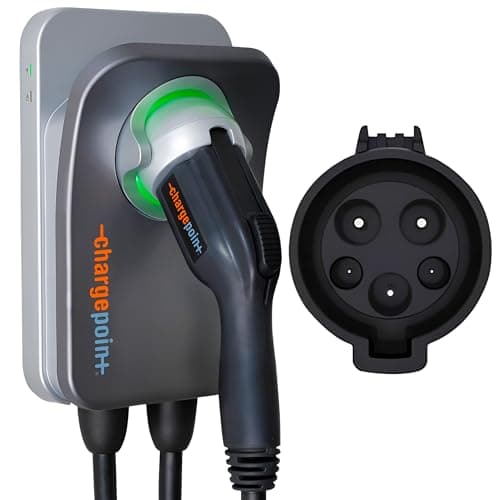
- ChargePoint Home Flex — best app & network ecosystem. Amperage adjustable to 50A and one account for home plus the biggest public network in North America. Read the full ChargePoint Home Flex review.
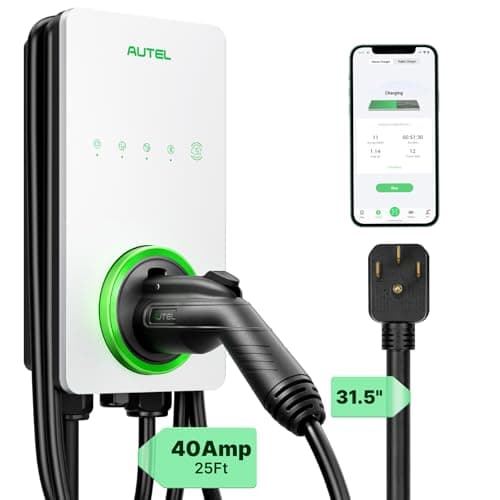
- Autel MaxiCharger — most features out of the box. Wi-Fi and Bluetooth, plus a holster in the box for a tidy install. Read the full Autel MaxiCharger review.
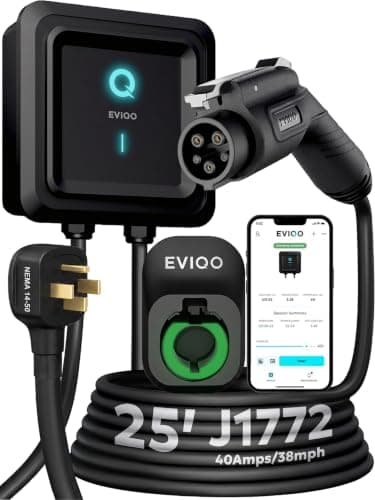
- EVIQO Level 2 — best budget smart charger. UL and ETL listed with an IP66 weather rating and a Wi-Fi app, usually at the bottom of the price band. Read the full EVIQO review.
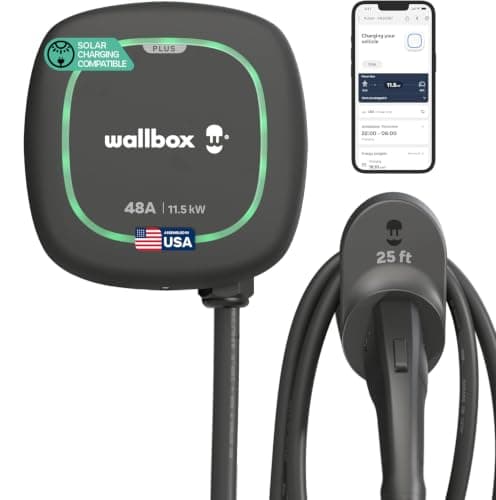
- Wallbox Pulsar Plus — best compact hardwired smart unit. One of the smallest 48-amp chargers made, for a tidy wall. Read the full Wallbox Pulsar Plus review.
The picks, in order
1. Emporia Level 2 — the smart charger to buy
The Emporia is the rare smart charger that does not charge you extra for being smart. It gives you the two connected features people actually use — scheduling and genuine per-session energy monitoring — in an app that undercuts most rivals on price, and its 48-amp ceiling (when hardwired on a 60-amp circuit) is faster than the 40-amp default most plug-in units top out at. A 25-foot cable reaches across a two-car garage. The honest cons are the flip side of that software-first design: the app and Wi-Fi are central to the experience, so setup is more involved than a sealed plug-and-go box, and if your Wi-Fi is weak in the garage you will feel it. And the 48-amp number needs hardwiring — the NEMA 14-50 plug version is capped at 40 amps like everything else on a 50-amp circuit. If you want the app features at the lowest sensible price, this is the buy. Full Emporia Level 2 review.
2. ChargePoint Home Flex — the app and network play
If "smart" to you means one polished app for everything, the ChargePoint is the pick. Its amperage is adjustable in the app up to 50 amps, so a single unit fits whatever breaker you install, and its real edge is the ecosystem: the same ChargePoint account that runs the charger on your wall also finds and pays at the largest public charging network in North America. It is a mature product with a long track record and responsive support, which budget brands cannot match. The cons are price and dependence: it costs more than equally capable chargers from newer brands, and the experience leans hard on the ChargePoint account and app — if you want the hardware to stand alone, that is not this unit's philosophy. For a household that values brand maturity and one app for home and away, it earns the premium. Full ChargePoint Home Flex review, and see it against our top pick in Emporia vs ChargePoint.
3. Autel MaxiCharger — the most features out of the box
The Autel is for the feature-maximalist. It carries both Wi-Fi and Bluetooth — so app control still works if your garage Wi-Fi is weak, a genuinely useful redundancy the others here lack — and it ships with a separate holster in the box, so you get tidy cable management without a second purchase. The weather-rated enclosure mounts indoors or out. The trade-off is speed and scope: it tops out at 40 amps, so it is not the fastest option if your panel could support 48A, and the feature set is frankly more than a set-and-forget buyer needs. If you want everything and a clean install, and 40 amps covers your daily driving (it does for almost everyone), the Autel is the loaded pick. Full Autel MaxiCharger review.
4. EVIQO Level 2 — the budget smart charger
The EVIQO proves you do not have to spend up to get a connected charger. It carries both UL and ETLlistings plus an IP66 / NEMA 4 weatherproof rating — a stronger enclosure spec than several pricier units — and its Wi-Fi app handles scheduling on a long 25-foot cable, all while usually sitting at the bottom of the price band. For a smart charger, that is a lot of hardware for the money. The honest cons: it is a newer brand with a shorter support track record than ChargePoint or Emporia, and it tops out at 40 amps, so it is not the fastest if your panel could do more. If brand maturity is what reassures you, step up to the ChargePoint; if you want the app features for the least money and the certifications check out (they do here), the EVIQO is the value smart pick. Full EVIQO Level 2 review.
5. Wallbox Pulsar Plus — the compact hardwired smart unit
When you want the full 48 amps hardwired and the tidiest possible wall, the Wallbox is the pick: it is one of the physically smallest 48-amp chargers you can buy, Energy Star and UL certified, with a 25-foot cable. It is the connected charger for a buyer who cares about the install looking clean and running at full speed. Two honest cons keep it at the bottom of a smartranking rather than the top: it is hardwired only at 48A, so there is no plug-in convenience if you might move it, and its app has historically drawn more owner complaints than its hardware — which matters more in a roundup where the app is the point. If the software track record worries you, the Emporia or ChargePoint is the safer connected buy; if you want 48-amp speed in the smallest box and will mostly set-and-forget it, the Wallbox delivers. Full Wallbox Pulsar Plus review.
What about load management for a tight panel?
The smartest feature of all — dynamic load management, where the charger throttles itself when the house is drawing hard so you avoid a costly panel or service upgrade — is a specialist capability most of the units above do not have. If your electrical panel is the constraint rather than your budget, that is the feature to prioritize, and the standout is Emporia's Emporia Pro with PowerSmart, which we cover in the NACS lineup. For a J1772 car, the ChargePoint's app amperage limiting is a simpler, static way to fit a smaller breaker, and our charging two EVs in one householdguide covers load-sharing between cars. Do not pay a load-management premium if your panel has a spare 60-amp slot — you would be buying a feature you will never trigger.
Two things worth separating from the app features above. "Smart" and "load managed" are not the same purchase: an app knows only what the charger is doing, whereas load management needs current sensors on your service — see what a CT clamp is and the load-management roundup. And if the acronym on a listing is what brought you here, what is OCPP explains the open protocol and when it is genuinely worth paying for. Solar households should read the solar roundupbefore paying extra for a "solar" feature.
How to choose a smart EV charger
Once you have confirmed what your panel can support, choosing a connected charger comes down to five things. Here is how we weighted them and how to read them for your own situation.
Certification comes first, always
A home charger pushes 40 amps or more continuously for hours, often unattended overnight. No app feature matters if the box is not safe. The one spec we will not compromise on is a UL or ETLlisting — independent proof the unit was tested to a recognized safety standard. Every pick here carries a real listing; make it your first filter on anything you consider outside this list, no matter how good the app looks.
Buy for the features you will actually use
Match the unit to the connected features that do real work for you. If you are on a time-of-use rate, schedulingis the one that pays — and any pick here has it. If you want to track charging cost, look for genuine per-session energy monitoring (the Emporia is strong here). If your panel is tight, you want load management, which is a specialist feature — see the note above. If you are on a flat electricity rate and just want the data and remote control, the cheapest certified smart unit here does the job. Do not pay for a feature you have already decided you will not use.
Wi-Fi reliability — and the Bluetooth safety net
A smart charger is only as reliable as its connection, and garages are where Wi-Fi goes to die. Two things help. First, a unit with Bluetooth as well as Wi-Fi(the Autel here) still lets you control it from your phone at the car even when the Wi-Fi drops. Second, a good app degrades gracefully — the charge should continue on its last schedule if the cloud is unreachable, rather than stopping. If your garage signal is weak, weight Bluetooth support and a strong offline story heavily.
Plug-in vs hardwired, and the outlet that matters
Most smart chargers here are plug-in units on a NEMA 14-50 cord, which is the flexible call: no electrician needed if the outlet exists, and you can unplug and take it with you when you move. If you go plug-in, buy an industrial-grade, listed NEMA 14-50 receptacle, because the cheap ones are the part that overheats under a sustained 40-amp draw. If you want the full 48 amps or the cleanest fixture, hardwiring is the route — the Wallbox is hardwired, and our best hardwired chargers roundup covers that tier in full.
The app's track record, not just its feature list
On a smart charger, the app is half the product, so its reliability and longevity matter as much as the spec sheet. An established brand with years of app updates behind it (ChargePoint, Emporia) is a safer bet for long-term support than a brand-new one, however good the current feature list looks. And remember the failure mode a dumb charger avoids entirely: if a company abandons its app or shuts down its servers, a cloud-dependent charger can lose features. If that risk bothers you more than the convenience is worth, read the best dumb EV chargers before you decide.
So, which one?
Buy the Emporia Level 2unless you have a specific reason not to — it gives you the smart features that matter without the smart-charger tax. Want one app for home and the public network? The ChargePoint Home Flex. Want every feature and a Bluetooth backup in the box? The Autel MaxiCharger. Want the app features for the least money? The EVIQO. Want 48-amp speed hardwired in the smallest box? The Wallbox Pulsar Plus. And if you are still not sure the software is worth it at all, start with do I need a smart EV charger? before you spend.