HUB 05 · Guides & Buying Advice
Can I Use a Dryer Outlet to Charge My EV?
Sometimes yes, with the right charger and some caution. The catch is that a dryer outlet is usually a smaller circuit than an EV charger expects.
We earn a commission when you buy through our Amazon links, at no extra cost to you. It never affects our rankings, and we say so when the cheaper product is the better buy. How this works.
Sometimes — but read the outlet first. A modern dryer outlet is usually a NEMA 14-30 on a 30-amp circuit, while most Level 2 EV chargers are built for a NEMA 14-50 on a 50-amp circuit. You can charge from a 14-30 with a charger or adapter made for it, but only at a lower amperage (about 24 amps max), and never by forcing a 14-50 charger onto a 30-amp circuit. Often the cleanest answer is to have an electrician add a dedicated 14-50.
It is one of the most common EV-charging questions, because a 240-volt dryer outlet looks like exactly what a charger wants. It can work, but the details matter for safety, and getting them wrong overloads a circuit. Here is how to tell what you have and what to do with it.
Know your outlet: 14-30 vs 14-50
Both are 240-volt outlets, but they sit on different circuits and are not interchangeable:
- NEMA 14-30 — the modern dryer outlet, on a 30-amp circuit. Under the continuous-load rule, that caps EV charging at about 24 amps(30 × 0.8), or roughly 5.7 kW — a bit less than a full 40-amp charge, but still solid Level 2 speed.
- NEMA 14-50 — the range/RV outlet, on a 50-amp circuit, which most Level 2 chargers use and which allows up to 40 amps. This is what EV charger listings assume.
You may also find an older NEMA 10-30dryer outlet (three-prong, no ground), which is not appropriate for EV charging without an electrician's attention. Look at the outlet, or check the breaker it is on, before anything else.
The rule you cannot break
Never put a 40-amp charger on a 30-amp circuit.Plugging a 14-50 charger into a 14-30 circuit with a plug adapter, or otherwise drawing 40 amps from a 30-amp breaker, overloads the wiring and is a genuine fire risk. The charger must be set to draw no more than the circuit allows — about 24 amps on a 30-amp circuit. This is the single most important thing on this page.
How to charge from a 14-30 dryer outlet safely
If you have a 14-30 and want to use it, do it the right way:
- Use a charger designed for a 14-30, or a portable with the correct 14-30 plug that limits itself to the circuit's rating. Many portable EVSEs sell interchangeable plug tails and adjustable current for exactly this.
- Set the amperage to about 24 amps (or let a 14-30-rated unit do it for you). An adjustable portable is ideal because you dial it to the circuit.
- Do not share with the dryer. A single circuit cannot safely run a dryer and an EV charger at once; only one appliance should be on it at a time, and code generally expects a dedicated circuit for EV charging anyway.
- Confirm the wiring is sound.An old or worn dryer outlet was not built for hours of continuous EV load. If in any doubt, have an electrician check it — the same caution as any EV outlet.
When to just add a proper 14-50
For many people the better answer is to stop working around the dryer outlet and have an electrician install a dedicated NEMA 14-50on a 50-amp circuit. You get full 40-amp charging, a circuit built for continuous EV load, and no juggling with the dryer. If your panel has the capacity, it is often a modest job — the ranges are in our installation cost guide, and the receptacle to ask for is in the NEMA 14-50 outlet guide. This is the path that ends the compromises.
The honest trade-off
Charging from a dryer outlet trades a little speed and some caution for avoiding an install. At about 24 amps, a 14-30 still adds meaningful range overnight — enough for many drivers — but you give up the top 40-amp speed and you must respect the circuit's limit. If it gets you charging cheaply today, good; if you find yourself fighting the dryer or wanting more speed, a dedicated 14-50 is the upgrade. Either way, the golden rule stands: the charger must never draw more than the circuit is rated for.
The gear
Recommended gear for this guide
The products this guide refers to, with prices pulled live from Amazon and dated on each card.
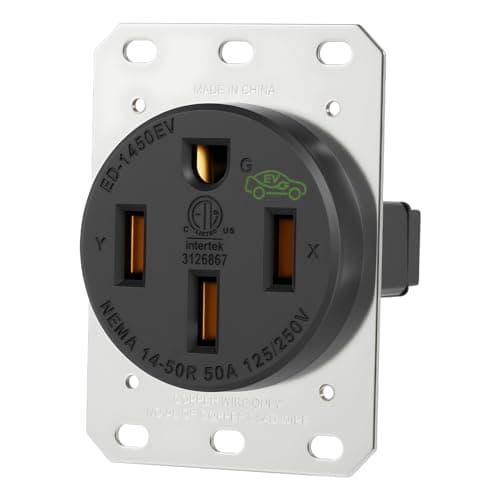
The outlet a plug-in charger needs
Industrial NEMA 14-50 Outlet
The receptacle a plug-in charger actually plugs into — buy the industrial-grade, listed version, because the cheap ones are the part that fails.
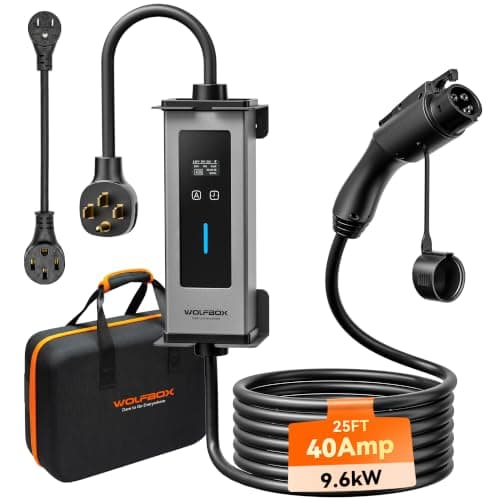
One charger for home and travel
WOLFBOX Portable (Level 1/2)
A dual-level portable that charges on both 120V and 240V, ships with both plug adapters, and adds a delay timer for off-peak charging — a genuine take-anywhere charger.
#ad · As an Amazon Associate we earn from qualifying purchases.
Questions
Frequently asked
Can I plug my EV charger into a dryer outlet?
What is the difference between NEMA 14-30 and 14-50?
Is it safe to use a dryer outlet for EV charging?
Can I share one circuit between my dryer and EV charger?
Keep reading
Related
- Wire Size & Breaker GuideThe continuous-load math behind the 24A and 40A limits.
- NEMA 14-50 Outlet GuideThe dedicated outlet that ends the dryer-circuit compromise.
- Level 2 Installation CostWhat adding a proper 14-50 circuit runs.
- Best Portable EV ChargersAdjustable portables that can dial down to a 30-amp circuit.
- EV Outlet Types Explained14-50, 6-50, 14-30 and 10-30, decoded.
- Can You Use an Extension Cord?The unsafe workaround to avoid entirely.
- Best EV Chargers for a 100-Amp PanelCertified splitter switches and load-managed chargers, ranked.
- Best EV Charger Outlet AdaptersThe NEMA adapters that make a dryer outlet fit a 14-50 charger, ranked.
Receipts
Sources
- US DOE Alternative Fuels Data Center — charging at home
- US DOE / fueleconomy.gov — EV charging basics
We do not run a testing lab, and we do not pretend to. Where a measured number came from someone else's lab, we name them and link them. Where we could not verify something, we say so on the page rather than quietly leaving it out. Read our full method.