HUB 05 · Guides & Buying Advice
Charging Two EVs in One Household
Three ways to charge a two-EV household — sharing one charger, two separate circuits, or a load-sharing unit — and how to pick without overloading your panel.
We earn a commission when you buy through our Amazon links, at no extra cost to you. It never affects our rankings, and we say so when the cheaper product is the better buy. How this works.
A two-EV household has three real options: share one charger by swapping the plug overnight, install two separate circuits, or use a load-sharing dual charger that splits one circuit between two cars. Which one fits comes down to how much you drive and how much spare capacity your electrical panel has.
The good news is that most households do not both need a full charge every night. A Level 2 charger adds so much range per hour that sharing is often enough — and the fancier options exist mainly for high-mileage two-driver homes.
Option 1: share one charger
The cheapest answer is one charger and a little coordination. A single 40- or 48-amp unit adds roughly 30–40 miles of range per hour, so a few hours on each car overnight usually covers two normal commutes. Plug in car A when you get home, swap to car B before bed, or alternate nights. A value unit like the Emporia Level 2 handles this well, and a portable can serve as a second, slower charger on another outlet.
Option 2: two separate circuits
If both cars are driven hard and need a full charge nightly, two independent circuits and two chargers are the simplest robust answer — each car charges at full speed with no coordination. The limit is your panel: two 48-amp chargers can demand a lot of continuous current, and many homes do not have the spare capacity without an upgrade. The wire size and breaker guide and installation cost guidecover the electrician's side.
Option 3: a load-sharing dual charger
Load sharing is the elegant middle path: one circuit feeds a unit (or two networked units) that automatically divides the available current between two plugged-in cars, so you never exceed the breaker. The Grizzl-E Duo is a dual-cable example. It costs more than a single charger but far less than a panel upgrade, and it is the right call when you want both cars plugged in at once on a panel that cannot support two full circuits.
How to choose
Start with your panel's spare capacity and your real nightly mileage. Modest driving → share one charger. Heavy driving with panel headroom → two circuits. Heavy driving without headroom → load sharing. When in doubt, an electrician's load calculation settles it, as our DIY-versus-electrician guide explains.
The gear
Recommended gear for this guide
The products this guide refers to, with prices pulled live from Amazon and dated on each card.
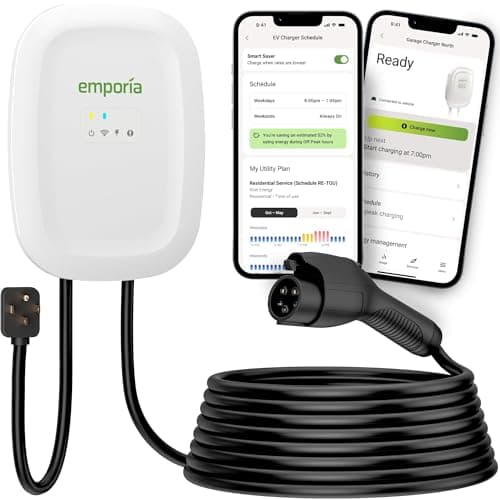
Most people who want the smart features too
Emporia Level 2 (48A)
The smart charger that does not charge a smart-charger premium — 48-amp capability and real energy monitoring for the price of a dumb one.
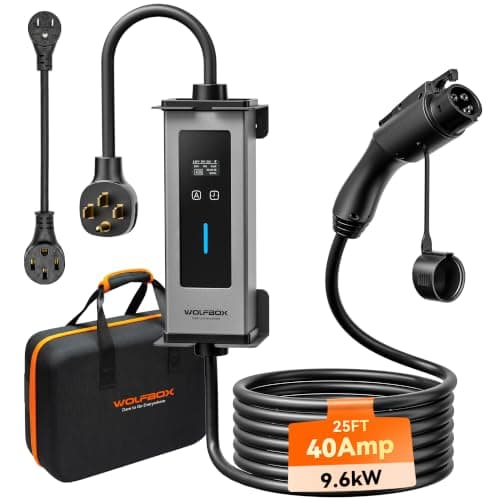
One charger for home and travel
WOLFBOX Portable (Level 1/2)
A dual-level portable that charges on both 120V and 240V, ships with both plug adapters, and adds a delay timer for off-peak charging — a genuine take-anywhere charger.
#ad · As an Amazon Associate we earn from qualifying purchases.
Questions
Frequently asked
Can two EVs share one home charger?
What is a load-sharing EV charger?
Do I need two circuits for two EVs?
Keep reading
Related
- Grizzl-E Duo ReviewA dual-cable, load-sharing charger for two cars.
- Wire Size & BreakerWhether your panel can support two circuits.
- Level 2 Installation CostWhat a second circuit or a panel upgrade runs.
- Emporia Level 2 ReviewA value unit two cars can share.
- Best Portable EV ChargersA second, slower charger on another outlet.
Receipts
Sources
We do not run a testing lab, and we do not pretend to. Where a measured number came from someone else's lab, we name them and link them. Where we could not verify something, we say so on the page rather than quietly leaving it out. Read our full method.