HUB 05 · Guides & Buying Advice
Putting an EV Charger in a Detached Garage
The charger is the easy part. The question is whether the wire already running out to that building can carry 32 amps continuously — and usually it cannot.
We earn a commission when you buy through our Amazon links, at no extra cost to you. It never affects our rankings, and we say so when the cheaper product is the better buy. How this works.
Find out what the existing feeder to the garage is rated for before you shop for anything. A detached garage is typically fed by a small circuit sized for lighting and a door opener — often 20 or 30 amps — and a Level 2 charger needs a dedicated circuit of its own on top of whatever else is out there. In most cases the real project is a new feeder and a small sub-panel in the garage, and the distance makes the wire, not the charger, the biggest line item. If the feeder is already generous, an adjustable charger like the ChargePoint Home Flex lets you dial the draw to fit what is actually available.
Detached-garage installs split cleanly into two very different projects, and knowing which one you have is the whole job. Either there is enough capacity already out there and you are adding a circuit, or there is not and you are running a new feeder across the yard. The second is several times the first. Everything below is about finding out which you are in.
Step one: what is actually feeding that building?
Go look. In the main panel, find the breaker labeled for the garage, shed or outbuilding and note its rating. Then look at what is in the garage: a single breaker, a small sub-panel, or just a junction box.
- A 15 or 20-amp circuit. Common, and it means no Level 2 charging. It will run a 120-volt Level 1 cord, which adds roughly 4 miles of range per hour — about 40 miles overnight. For some drivers that is genuinely enough; see can you live with only Level 1.
- A 30 or 40-amp 240-volt feeder. Now you have options. Subtract the existing garage loads, apply the 80% continuous rule to what is left, and you may land at 16 or 24 amps of charging — which is real Level 2, roughly 12 to 17 miles per hour.
- A 60-amp or larger feeder with a sub-panel. The good case. You likely have room for a full 32- or 40-amp charging circuit, and the job becomes an ordinary install inside the garage.
- Nothing, or unknown. Treat it as a new feeder project and get it looked at. Old outbuilding wiring is also where you find the hazards — no separate ground, or a shared neutral. And to answer the question people ask at this point: a generator is not a practical substitute for a feeder, for reasons we set out in can I use a generator to charge an EV.
An electrician performing the load calculation for your permit does this arithmetic formally. The point of doing it roughly yourself first is to know whether you are discussing a small job or a trench.
Why distance costs money: voltage drop
This is the part that surprises people. Over a long run, wire has to be sized not just for the current but to keep voltage drop acceptable — the NEC's informational guidance is to keep branch-circuit drop around 3%. Resistance scales with length, so a run to a detached garage can require a conductor one or two sizes larger than the same circuit would need inside the house. Work an example:
- A 40-amp circuit for a 32-amp charger, running 100 feet to the garage, is a 200-foot round trip of conductor.
- At 240 volts, a 3% budget is about 7.2 volts of allowable drop.
- The wire that would have been adequate for 40 amps over a short run often will not hold that budget at this distance, so the installer steps up a size (or two at 150 feet or more).
Bigger wire over a longer distance, plus conduit, plus trenching or an overhead span, is why detached-garage quotes land well above the typical attached-garage install cost. It is also why running one generous feeder to a sub-panel is usually smarter than running a dedicated charger circuit all that way: you pay for the long run once, and future circuits in the garage are short.
Size the feeder for the garage you will have, not the charger you are buying. The expensive, disruptive part is getting copper across the yard. Doing that once at 60 or 100 amps into a small sub-panel costs modestly more than doing it at 40, and it covers a second EV, a compressor, a heater or a workshop later. Undersizing the feeder to save a little now is the decision people regret, because redoing it means digging the same trench twice.
What a detached-garage install involves
- A feeder from the main panel — underground in conduit, direct-burial cable, or an overhead span, depending on the site and local rules.
- A sub-panel in the garage with its own main breaker, plus grounding at the outbuilding per code. This is the part that makes everything afterwards easy.
- A dedicated branch circuit for the charger from that sub-panel — NEC 625.40, same as anywhere. See do I need a dedicated circuit.
- A permit and an inspection. A new feeder to an outbuilding is substantial work and inspectors look closely at outbuilding grounding.
- The charger, mounted to suit how you park. Cable reach is often tighter in a detached garage — check mounting height and cable reach before you fix the location.
What to put on the end of the feeder
Published specifications from the live listings, with live prices. The column that matters in a detached garage is the adjustable range, because you often will not know your usable amperage until the load calculation is done:
| Charger | Best for | Published range / specs | Price |
|---|---|---|---|
| ChargePoint Home Flex | Buyers who want the established brand and app | Adjustable to 50A · J1772 · NEMA 14-50 plug · Energy Star | $599.00 |
| Emporia Pro (48A, PowerSmart) | A 100-amp service you would rather not upgrade | Up to 48A hardwired · J1772 · PowerSmart + Vue monitor · UL · ENERGY STAR · NEMA 4 | $599.00 |
| WOLFBOX Portable (Level 1/2) | One charger for home and travel | 6–40A · 9.6kW · J1772 · Level 1/2 · NEMA 14-50 + 5-15 · ETL · IP66 · 25ft | $299.99 |
#ad Prices read live from the Amazon Product API as of October 16, 2026, and they move. Specs are the manufacturer's published claims from the live listing — we have not bench-measured them. Where we have no verified price we print none rather than a number that has gone stale.
What to look for, given the constraint is the feeder
An adjustable charger, so the hardware fits whatever capacity you find. This is the central recommendation of this page. You often do not know your usable amperage until the load calculation is done, and a charger adjustable across a wide range can be set to 16, 24 or 32 amps accordingly — rather than being the wrong purchase. ChargePoint publishes 16–50A. See how to set the amperage.
Load management, if the whole-house capacity is the binding limit. When the service cannot carry a new garage feeder at the size you want, a charger with built-in load management lets it back off when the rest of the house is drawing. That can be the difference between a project that gets approved and a service upgrade. See best chargers for a 100-amp panel.
A portable, as the interim or the permanent answer. If the garage already has a 240-volt outlet — many have an old welder or dryer receptacle — an adjustable portable charges from it today with no new wiring and no permit. Set the current to match the circuit, not the plug. Our dryer outlet guide has the rules.
The right enclosure rating for an unheated building. A detached garage is often uninsulated and damp. Treat the enclosure rating the way you would outdoors, and expect cold cable; see best outdoor chargers.
Get the feeder quoted at two sizes. Ask explicitly what a 60-amp and a 100-amp feeder cost. The difference is usually small next to the trenching, and it decides what that building can ever do.
The gear
Recommended gear for this guide
The products this guide refers to, with prices pulled live from Amazon and dated on each card.
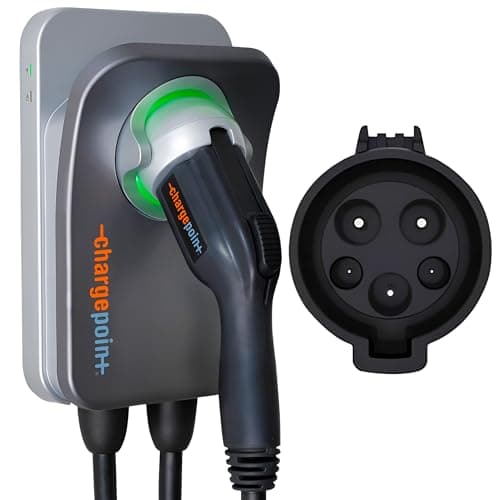
Buyers who want the established brand and app
ChargePoint Home Flex
The polished, well-supported option — adjustable up to 50 amps and tied into the largest public charging app in North America.
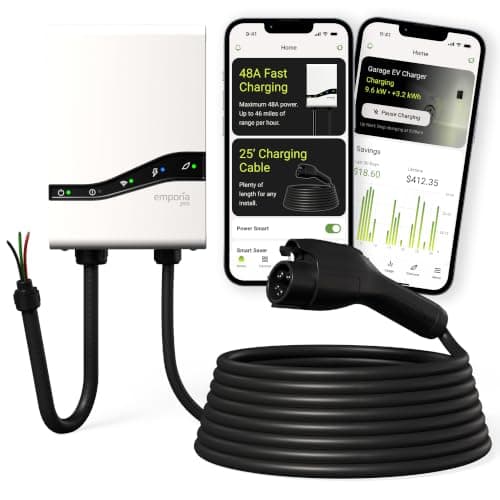
A 100-amp service you would rather not upgrade
Emporia Pro (48A, PowerSmart)
The one charger that changes the electrical answer rather than working around it — it watches the whole panel and backs off instead of tripping the main.
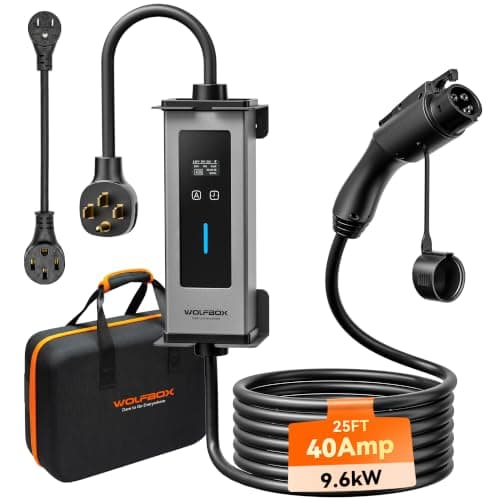
One charger for home and travel
WOLFBOX Portable (Level 1/2)
A dual-level portable that charges on both 120V and 240V, ships with both plug adapters, and adds a delay timer for off-peak charging — a genuine take-anywhere charger.
#ad · As an Amazon Associate we earn from qualifying purchases.
Questions
Frequently asked
Can I run an EV charger off my detached garage's existing circuit?
Do I need a sub-panel in a detached garage for an EV charger?
How far can you run wire to an EV charger?
Is it cheaper to put the charger on the house instead?
Keep reading
Related
- Level 2 Installation CostWhy a detached-garage quote runs above the typical install.
- Wire Size & Breaker GuideThe conductor table the long run is sized against.
- Do I Need a Permit?A new feeder to an outbuilding is firmly permitted work.
- Best Chargers for a 100-Amp PanelWhen whole-house capacity, not distance, is the limit.
- Do I Need a Dedicated Circuit?NEC 625.40 applies in the garage sub-panel too.
- Can You Live With Level 1?The honest fallback when the feeder cannot do Level 2.
Receipts
Sources
- EC&M — NEC Article 625, Electric Vehicle Charging Systems
- US DOE AFDC — EV charging levels and typical power
We do not run a testing lab, and we do not pretend to. Where a measured number came from someone else's lab, we name them and link them. Where we could not verify something, we say so on the page rather than quietly leaving it out. Read our full method.