HUB 05 · Guides & Buying Advice
EV Charging Speed: kW vs Amps Explained
Amps, volts, kilowatts and miles per hour — the four numbers on every charging spec, and the simple math that connects them.
We earn a commission when you buy through our Amazon links, at no extra cost to you. It never affects our rankings, and we say so when the cheaper product is the better buy. How this works.
Charging speed is really about kilowatts (kW), but chargers are sold by amps. The bridge is one line of arithmetic: volts x amps = watts. A 40-amp charger on a 240-volt circuit is 9,600 watts, or 9.6 kW. Divide that into miles per hour and you get real charging speed — roughly 25–30 miles of range per hour for most EVs.
The one equation that matters
Power (watts) equals voltage times current (amps). So on a home 240-volt Level 2 circuit:
- 32 amps x 240 V = 7.7 kW
- 40 amps x 240 V = 9.6 kW
- 48 amps x 240 V = 11.5 kW
That is why the amperage you chooseis just a proxy for kilowatts. A 120-volt Level 1 outlet at 12 amps is only about 1.4 kW — the same reason a wall outlet trickles so slowly.
From kW to miles per hour
A rough rule: most EVs travel 3–4 miles per kWh. So 9.6 kW adds roughly 28–38 miles of range in an hour, depending on the car's efficiency. Our charge-time guide turns that into full-charge hours for your battery size.
Why you may get less than the number
Two ceilings apply, and you get the lower of them: the charger's rating and the car's onboard AC charger. Plug a 48-amp charger into a car that only accepts 32 amps of AC and you charge at 32 amps. The circuit also matters — a charger can only pull what its breaker allows, per the wire size and breaker rules. DC fast charging is a different world, measured in tens or hundreds of kW; see DC fast charging explained.
The gear
Recommended gear for this guide
The products this guide refers to, with prices pulled live from Amazon and dated on each card.
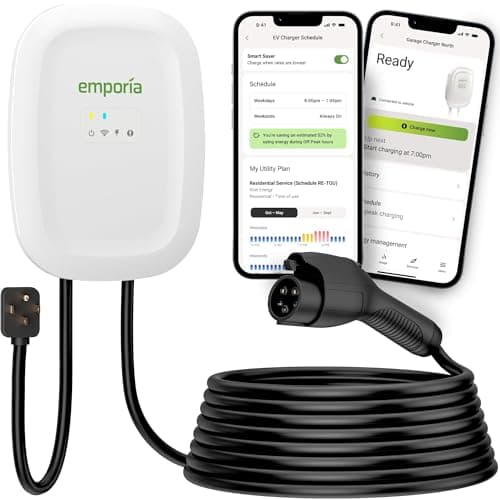
Most people who want the smart features too
Emporia Level 2 (48A)
The smart charger that does not charge a smart-charger premium — 48-amp capability and real energy monitoring for the price of a dumb one.
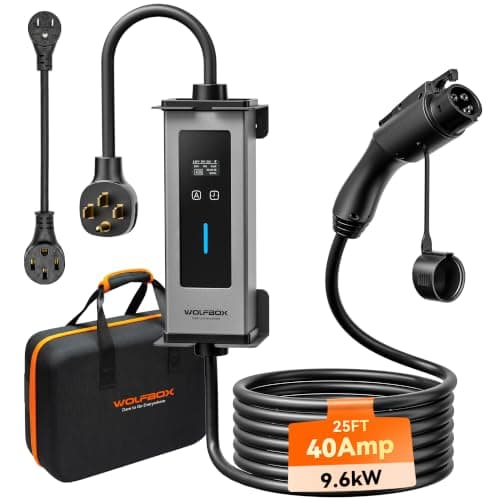
One charger for home and travel
WOLFBOX Portable (Level 1/2)
A dual-level portable that charges on both 120V and 240V, ships with both plug adapters, and adds a delay timer for off-peak charging — a genuine take-anywhere charger.
#ad · As an Amazon Associate we earn from qualifying purchases.
Questions
Frequently asked
How do I convert amps to kW for charging?
How many miles per hour does a home charger add?
Why is my car charging slower than the charger's rating?
Keep reading
Related
Receipts
Sources
We do not run a testing lab, and we do not pretend to. Where a measured number came from someone else's lab, we name them and link them. Where we could not verify something, we say so on the page rather than quietly leaving it out. Read our full method.