A two-EV household has four real answers, and only one of them is "buy two chargers." You can run one dual-cable charger that splits a single circuit between both cars, pair two smart chargers that share one circuit under load management, switch an existing 240-volt outlet between two cars, or hang a cheap portable on a second outlet you already have. For most two-EV homes our pick is the Grizzl-E Duo Connect — one plug-in box, two 25-foot cables, two cars, one circuit, nothing to coordinate.
The reason this page is not simply "buy two of the charger we like best" is that the second charger is rarely the expensive part. The second circuit is. A charger is a few hundred dollars on a shelf; a second 240-volt run to the far side of the garage, with its own breaker in a panel that may not have a slot free, is the line item that turns a weekend purchase into a quote — and on an older service it can drag a panel upgrade in behind it. Every option below is really a different answer to the same question: how do two cars share electrical capacity you have already paid for?
As on every page here, we have not bench-tested these units. What follows is compiled from published manufacturer specifications and manuals, the manufacturers' own documentation on how their load sharing works, verified safety listings, the NEC rules that govern more than one charger on a circuit, and the arithmetic of charging two cars overnight. Scores are judgments against our published rubric, not lab measurements, and no dollar figure is written into this page — prices render live and date-stamped.
The short version
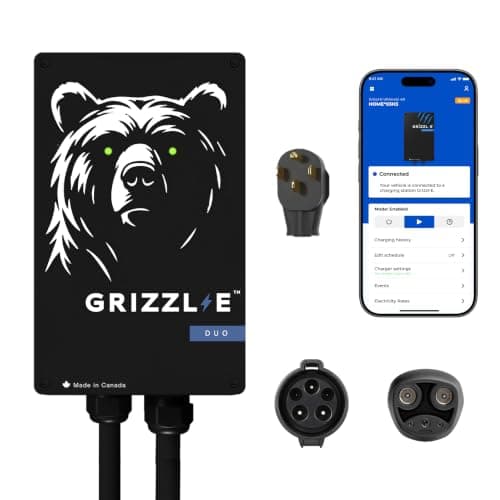
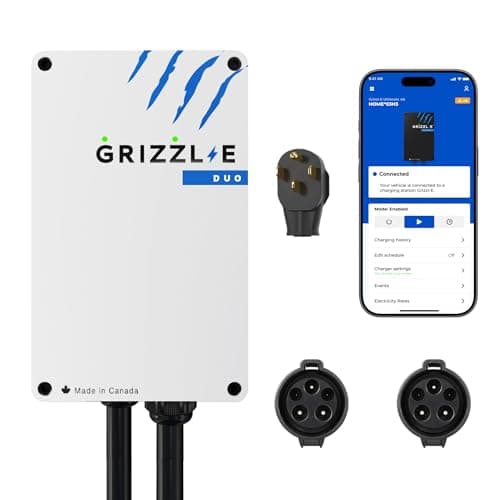
- Grizzl-E Duo Connect (J1772 × 2) — best for two EVs overall. One plug-in unit on one NEMA 14-50 circuit, two 25-foot J1772 cables, 40 amps to a single car or 20 amps each when both are plugged in. Full Grizzl-E Duo review.
- Grizzl-E Duo Connect (J1772 + NACS) — best for a mixed driveway. The same box with one J1772 head and one Tesla-style NACS head, so a Tesla and a non-Tesla both plug in natively with no adapter in the loop.
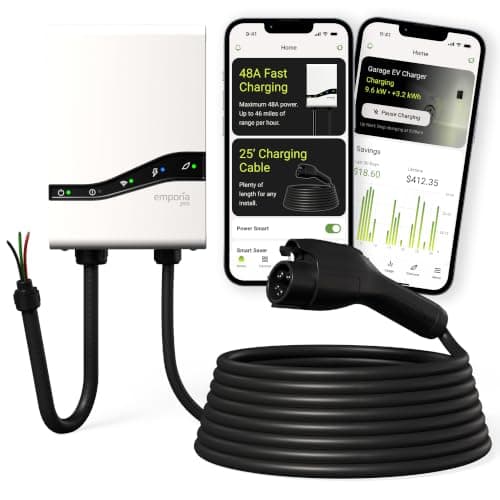
- Emporia Pro — best two-charger setup. Emporia's Intelligent Load Sharing lets two or more of its chargers divide one circuit between them, so each car gets its own cable and the whole 48 amps when it is charging alone. Full Emporia Pro review.
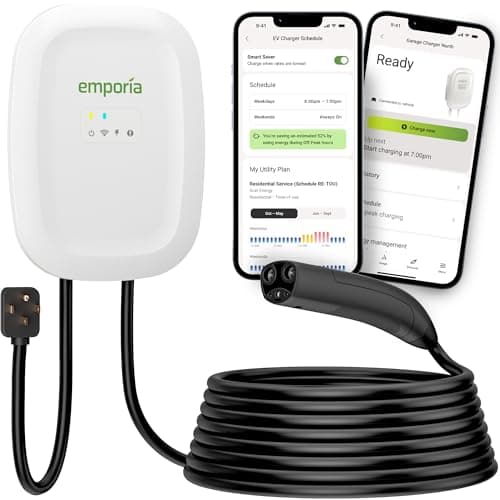
- Emporia Level 2 NACS — the cheaper second unit. The NACS half of a load-sharing pair for the Tesla side of the driveway, for less than a second Pro. Full Emporia NACS review.
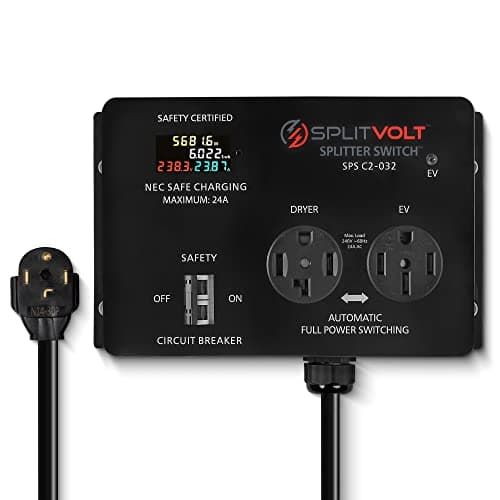
- Splitvolt Splitter Switch — cheapest way in. Shares a 240-volt circuit you already have rather than adding one, at a 24-amp ceiling and one device at a time.
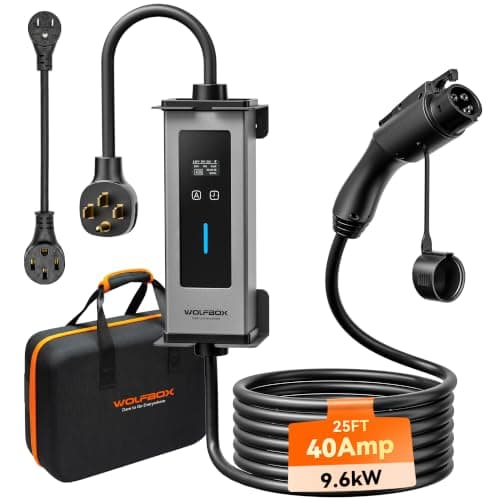
- WOLFBOX Portable — the second car's slow lane. An adjustable 6–40A portable for a second outlet elsewhere in the garage, and it travels.
The arithmetic that makes sharing fine for most households
Two EVs sound like twice the charging problem. They almost never are, because the constraint is not how fast a car can charge but how many hours it sits still. Do the math on the shared case, which is the one everybody worries about:
- A dual-cable charger on a 50-amp plug-in circuit delivers 40 amps to one car, or splits to 20 amps each when both are connected.
- Twenty amps at 240 volts is 4.8 kW. A car averaging 3 miles per kWh therefore gains roughly 14 miles of range per hour, per car, simultaneously.
- Over a ten-hour overnight window that is about 140 miles added to each car — both of them, on one circuit, every night.
Unless both drivers routinely cover more than that in a day, the shared rate is not a compromise you will ever feel. And the split is only in effect while both cars are actually drawing: the moment one finishes, the other steps back up to the full 40 amps for the rest of the night. The households that genuinely need more are the ones where two big batteries both arrive near empty and both need a fast turnaround the same evening — a two-circuit house, or a load-sharing pair on a 60-amp circuit.
Where sharing actually breaks down. Not overnight charging — daytime. If one car leaves at 7am and comes back at noon needing to go out again, it is competing with a car that is still plugged in and drawing. That is the case for two separate circuits, or for load sharing that gives the active car everything the circuit has. It is not a case for buying more amperage than your panel can carry.
Two chargers on one circuit is a code question, not a gadget question
This is the part the product listings skip. The default rule in the National Electrical Code is one circuit per charger: NEC 625.40 requires that each outlet installed to supply EV charging equipment above 16 amps or 120 volts be fed by an individual branch circuit. The exception is narrow and specific — branch circuits are permitted to feed multiple chargers only as allowed by 625.42(A) or (B), which is to say when an energy management system in accordance with NEC 750.30 is doing the load management, or when the equipment's ampere setting is restricted-access and set to fit. Where that system exists, 625.42(A) makes the maximum load counted on the service and feeder the maximum the management system permits, rather than the sum of every charger at full output.
In plain terms: you cannot put two ordinary chargers on one breaker and hope. You need equipment designed and listed to divide that circuit. That is exactly why the two routes on this page are a single unit with two cables (one piece of equipment, one circuit, internal sharing) or a brand whose chargers talk to each other — and why a charger that does neither is not a two-EV answer no matter how good it is. EV charging is also a continuous load under 625.42, so the 80% rule still applies to the circuit as a whole: 40 amps of charging on a 50-amp breaker, 48 on a 60. Our wire size and breaker guide has the full table, and whether you need a dedicated circuit covers the single-charger version of this rule. Your local inspector has the final say on all of it, so confirm the method before you buy the hardware.
In a two-EV house, the connector pair is half the decision
One-car households pick a connector once. Two-car households frequently have one of each, because the industry is mid-transition: the Tesla-style NACS plug (now the J3400 standard) is becoming the default, while most non-Tesla EVs on the road today charge at home through J1772. Our NACS vs J1772 explainer covers which car has which. For a mixed driveway there are three honest options: a dual-cable charger with one head of each standard, two chargers with the right plug each, or one standard plus an adapter — and the adapter is the cheapest route by far, provided it is a properly listed one from our adapters hub and you accept living with it on the handle. If both of your cars are NACS-native, start from the best NACS home chargers instead.
What actually costs money
Before you rank hardware, price the install, because it usually dwarfs the difference between the picks. A second 240-volt circuit means a breaker, a run of heavy cable to wherever the second car parks, possibly a trench or an exterior run, a permit and an inspection; if the panel has no free slot or the load calculation fails, it can also mean a service upgrade. Our installation cost guide breaks the job down line by line, and if your service is an older 100-amp one, the 100-amp panel roundup is the page to read first. Weigh the dual-cable unit's price premium against that quote, not against the price of a single charger — that is the comparison that decides this category.
The picks, in order
1. Grizzl-E Duo Connect (J1772 × 2) — the default two-EV answer
One box, one circuit, two cars, no coordination: the Duo Connect is the simplest honest solution to the two-EV problem. It is a plug-in unit on a NEMA 14-50 outlet, so there is no second electrical run to pay for, and Grizzl-E publishes 40 amps to a single car with the current split evenly when two are charging — or set per connector in the app if you want one car prioritized. The hardware is the same cast metal, UL-certified, UL Type 4 indoor/outdoor enclosure as the rest of the Grizzl-E line, and the two cables are a genuinely useful 25 feet, which is what makes a single wall position work for two parking bays. The honest cons: 20 amps each while both are plugged in is about half the rate either car would get alone, it costs roughly double a good single 40-amp charger, and the scheduling and per-car priority now live behind Wi-Fi and the Grizzl-E Connect app. Full Grizzl-E Duo review.
2. Grizzl-E Duo Connect (J1772 + NACS) — for a Tesla and a non-Tesla
Identical hardware, one head of each standard: one 25-foot J1772 cable and one 25-foot NACS cable on the same enclosure. For the very common two-EV driveway with a Tesla on one side and a J1772 car on the other, this removes the adapter from the equation entirely — each car plugs in natively, and neither driver has to remember where the dongle went. We score it exactly the same as the J1772 build because it is the same chassis, the same 40 amps and the same cables; the connector pair is a fit question, not a quality difference. It carries the same cons too: 20 amps each when both are connected, double the price of a single charger, and an app in the loop. And if both of your cars take the same connector, do not buy it — Grizzl-E sells matching-cable versions for the same money.
3. Emporia Pro — the best two-charger setup
If you would rather each car had its own charger, this is the pair to build it from. Emporia documents Intelligent Load Sharing: two or more of its Level 2 chargers coordinate through Emporia's cloud and divide the available power between them, either on a single shared breaker or on separate breakers in an EV sub-panel. Emporia's own worked example is three chargers on a 60-amp circuit with 48 amps available — 16 amps each with all three charging, 24 amps each with two, and up to the full 48 for a car charging alone — rebalancing within about 30 seconds as cars finish. It states the feature needs no extra hardware, no Vue monitor and no subscription. The Pro is the one we rank here because it adds PowerSmart whole-panel load management on top, which is the feature that keeps a tight service out of an upgrade. Cons: it is the most expensive charger on this page, the Vue monitor bundled for PowerSmart goes inside your panel so this is licensed-electrician work, and — the one worth knowing — Emporia states that dynamic load sharing depends on internet connectivity, with chargers defaulting to 6 amps each when offline. Full Emporia Pro review, and the ChargePoint Home Flex vs Emporia Pro head-to-head if you are weighing it against the obvious alternative.
4. Emporia Level 2 NACS — the second unit for the NACS car
A load-sharing pair does not have to be two identical chargers, and it does not have to be two Pros. Emporia lists Load Sharing as working across its Pro and Classic chargers, so the cheaper route for a mixed driveway is one unit per car with the right plug on each: a J1772 Pro for the non-Tesla and this NACS Classic for the Tesla. It is UL listed and Energy Star certified with a 25-foot cable and the same app. The cons are the ones in our standalone review: 48 amps is the hardware ceiling rather than what the plug delivers — on a NEMA 14-50 the 50-amp circuit caps continuous draw at 40 amps, so the full 48 needs the hardwired version — and Wi-Fi is central to setup, which matters more here because the sharing itself is cloud-coordinated. Full Emporia NACS review.
5. Splitvolt Splitter Switch — the no-new-circuit route
The cheapest way to charge two cars is to stop buying circuits. The Splitvolt plugs into an existing NEMA 14-30 dryer receptacle and gives you a dryer outlet and an EV outlet, switching the circuit between them automatically, with an internal safety breaker holding charging to the 24 amps a 30-amp circuit allows continuously. It is cETLus certified, which most of the marketplace dryer splitters are not. Be clear about what it is, though: it is sequential, not simultaneous. One device draws at a time, so two EVs take turns rather than sharing — which is fine if the cars are on alternate nights or one is a short-commute car, and useless if both need to be plugged in together. The 24-amp ceiling is about 5.8 kW, it costs about as much as a decent charger, and it depends on your dryer outlet being somewhere you can park near. See also using a dryer outlet for EV charging.
6. WOLFBOX Portable — the second car's slow lane
The under-rated two-EV setup: keep the good wall charger for the car that needs it and give the second car a portable on whatever other outlet exists. The WOLFBOX runs on both 120 volts and 240 volts, ships with both the NEMA 5-15 and NEMA 14-50 plug adapters, and its current is adjustable from 6 to 40 amps — which is what lets it suit a smaller existing circuit instead of demanding a new one. It is ETL certified, IP66 rated, has a 25-foot cable and a built-in delay timer for off-peak charging without an app. It is a brick on the floor rather than a tidy wall fixture, and a 40-amp draw needs a properly rated receptacle — do not run it flat out on a worn outlet. For a low-mileage second car, a 120-volt trickle is often genuinely enough; see can you live with only Level 1 charging.
What we deliberately did not rank
The ChargePoint Home Flex. It is a charger we rate highly and it is the wrong tool here: ChargePoint's own installation FAQ states that each Home Flex station requires its own dedicated circuit, and answers the question "can I buy two Home stations and use them on a single circuit" with a flat "No." Two Home Flex units mean two circuits. If you have two circuits, it is a fine pair — see the Home Flex review — but it cannot solve the shared-circuit problem this page is about.
Autel's dynamic load balancing. Autel documents charger-to-charger Dynamic Load Balancing on its AC Lite Home 40A, which would put it in the same category as the Emporia pair. We have not ranked it on that basis because the Amazon listing we track for the MaxiCharger 40A does not state which build it is, and we are not going to promise a feature we cannot confirm is on the unit that arrives. If you want that route, buy it from a seller who states the model explicitly.
Uncertified dryer splitters. There are cheaper 14-30 splitters on the marketplace than the Splitvolt with no named safety listing at all. A device that switches 240 volts and sits in a receptacle unattended all night is the wrong place to save thirty dollars.
How to choose for two EVs
Work through it in this order. The hardware question is last, not first, because the first two answers usually decide it for you.
Start with the two overnight windows, not the amperage
Write down how many miles each car covers on a normal day and how many hours each one actually sits at home. If both numbers are ordinary — a commute each, home from evening to morning — then shared 20-amp charging adds about 140 miles to each car overnight and you can stop worrying about amperage entirely. If one car does long days, or if a car routinely needs a fast top-up in the middle of the day, it needs its own circuit and the sharing options are a false economy.
Then ask how many circuits you can get, and what the second one costs
Get a number from an electrician for the second 240-volt run before you choose hardware. If a second circuit is cheap — a short run, a panel with a free slot — two single chargers are the better buy: each car gets full speed, and two good 40-amp units can cost less than one dual-cable one. If the second circuit is expensive, or the panel has no room, the dual-cable Duo or a load-sharing pair on one breaker is how you avoid it. On an older service, read the 100-amp panel roundup before you spend anything.
Match the connectors, then pick the box
Two J1772 cars: the J1772–J1772 Duo, or two J1772 chargers. One Tesla and one J1772 car: the J1772+NACS Duo, or a Pro and a NACS Classic as a load-sharing pair, or one J1772 charger plus a listed adapter if you would rather spend the money on nothing at all. Two NACS cars: the NACS roundup is the right starting point.
Confirm the shared-circuit method with the person who signs it off
Anything that puts two chargers on one circuit relies on NEC 625.42 and a listed load-management system, and your inspector decides whether what you have bought satisfies it. A single dual-cable unit is the easy case — it is one piece of listed equipment on one circuit, like any other plug-in charger. Two chargers sharing a breaker is the case to ask about first, not after the cable is in the wall.
So, which one? The Grizzl-E Duo Connect for most two-EV homes — one circuit, two cables, done. The J1772+NACS Duo if one of the two cars is a Tesla. A pair built around the Emporia Pro when you want each car on its own charger and the panel cannot give you two full circuits. The Splitvolt when adding any circuit is off the table and the cars can take turns. The WOLFBOX Portable as the cheap second lane for a low-mileage second car.