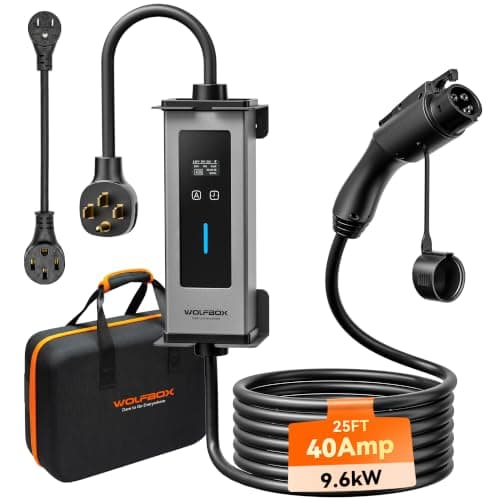
For road trips our pick is the WOLFBOX Portable — adjustable 6 to 40 amps, so it can dial itself down to whatever outlet you find instead of tripping it, with both a NEMA 14-50 and a standard 5-15 plug in the box. If your car has a Tesla-style NACS port, the Lectron NACS Portable is the same idea with the right head on it. Then spend about twenty dollars on a 14-30 dryer adapter, which roughly doubles the number of places your charger is useful.
Travel charging is a different problem from home charging, and the roundups do not separate them. At home you have one known outlet and you buy the charger that suits it. On the road you have a charger and you go looking for an outlet — a relative's garage, a motel laundry room, a campsite pedestal, a workshop. The outlet is the unknown, which means the single most valuable feature in a travel EVSE is adjustable current: the ability to tell the charger to draw 16 amps instead of 40 when you are not confident what is behind the wall.
To be clear about what this is for: a portable Level 2 charger is not a substitute for DC fast charging on a long drive. It is the thing that gets you moving the morning after a bad night — a dead charging site, a full queue, a hotel with no charger, a detour past a cabin. Our road trip charging guide covers planning the drive itself; this page is about the hardware you keep in the trunk for when the plan fails. Nothing here was bench-tested; specs are the manufacturers' published figures and scores are judgments against our published rubric.
The short version
- WOLFBOX Portable — best road-trip charger overall. For the driver who wants one unit for home and travel. Adjustable 6–40A, 25-foot cable, NEMA 14-50 and 5-15 plugs, ETL listed, IP66. Full review.
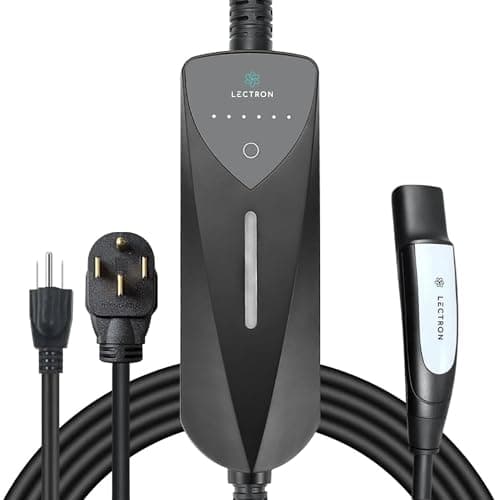
- Lectron NACS Portable — best for a Tesla or NACS car. For the driver whose car takes the Tesla-style plug and does not want an adapter in the loop. Adjustable 8–40A, 14-50 and 5-15. Full review.
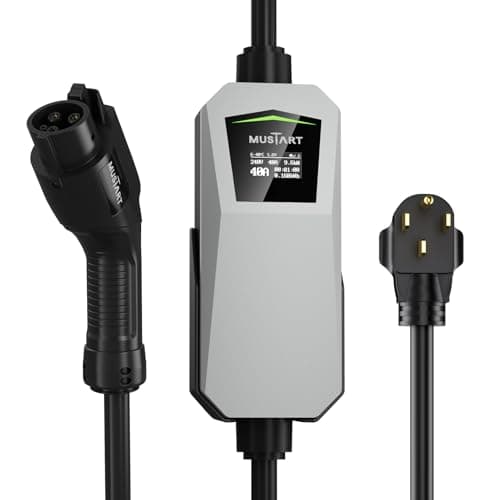
- MUSTART 40A Portable — cheapest capable 40-amp portable. For the driver who only ever expects to find a proper 14-50 and wants to spend the least getting there. Full review, or see it against the EVDANCE in MUSTART vs EVDANCE.
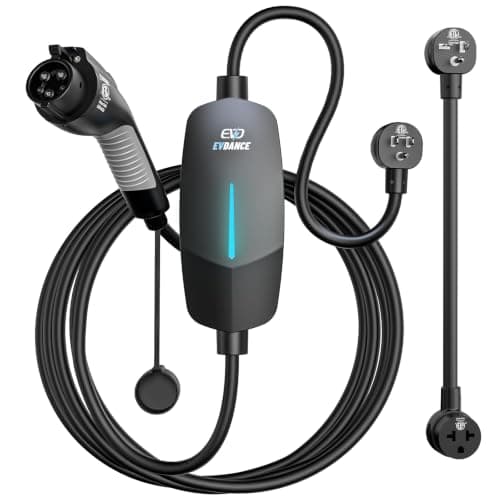
- EVDANCE Level 1 & 2 — best true emergency backup. For the driver who wants something that works from any household socket. 12A at 120V or 16A at 240V, with a 5-15 and a 6-20 plug, and small enough to forget about.
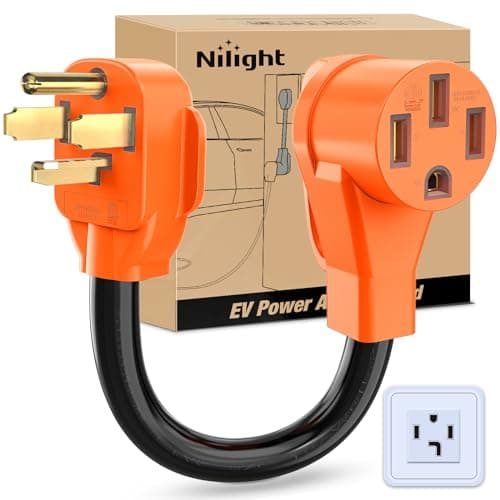
- Nilight 14-30 adapter — the cheapest range upgrade you can buy. For anyone with a 40-amp portable: it turns a four-prong dryer outlet into a charging point. Set the charger to 24 amps when you use it. Full adapter roundup.
The outlets you will actually find, and what each one gives you
This is the table to screenshot before a trip. Every figure is the continuous current the circuit allows at 80% of its breaker, which is what the charger must be set to:
| Outlet you find | Where it usually is | Set charger to | Range added per hour |
|---|
| NEMA 5-15 (standard household) | Anywhere | 12A at 120V | ~4 miles |
| NEMA 5-20 | Garages, workshops | 16A at 120V | ~5 miles |
| NEMA 10-30 / 14-30 (dryer) | Laundry rooms, motels | 24A at 240V | ~17 miles |
| NEMA 6-50 (welder) | Workshops, farm buildings | 32–40A at 240V | ~23–29 miles |
| NEMA 14-50 (range / RV) | Campsites, RV parks, kitchens | 40A at 240V | ~29 miles |
The row that changes a trip is the dryer outlet. It is in essentially every motel laundry room and every relative's house, it is almost never thought of as a charging point, and at 24 amps it adds about 170 miles over a ten-hour night. That is a real day of driving recovered from a plug nobody else is competing for. The RV pedestal row matters nearly as much: a campsite 14-50 is a full-speed Level 2 charge for the price of a site.
Adjustable current is a safety feature, not a convenience. An unfamiliar outlet is an unknown breaker, unknown wire gauge and unknown age. A charger you can set to 16 amps lets you draw conservatively from a circuit you cannot inspect; a fixed 40-amp charger gives you one option and it is the aggressive one. If the outlet gets warm, stop and step down. Our 16 vs 32 vs 40 amp explainer covers the trade-offs, and charging from a regular outlet covers the 120-volt case.
How the picks compare on paper
Published specifications from the live listings, with live prices. For travel, read the amperage range column first and the plug types second — those two decide where the unit can be used at all.
| Pick | Best for | Published range / plugs | Price |
|---|
| WOLFBOX Portable (Level 1/2) | One charger for home and travel | 6–40A · 9.6kW · J1772 · Level 1/2 · NEMA 14-50 + 5-15 · ETL · IP66 · 25ft | $299.99 |
| Lectron NACS Portable (8–40A) | Renters and anyone who travels | 8–40A adjustable · NACS (J3400) · NEMA 14-50 + 5-15 · ETL certified · 20ft | Not verified today |
| MUSTART 40A Portable | The cheapest capable portable | 40A / 9.6kW · J1772 · NEMA 14-50 plug · 21ft cable, LCD | Not verified today |
| EVDANCE Level 1&2 (12A/16A) | Most people buying a 110V charger | 12A @ 120V / 16A @ 240V · J1772 · NEMA 5-15 + 6-20 · ETL listed · 25ft | $107.99 |
| Nilight NEMA 14-30P → 14-50R Adapter | A four-prong (14-30) dryer outlet | 14-30P → 14-50R · 4 × 10 AWG copper · 12 in · STW jacket · Set charger to 24A | $24.99 |
#ad Prices read live from the Amazon Product API as of October 16, 2026, and they move. Specs are the manufacturer's published claims from the live listing — we have not bench-measured them. Where we have no verified price we print none rather than a number that has gone stale.
What to look for in a travel EVSE
Adjustable amperage, with the setting easy to reach. The whole case for a travel charger rests on this. WOLFBOX publishes 6–40A and Lectron 8–40A; a unit with one fixed output can only be used where you are certain of the circuit. If the setting requires an app and you have no signal, that is a problem — prefer a control you can reach on the unit itself.
The plugs in the box, then the adapters you add. A 14-50 plus a 5-15 covers the two extremes. The useful middle — dryer outlets and welder receptacles — comes from outlet adapters, and two of them cost less than the difference between most chargers. Remember that an adapter never raises a circuit's limit: on a 30-amp dryer circuit you set the charger to 24 amps no matter what the plug on the end looks like. The full rules are in can I use a dryer outlet for EV charging.
A real safety listing, and weather rating if it lives outside. ETL or UL, named on the listing. A portable gets rained on, packed wet and dragged across gravel in a way a wall unit never does; an IP66 rating is worth more here than at home. See can you leave a portable charger outside.
Cable length, and how it packs. Twenty-five feet is generous for travel and awkward to coil; shorter is easier to stow but leaves you dependent on parking close to the outlet. Either way, keep it in a bag — a connector rolling loose in a trunk picks up grit that ends up in the contacts. The Lectron portable is the J1772 counterpart to the NACS unit above if that is your connector, and for a cord that plugs into an ordinary household outlet the SEGUMA Level 1/2 is the smallest thing that will get you moving.
The right connector for your car. J1772 for most non-Tesla EVs, NACS for Tesla-style ports; our NACS vs J1772 explainer covers which you have. A J1772 portable plus a listed J1772-to-Tesla adapter also works and is often the cheaper route for a mixed household.