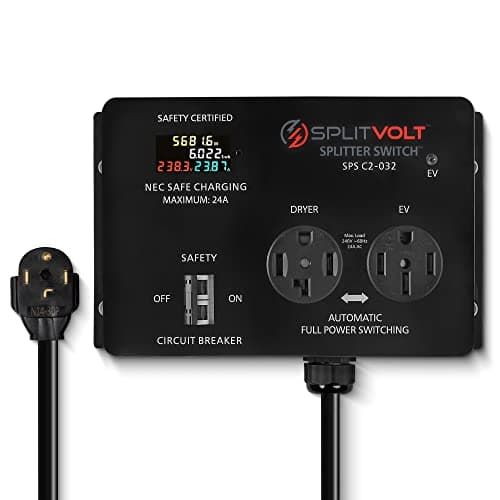
The Splitvolt Splitter Switch is the only product we rank that turns "I cannot install a charger" into "I have Level 2 charging tonight." It plugs into an existing 240-volt dryer receptacle, gives you a dryer outlet and an EV outlet, and switches the circuit between them automatically, with an internal safety breaker holding EV charging to 24 amps. No electrician, no permit, no panel work. It is also expensive for what it is, and 24 amps is a real ceiling — so it is a strong buy for exactly one kind of household and a poor one for everybody else.
Most advice about charging without a dedicated circuit ends at "use an adapter." An adapter works, and we rank several in the best EV charger outlet adapters, but it leaves you unplugging the dryer to charge and unplugging the car to do laundry. The Splitvolt is that idea with the switching built in, which is why it already appears as a pick on our 100-amp panel roundup and load management roundup. This is the full picture, including the parts that should put you off.
Who it is for
One household, specifically: the one where a dedicated 240-volt circuit is genuinely off the table. That covers more people than it sounds like. A renter cannot rewire a landlord's panel. A condo owner may have a panel in a shared utility room with no spare space and an HOA between them and any change to it. A homeowner with a full 100-amp service and a laundry room that happens to adjoin the garage has the capacity problem but not the budget for a service upgrade. For all three, the alternative to this device is not a cheaper charger — it is a 120-volt wall socket and four miles of range an hour.
It is not for the household with room in the panel. If an electrician can land a 50-amp breaker and run a NEMA 14-50 receptacle to the garage wall, do that instead: it is faster, it is permanent, it is not competing with the laundry, and over the life of the car it is the cheaper decision. The installation cost guide covers what that job runs, and EV charger vs 240V outlet covers whether you need a wall unit at all.
What it actually is
A sealed box with a 240-volt plug on a short tail and two receptacles on the front: one for your dryer, one for your EV charger. It plugs into the existing dryer receptacle. From the live Amazon listing and Splitvolt's own documentation, the published specification is:
- A NEMA 14-30/14-50 configuration— the four-prong dryer standard, which is what you will find on a dryer circuit installed under any recent code cycle.
- 240 V, 24 A for EV charging, enforced by an internal breaker rather than by your good intentions. Twenty-four amps is the continuous limit a 30-amp circuit allows under the 80% rule, so this number is the code, not a conservative choice by Splitvolt.
- Automatic switching between the dryer and the car, so only one device draws at a time. The listing also covers switching between two EVs.
- cETLus certification, with an LED display showing real-time power.
That certification is the quiet reason to buy this one rather than something cheaper. There is a whole category of unlisted dryer splitters on marketplaces, sitting on a circuit carrying continuous current for eight hours at a stretch, with no named safety listing anywhere in the listing copy. A device that decides how your house's laundry circuit is shared is not the place to save forty dollars.
What 24 amps buys you
Twenty-four amps at 240 volts is about 5.8 kW. In the terms that matter:
- Roughly 18–20 miles of range per hourfor a typical efficient EV, against about 30–38 for a 40-amp charger and 3–4 for a household outlet.
- An overnight window of ten hours is therefore in the region of 180–200 milesadded — more than almost anybody drives in a day, and the reason this ceiling is far less painful in practice than it looks on paper.
- Where it hurts is the deep refill. Filling a large pack from near-empty at 24 amps is a two-night job. If you routinely arrive home empty and leave early, this is the wrong product.
You also have to set your charger to 24 amps or less. Most adjustable chargers do this in the app or with a dial; a fixed 40-amp charger does not, and pairing one with this device is not a valid install. Our guide to setting the amps covers which units adjust and how, and the 32-amp roundup is a good source of chargers that dial down properly.
Living with it
The thing nobody mentions in the product copy is geography. This device shares the laundrycircuit, which means the charger has to reach the car from wherever the dryer outlet is. In a house where the laundry room backs onto the garage, that is a twenty-foot cable run and a non-issue. In a house where the laundry is upstairs, it is not a solution at all. Measure before you buy — this is the most common reason this kind of product gets returned, and a long-cable charger only partly fixes it.
The second thing is sequencing. Only one device draws at a time. In practice that is usually fine, because laundry happens in the evening and charging happens overnight, but it does mean a load of washing started at 11pm pauses the car. If that matters to your household, a second 240-volt circuit is the honest answer.
The third is that this is a plug-in device on a receptacle installed for a dryer — an appliance that draws hard for an hour, not steadily for eight. If your dryer outlet is old, loose, or warm to the touch after a cycle, have it looked at before you add an EV to it. That is the same warning we give about every shared-circuit route, and it is set out in full in can I use a dryer outlet for EV charging.
The price problem
Here is the part a review owes you. This device costs roughly what a competent 40-amp smart charger costs. You are not saving money against a charger — you still need the charger — you are saving money against an electrician. In a market where a dedicated circuit runs into four figures because the panel needs work, that is an easy win. Where a 14-50 receptacle on an adjacent wall is a straightforward morning's work, the arithmetic flips, and you have spent charger money to be capped at 24 amps forever.
There is also a much cheaper version of the same idea: a plain NEMA 14-30 to 14-50 adapter is a fraction of the price and gets the same 24 amps to the car. What it does not do is switch, meter, or stop you drawing more than the circuit allows — you have to unplug the dryer, and you have to remember to set the charger down to 24 amps yourself, every time. For some people that trade is obviously correct. For a household where somebody else might plug the dryer back in, the automatic switch and the internal breaker are the whole value.
Alternatives worth checking first
- A dedicated circuit. Always the better outcome where it is possible. Start with the wire size and breaker guide.
- A load-managed charger. If the problem is service capacity rather than breaker space, a charger that measures your whole panel can often satisfy the load calculation at full amperage instead of capping you at 24 — the load management roundup covers it.
- A plain dryer adapter. Cheaper, manual, same amperage. Ranked in the outlet adapter roundup.
- Level 1, honestly assessed. If you drive under about 30 miles a day, a 120-volt outlet may genuinely be enough and costs nothing — can you live with only Level 1 charging.
The verdict
Recommended, narrowly and sincerely. If you are a renter, a condo owner, or anyone whose panel has no room and whose dryer outlet is near the car, this is the product that moves you from about 4 miles of range an hour to about 19, for the price of a charger and no electrician — with a named safety listing and an internal breaker that enforces the limit so you cannot get it wrong. That is a genuinely useful thing to exist.
If you have a spare 50-amp slot in the panel and a garage wall, skip it. Pay the electrician once, get 40 amps permanently, and spend the Splitvolt money on a better charger.
Before you buy: four things to check
1. The shape of your dryer outlet. This device is for a four-prong NEMA 14-30 receptacle. Many older homes have a three-prong NEMA 10-30, which has no separate ground, and no splitter or adapter makes that circuit a good place for an EV. If your outlet has three prongs, the right next step is an electrician, not a workaround — see NEMA 10-30 vs 14-50.
2. The distance from that outlet to the car. Measure the actual route, around the wall and over the obstacles, not the straight line. Then compare it against your charger's cable length with a few feet of slack. The cable length guide covers how to do this without guessing.
3. Whether your charger can be set to 24 amps. Non-negotiable. An adjustable charger is required; a fixed 40-amp unit is not compatible with a 30-amp circuit no matter what adapter sits in between.
4. What your landlord or HOA requires. Nothing here is a permanent alteration, which is most of the appeal, but shared-building rules about charging in a garage vary and are worth confirming in writing before the box arrives. EV charging for condos and HOAs and the best EV charger for renters cover the ground.