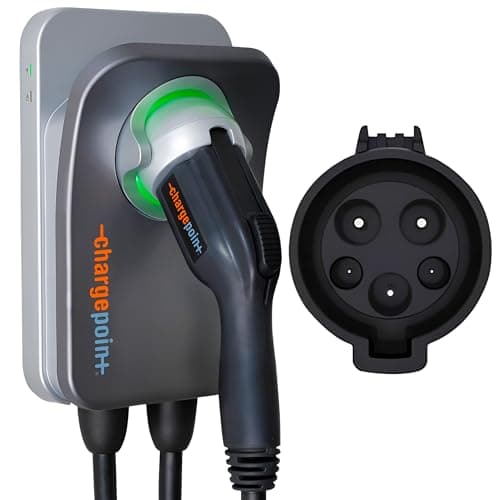
This is a choice between two philosophies, not two spec sheets. Buy the ChargePoint Home Flex if you want a fast, adjustable, app-connected charger tied into the biggest public network in North America. The Grizzl-E Classicwas the sealed metal box that just charges, with no app and no cloud — but it is now discontinued.
Update, August 2026:the Grizzl-E Classic has been discontinued on Amazon — the listing is gone and every 40-amp Grizzl-E still sold there is a Wi-Fi model. The comparison below is kept for reference rather than as a live buying recommendation. If the no-app side of this matchup is what you want, the charger to buy now is in our app-free roundup.
One of these chargers is defined by its software and the other by its refusal to have any. That is the real decision here, and it maps cleanly onto what kind of owner you are. We compile published specs, safety listings and owner reports and do the math — we have not bench-tested either unit.
Speed
The ChargePoint is the faster unit on paper: its amperage is adjustable in the app up to 50 amps, and hardwired on the right circuit it charges quicker than the Grizzl-E's fixed 40 amps. But the gap only exists if your panel can carry a 60-amp circuit and your car can accept the extra current. Install the ChargePoint on a 50-amp circuit, or drive a car that caps AC charging at 40 amps, and the two charge at the same rate. For overnight charging, both fill the car by morning.
Smart features and network
This is the ChargePoint's home turf. It brings scheduling, energy tracking, and — the real differentiator — a single account that also works across ChargePoint's large public charging network, so one app covers home and away. The Grizzl-E has none of this by design: no app, no Wi-Fi, no account. If smart features and a unified charging app are what you want, the ChargePoint wins outright, because the Grizzl-E is not competing on that field at all.
Build and durability
Here the Grizzl-E answers back. It is a cast-aluminum, UL-certified box rated for indoor and outdoor use — genuinely rugged, the kind of enclosure that shrugs off a carport winter. And because it has no app or cloud service, there is nothing on the software side to break, go unsupported, or need updating. A smart charger is only as reliable long-term as the company keeping its app alive; a sealed charger is reliable as long as the electricity flows. The ChargePoint is well-built and NEMA 3R outdoor-rated too, but part of its longevity depends on continued app and account support. Its one recurring owner gripe on the Grizzl-E side is a stiff cable in the cold.
Value
The Grizzl-E generally costs less up front and spends its budget on the enclosure rather than software. The ChargePoint sits higher, and you are paying for brand maturity, the adjustable amperage, and the public-network integration. If you will use the app and the network, that money buys something real; if you never would, it is spend you will not feel the benefit of, and the Grizzl-E is the better value. This is the classic smart-versus-simple trade, and neither answer is wrong — they are for different people.
The split in one line: the ChargePoint is the connected, adjustable, network charger; the Grizzl-E is the tank that ignores software entirely. Decide whether you want features or the absence of them, and the winner picks itself.
The verdict
Choose the ChargePoint Home Flexif you value speed headroom, a polished app, and one account for home and public charging — it is the more capable, more connected unit. Choose the Grizzl-E Classic if you want a rugged, no-app charger that will still be working long after the smart units have outlived their app support, at a lower price. Both are UL-listed and dependable; the deciding question is simply whether software is a feature you want or a liability you would rather avoid. If you are torn, our home charger roundup ranks both against the full field.