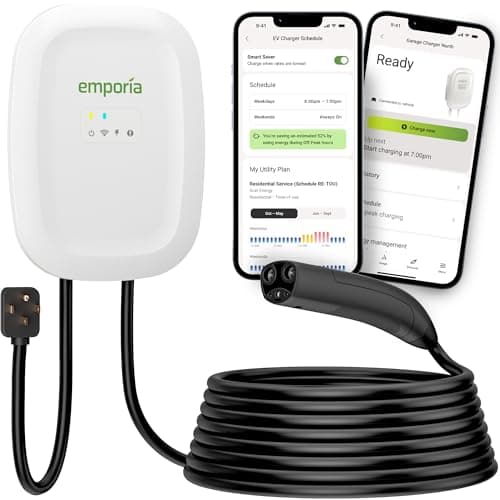
The Emporia NACS is the charger to buy if your car has a Tesla-style (NACS / J3400) port and you want the unit we already rate best for most homes — now with a native NACS plug, so no adapter dangles off the handle. It is UL listed and Energy Star certified, 48-amp capable when hardwired, and runs the same energy monitoring and scheduling as the J1772 Emporia. The catch is the familiar one: the full 48 amps needs hardwiring, and the app is central to the setup.
In our best NACS home chargers roundup the Emporia NACS is the top pick, and its J1772 sibling leads our flagship roundup. This is the closer look. We compile published specs, safety listings and owner reports and do the math — we have not bench-tested the unit.
Who it is for
This is for the household whose car came with a NACS port — a Tesla, or a 2025-and-later model from the many brands adopting the standard — and who wants to skip the adapter entirely at home. If your car is J1772, buy the standard Emporia instead; you gain nothing from the NACS plug and would just need an adapter to use it. The connector question, if you are unsure which plug you have, is covered in our NACS vs J1772 guide.
The specs that matter
Emporia rates it at 48 amps hardware capability, with a native NACS (J3400) connector, a NEMA 14-50 plug, a 25-foot cable, and both UL and Energy Star listings. Two things define it:
- A factory NACS plug, so no adapter.A Tesla or a NACS-port EV plugs straight in with nothing hanging off the handle — cleaner and one less thing to lose than a J1772 charger plus a J1772-to-NACS adapter. And unlike several cheap NACS units on Amazon, it is UL listed and Energy Star certified.
- 48 amps is the hardware ceiling, not what the plug delivers. On a NEMA 14-50 plug the 50-amp circuit caps continuous draw at 40 amps; the full 48 needs the hardwired version on a 60-amp circuit. This trips people up, so it is worth being clear about before you buy.
What is good
It is the Emporia we rate best, with the connector transition solved at the plug. You get genuine energy monitoring and scheduling in the app — Emporia started in home energy tracking, and it shows — a 25-foot cable that reaches across a two-car garage, and UL plus Energy Star listings on a native NACS unit, which is a combination several cheaper NACS chargers cannot match. For a NACS-port household that wants the value-leading smart charger without an adapter, it is the natural pick.
Where it falls short
Two honest caveats. First, if you are buying it for the 48-amp number but not hardwiring it, you will not get 48 amps — on a 14-50 plug it charges at 40 like everything else on a 50-amp circuit, and at that point a cheaper Lectron Nexus or EVIQO NACS does the same job for less. Second, the app and Wi-Fi are centralto the experience, so setup is more involved than a sealed plug-and-go box, and part of the unit's long-term usefulness depends on that app staying supported.
Installation notes
As a plug-in unit it wants a properly rated NEMA 14-50 outlet on a 50-amp circuit (40-amp charging); to reach the full 48 amps it is hardwired to a 60-amp circuit by a licensed electrician. Either way, confirm your panel has the capacity first — a service upgrade is the line item that turns a cheap install expensive. See the installation cost guide for the ranges.
Bottom line
The Emporia NACS takes our top-rated home charger and puts the future's default plug on the end of it. If your car has a NACS port, it is the value-leading way to charge at home without an adapter — provided you either accept 40 amps on a plug or hardwire for the full 48. If your car is J1772, buy the standard Emporia. Either way, see how it ranks against the native-NACS field in our best NACS home chargers roundup.