A 100-amp service does not disqualify you from home charging, and the panel upgrade you were quoted may not be necessary at all — that is a load-calculation question, and plenty of 100-amp homes pass it. If yours does not, there are three legitimate ways through: a charger that manages the load, a charger you turn down to fit the breaker you can spare, or a certified splitter on a circuit you already have. Our pick when the calculation fails is the Emporia Pro, because its PowerSmart system reads the whole panel and throttles the charger instead of asking you to rebuild the service.
This page is for houses with an older 100-amp service — typically anything built before the mid-1990s that never had its panel touched. We compile published manufacturer specifications, safety listings and the relevant code requirements, and do the amperage math; we do not have a lab and we have not bench-tested these units. Nothing below is a substitute for a licensed electrician's load calculation on your actual house, and your local inspector has the final say on every method described here. Before the picks, the four things that decide what you can install.
Rule 1: the number on the panel is not the answer — the load calculation is
"I have a 100-amp panel" tells you almost nothing on its own. What matters is how much of that 100 amps your house is already calculated to use. An electrician works this out with the standard method for adding a load to an existing dwelling, adding up the general lighting and receptacle load, the fixed appliances, the range, the dryer, the water heater and the heating or air conditioning, applying the demand factors the code allows, and seeing what is left underneath the service rating.
The outcome swings enormously on how much of your house is electric. A 100-amp home with gas heat, a gas water heater and a gas range often has room for a 30- or 40-amp EV circuit without touching anything. An all-electric house with a resistance furnace, an electric range, an electric water heater and central air is usually the one that fails. There is also a second, more forgiving route the code allows in many cases: instead of the paper calculation, an electrician can use twelve months of your utility's recorded maximum demand data for the property. Houses fail the assumption-based calculation and pass the metered one all the time, because the paper method assumes appliances that in practice never run together.
A load calculation costs one service call. Every option on this page costs more than that, and two of them are unnecessary if the calculation passes. Do it first. Our installation cost guide covers what the surrounding work runs, and can I install an EV charger myself covers where the DIY line actually sits.
Rule 2: a charger is a continuous load, so the breaker is always bigger than the charger
EV charging is treated as a continuous load, which means the circuit has to be rated for 125% of the charger's draw — or, read the other way round, a charger may only draw 80% of its breaker. That relationship is fixed, and it is the arithmetic that decides what fits:
- 16 amps of charging needs a 20-amp circuit
- 24 amps needs a 30-amp circuit
- 32 amps needs a 40-amp circuit
- 40 amps needs a 50-amp circuit — the NEMA 14-50 default
- 48 amps needs a 60-amp circuit
On a 100-amp service, a 60-amp EV circuit is 60% of the whole service on paper, which is why 48-amp chargers are usually the first thing to fall off the list. A 40-amp breaker feeding a 32-amp charger is a far easier number to get past a load calculation, and as Rule 4 explains, it is not the sacrifice it sounds like. The wire and breaker sizing is worked through in our wire size and breaker guide.
Rule 3: there are three honest ways to fit a charger onto a small service
Turn the charger down.Several chargers let you set the maximum amperage to match whatever breaker your panel can spare. ChargePoint publishes the whole ladder for the Home Flex — 16 amps on a 20-amp breaker, 24 on a 30, 32 on a 40, 40 on a 50, 48 on a 60 — with the caveat that only the 32- and 40-amp settings are available on a plug-in NEMA 14-50 install; everything below that has to be hardwired. One unit therefore fits almost any panel, and it can be turned up later if the service is ever upgraded.
Manage the load.A load-management system measures what the rest of the house is drawing and reduces the charger's current in real time so the total never exceeds the service. The code recognizes this idea: where a listed system limits the maximum load, the calculation can be based on that managed maximum rather than the full nameplate rating of the equipment. The exact wording and article references have moved between recent editions of the National Electrical Code — the energy-management language that sat behind the 2023 edition is expressed as a power control system in the 2026 edition — so which edition your jurisdiction has adopted, and what your inspector will sign off, is a conversation to have before you buy. Emporia states plainly that PowerSmart is accepted as a substitute for a panel upgrade in most jurisdictions; that is the manufacturer's claim about the general case, not a determination about your house.
Share a circuit you already have. If the panel has no spare breaker space at all, a certified splitter switch sits on an existing 240-volt dryer receptacle and hands the circuit back and forth between the dryer and the car. It adds no load to the service, because it is re-using a circuit the calculation already accounts for.
And the method that is not on this list: running a charger set higher than the breaker allows, feeding a charger through an extension cord, or landing an EV circuit on a panel with no room by doubling up. A charger that draws more than 80% of its breaker on a continuous basis is not "fine because the breaker will trip" — it is an install that will not pass inspection and should not be in your house. We go through this in EV charger tripping the breaker.
Rule 4: you almost certainly need fewer amps than you think
This is the part that makes a constrained panel much less painful than it sounds. For a car averaging roughly 3 miles per kilowatt-hour, a 24-amp charger on 240 volts delivers about 5.8 kilowatts, or roughly 15 miles of range an hour — about 150 miles across a ten-hour night. Even 16 amps, the smallest sensible 240-volt setting, is around 3.8 kilowatts or roughly 10 miles an hour, which is about 100 miles overnight. The US average is well under 40 miles of driving a day.
Put bluntly: for most households, the difference between a 48-amp charger and a 24-amp one is the difference between a car that is full at 1 a.m. and a car that is full at 5 a.m. Both are full when you leave. Amperage matters when you drive very long distances daily, when two cars share one circuit, or when you need to top up quickly between trips — not for an ordinary overnight charge. Our what amp EV charger do I need guide does the arithmetic for your own mileage, and how long it takes to charge an EV puts the numbers next to real battery sizes.
The honest takeaway:get the load calculation before you buy anything. If it passes, buy an ordinary charger and stop reading — you have no problem to solve. If it fails, load management is what buys back full speed, turning a charger down is what buys back simplicity, and a certified dryer-circuit splitter is what you use when there is genuinely no room in the panel. A service upgrade is a legitimate answer too; it is just rarely the cheapest one, and it is worth knowing whether you need it before you pay for it.
The picks, in order
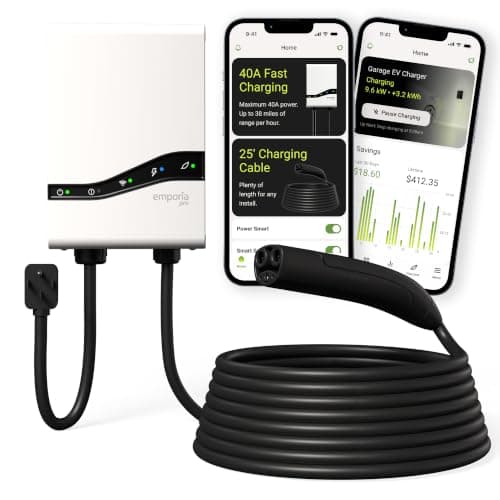
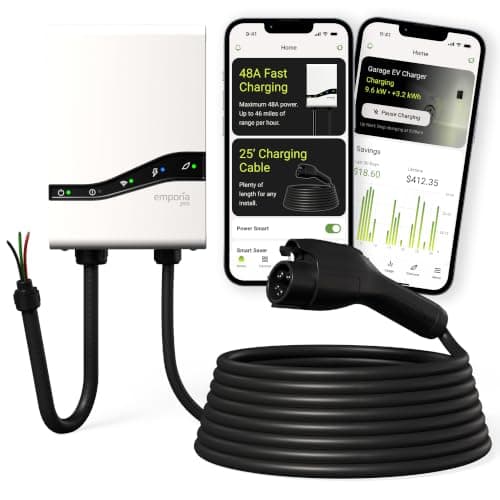
1. Emporia Pro (48A, PowerSmart) — the charger that changes the electrical answer
This is the pick when the load calculation says no. The Pro ships bundled with Emporia's Vue energy monitor and a pair of 200-amp sensors that clamp onto the mains inside your panel; the charger then reads the whole house in real time and allocates only the capacity that is actually spare. When the dryer, the oven and the air conditioning are all running, it backs off. When they stop, it takes the power back. Emporia's own framing is that this makes full-rate charging workable on older 60- and 100-amp services, and that PowerSmart is accepted as an alternative to a panel upgrade in most jurisdictions. Hardwired on a 60-amp circuit it still runs the full 48 amps — about 11.5 kW — and it is UL listed, ENERGY STAR certified, NEMA 4 rated, with a 25-foot cable and a J1772 connector.
The honest caveats. It is the most expensive unit on this page, and the premium buys panel headroom rather than speed — if your calculation already passes, the standard Emporia Level 2charges identically for much less. The Vue monitor goes inside the panel, so this is licensed-electrician work with no DIY path. And "accepted in most jurisdictions" is a claim about the general case: confirm with your inspector before you buy, because if your AHJ will not accept load management in place of a service upgrade, the feature you paid for does not help you.
2. Emporia Pro NACS — the same trick for a Tesla or NACS car
Identical hardware and identical PowerSmart load management, with a native NACS (J3400) connector on the end of the cable instead of a J1772 one. If your car came with a Tesla-style port, this removes an adapter from the chain permanently — one fewer junction, one fewer thing to lose, and no dongle hanging off the handle in the cold. Everything in Rule 3 about managed load applies exactly the same way, and it carries the same 48-amp hardwired ceiling and 25-foot cable. Our full Emporia Pro NACS review covers the unit in isolation, and best NACS home chargers ranks the wider native-plug field.
Against it: the same price premium, the same in-panel install, and the same dependence on your inspector accepting load management. It is also NACS-only, so a household that mixes a Tesla with a J1772 car needs an adapter for the second vehicle — a real consideration if the whole reason you are here is that you cannot add a second circuit. If that is your situation, buy the J1772 version above and adapt the Tesla instead; the adapters that do that job are ranked in our J1772 to Tesla adapter roundup.
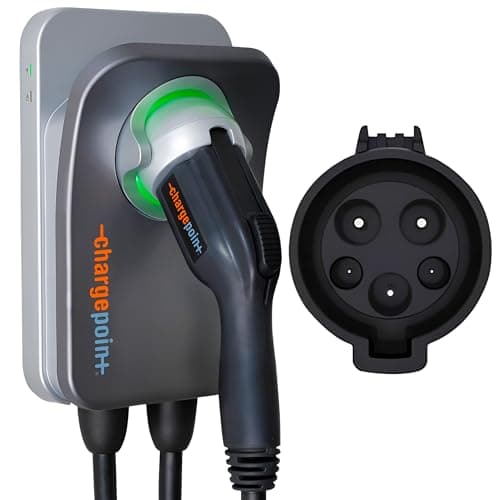
3. ChargePoint Home Flex — the one you can turn all the way down to 16 amps
If your panel can spare a breaker but not a large one, this is the most flexible charger you can buy. ChargePoint publishes the full ladder of settings — 16, 24, 32, 40, 48 and 50 amps — each tied to its matching breaker, so the installer simply selects the highest setting your panel has room for. That means a Home Flex on a 20-amp circuit is a legitimate, code-shaped install rather than a compromise, and if you ever upgrade the service you change a setting in the app rather than buying a new charger. Add ChargePoint's support history, the largest public charging network app in North America, and a NEMA 3R outdoor-rated enclosure.
The caveats matter here. Only the 32- and 40-amp settings are available on a plug-in NEMA 14-50 install — every setting below that has to be hardwired, which for a constrained panel is exactly the range you are shopping in, so budget for the electrician rather than assuming a plug-in job. It also costs more than equally capable chargers from newer brands, the experience leans on a ChargePoint account, and turning a charger down does nothing for the panel itself: if the load calculation fails even at 16 amps, only load management or a service upgrade will fix that. The full unit is in our ChargePoint Home Flex review.
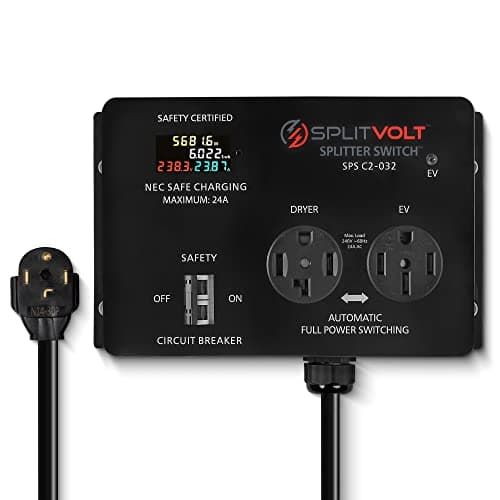
4. Splitvolt Splitter Switch — when there is no room for another breaker at all
Some panels are not short of capacity so much as short of space: every slot is full, and the answer to "where would the EV breaker go" is nowhere. A splitter switch sidesteps that. It plugs into an existing NEMA 14-30 dryer receptacle and provides an outlet for the dryer and an outlet for the EV charger, switching the circuit between them automatically, with an internal safety breaker that holds EV charging to 24 amps — the continuous limit on a 30-amp circuit. It is cETLus certified, which matters: several cheaper dryer switches on Amazon do not name a certification body in the listing at all, and an unnamed listing is an unverified claim. There is no electrician, no permit conversation and no new load on the service, because the circuit already exists.
Be clear about the trade-offs. Twenty-four amps is the ceiling, so your charger must be set to 24 amps or less — this pairs naturally with the adjustable units above, and not at all with a fixed 40-amp charger. Only one device draws at a time, which is fine overnight and irritating if you do laundry at midnight. It costs about as much as a decent charger, so the saving is measured against an electrician's bill, not against cheaper hardware. And it is only useful if the dryer outlet is somewhere you can actually park near, which in a basement laundry room it often is not. Our guide to using a dryer outlet for EV charging is the fuller version of this discussion.
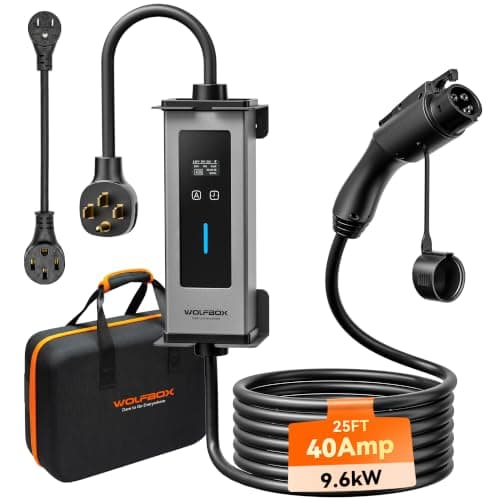
5. WOLFBOX Portable (Level 1/2) — adjustable, cheap, and not bolted down
The portable answer to the same problem. The WOLFBOX PE40 has adjustable current from 6 to 40 amps, which is the widest range here, so you can dial it to whatever the circuit in front of you allows — including down to 24 amps to sit behind a splitter switch, or 16 amps on a small 240-volt outlet. It ships with both NEMA 5-15 and NEMA 14-50 plug adapters, so the same unit covers an ordinary household socket and a 240-volt one, and its listing states ETL certification, an IP66 rating and a 25-foot cable. There is also a delay timer for off-peak rates that needs no app. For a household that is not sure what its electrical situation will be in two years, a charger that adapts and moves is a genuinely sensible hedge.
The compromises are the portable ones: it is a brick on a hook rather than a tidy wall box, there is no app or per-session energy data, and drawing the full 40 amps needs a properly rated 14-50 receptacle — do not run it flat out on a worn dryer-era outlet. It is also easier to walk off with than a bolted-on charger. The wider field is in our best portable EV chargers roundup.
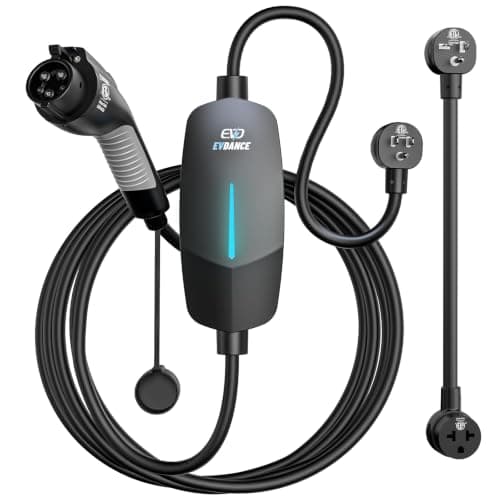
6. EVDANCE Level 1&2 (12A/16A) — the smallest legitimate 240-volt circuit
The cheapest way onto 240 volts when the panel can spare almost nothing. This EVDANCE runs at 12 amps from a standard 120-volt household outlet and at 16 amps from a 240-volt NEMA 6-20 — and a 20-amp 240-volt circuit is a small, cheap thing to add, both in breaker space and in what it does to a load calculation. Sixteen amps at 240 volts is roughly 3.8 kilowatts, call it 10 miles of range an hour, or about 100 miles across a night: three times what the 120-volt cord in your trunk manages, for a fraction of what a 50-amp circuit costs to install. It is ETL listed with a 25-foot cable, which is longer than most cords in this class.
The honest limit is speed. This will not replace a day of long-distance driving overnight, and if you regularly do 150 miles a day it is not enough charger — you want the load-managed route instead. It has no app, no scheduling and no display, and at 12 amps on 120 volts it is a Level 1 cord like any other, at roughly 3 to 5 miles an hour. Buy it because a 20-amp circuit is what your panel can honestly carry, not because it is cheap. The rest of this class is ranked in our best 110V EV chargers roundup.
What we left out, and why
Dedicated external load controllers— the panel-mounted devices an electrician installs to shed the EV circuit when the house draws hard — are a legitimate and widely used solution, and in some jurisdictions the preferred one. We have not ranked them here because they are licensed-install electrical equipment specified by your electrician rather than something you sensibly choose off a retail listing, and because the ones we looked for do not have live consumer listings we can point you at. Ask your electrician about them; if one is the right answer for your panel, it may cost less than the load-managed chargers above.
Cheap unbranded dryer splitters are all over Amazon at a third of the Splitvolt price. We did not rank them because their listings do not name a certification body, and this is a device carrying 24 amps continuously through your laundry circuit while you sleep. That is not the place to accept an unverified safety claim. 48- and 80-amp hardwired chargers are also absent by design: on a 100-amp service the circuit they require is usually the first thing a load calculation rejects, and buying one to run it at half speed is paying for headroom you cannot use. If your service does have the room, the 48-amp roundup is the right page.
Two companion pages go deeper on the mechanism rather than the panel size. The load-management roundup ranks the three different ways a charger can be made to fit a service with no spare capacity, and what a CT clamp isexplains the sensor every one of those systems depends on — and why fitting it is electrician work.
How to buy a charger for a 100-amp service
Work through these in order. Step one does most of the work, and it is the one people skip.
1. Get the load calculation before you shop
Have a licensed electrician run the calculation for adding an EV circuit to your existing service. If the paper method comes up short, ask whether your jurisdiction allows the calculation to be based on twelve months of recorded maximum demand from the utility instead — a real house usually uses far less than the assumption-based method credits it with. You will come out with a number: the largest EV circuit your service can carry. Everything after this is shopping to that number.
2. Work out how many amps you actually need
Take your worst normal day of driving, divide by roughly 3 miles per kilowatt-hour, and compare it with the hours the car sits at home. A 24-amp circuit replaces about 150 miles overnight; a 32-amp one about 200. If that covers your driving with margin, the smaller circuit is not a compromise, it is the correct size. Buying amperage you never use is the most common way to overspend on a home charging install.
3. Match the mechanism to the constraint
Three different problems have three different answers, and they are not interchangeable. Not enough calculated capacity→ load management, which is what buys back full-rate charging. Enough capacity, but only for a small breaker→ an adjustable charger set to that breaker. No physical space in the panel→ a certified splitter on an existing 240-volt circuit, or a subpanel if you are having electrical work done anyway. Diagnosing which one you have is exactly what step one produces.
4. Do not skip the safety listing
On a constrained panel, everything you install is working closer to its limits, which is precisely when certification stops being a formality. Insist on a named listing — UL or ETL on a charger, cETLus on a splitter — and treat any listing that does not name a certification body as making no claim at all. Every pick above names one.
5. Price the upgrade anyway, so you are choosing rather than avoiding
A service upgrade is not a failure state. It adds capacity for everything else you might electrify later — a heat pump, an induction range, a second car — and it removes this entire category of workaround permanently. Get the quote alongside the load-managed charger quote and compare them honestly; sometimes the difference is smaller than expected, especially if the panel is old enough that an insurer or an inspector will want it replaced eventually anyway. Our installation cost guide breaks down what goes into that number.
So, which one?
If your load calculation fails and you want full-speed charging, buy the Emporia Pro — or the Emporia Pro NACSif your car has a Tesla-style port — and confirm with your inspector first. If you have room for a modest breaker and want one charger that fits any of them, buy the ChargePoint Home Flex and set it to what the panel can carry. If the panel is physically full and your dryer outlet is somewhere you can park, the Splitvolt Splitter Switch is the only pick here that needs no electrician. If you want the cheapest flexible option that also travels, the WOLFBOX Portable dials from 6 to 40 amps. And if a small 240-volt circuit is genuinely all your service can give, the EVDANCE Level 1&2 makes honest use of it. Not sure a constrained panel is really your problem? Start from the full home charger roundup.