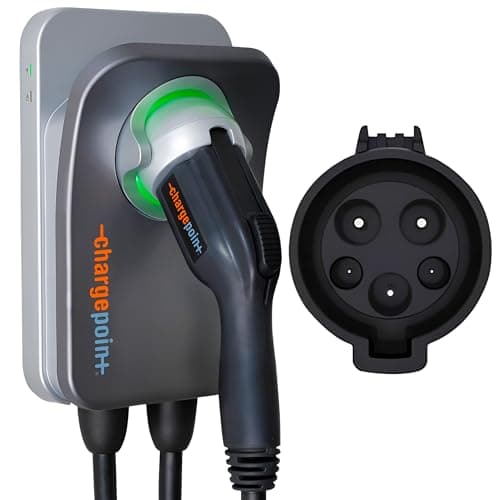
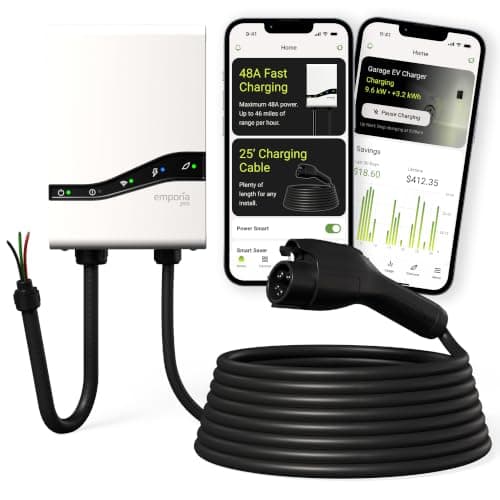
These two land within a few dollars of each other and are not really competing on speed. Buy the Emporia Pro if your electrical panel is the constraint: PowerSmart load management and the energy monitor that drives it are in the box, and together they can make a fast charger workable on a service that would otherwise need upgrading. Buy the ChargePoint Home Flex if your panel already has room and you want the mature app, 24/7 support and one account that also covers the largest public charging network in North America.
This is the J1772 pairing buyers actually ask about — two well-certified, ENERGY STAR, app-connected chargers with three-year warranties, at a similar price, from brands with very different characters. We compile published manufacturer specifications, safety listings and the live retail listings, and we do the amperage and install math; we do not have a lab and have not bench-tested either unit. Where a maker does not publish a figure, we say so instead of filling it in. If your car has a Tesla-style port instead, the same match-up in NACS form is our ChargePoint NACS vs Emporia Pro NACS comparison.
First, check which version you are actually buying
This is the detail that quietly decides the whole comparison, and almost no comparison article mentions it. Both chargers are sold in more than one configuration, and the configurations do not perform the same.
The Home Flex is a 16-to-50-ampunit on paper — the installer picks 16, 24, 32, 40, 48 or 50 amps to match the breaker. But ChargePoint is explicit that a plug-in install only works on 40- or 50-amp circuits, which means the plug-in version can only be set to 32 or 40 amps; every setting outside that pair has to be hardwired. The listing we link on this page is the NEMA 14-50 plug-in Home Flex, so treat it as a 40-amp charger with a 32-amp fallback, not a 50-amp one.
The Emporia Pro listing we link is the hardwiredJ1772 version, which is the one that reaches the full 48 amps; Emporia publishes up to 48 amps hardwired on a 60-amp circuit and up to 40 amps for the NEMA 14-50 variant, exactly like every other plug-in charger on a 50-amp circuit. So as sold on this page, it is a 48-amp charger against a 40-amp one — but only if your panel can carry a 60-amp circuit, which is the whole subject of the next section.
Speed: a real difference, but probably not for you
Hardwired at 48 amps the Emporia Pro delivers about 11.5 kW; the plug-in Home Flex at 40 amps delivers about 9.6 kW. In range terms that is roughly 30 miles an hour against roughly 25, for a car averaging about 3 miles per kilowatt-hour. Across a ten-hour night it is the difference between roughly 300 and roughly 250 miles restored — both far more than the average US driver uses in a day.
Two things flatten the gap further. First, your car's onboard AC charger sets the real ceiling: plenty of EVs cap at 7.7 kW or 11 kW, and a car that maxes out at 7.7 kW charges at the same rate from either of these units. Second, the 48-amp figure requires a 60-amp circuit, and a household that has 60 amps to spare usually did not need load management in the first place. Work out what you actually need with our what amp EV charger do I need guide before you let the bigger number decide.
The Emporia Pro's edge: it changes what your panel can do
The Pro ships as a bundle with Emporia's Vue 3 energy monitor, which an electrician installs inside your panel with a pair of 200-amp sensors on the mains. PowerSmart then reads the whole house in real time and gives the charger only the capacity that is genuinely spare: when the dryer, oven and air conditioning are running it backs the car off, and when they stop it takes the power back. Emporia's own position is that this makes full-rate charging workable on older 60- and 100-amp services and that PowerSmart is accepted as a substitute for a panel upgrade in most jurisdictions.
Two honest qualifications on that. It is the manufacturer's statement about the general case, not a determination about your house — your local inspector decides whether managed load is accepted in place of a service upgrade, and that is a question to settle before you buy rather than after. And the Vue has to go inside the panel, so there is no version of this you install yourself on a Saturday. What you are buying is a smaller electrical bill, not a faster charger; if the electrician says your panel has plenty of room, you are paying for a feature that will never trigger. That whole decision is laid out in our best EV chargers for a 100-amp panel roundup.
The ChargePoint's edge: the network, the app and the install ladder
ChargePoint's advantage is not hardware, it is everything around it. One account covers your home charger and the largest public charging network in North America, so the app you use to schedule overnight charging is the app you use to start a session at a shopping center. The station is Wi-Fi connected with scheduling, cost tracking, mileage tracking and Amazon Alexa voice control, backed by a three-year parts warranty and 24/7 phone support — a genuinely different proposition from a newer brand's email queue.
The install ladder matters too, in the other direction from the Emporia. If your panel can only spare a 20- or 30-amp breaker, the Home Flex can be set to 16 or 24 amps and installed as a deliberate, code-shaped install rather than a compromise — provided you hardwire it, since plug-in is limited to the 32- and 40-amp settings. And if you upgrade the service later, you raise the setting in the app instead of buying another charger.
Against it: it is usually the pricier box of the two, the experience leans hard on a ChargePoint account, and the enclosure is rated NEMA 3R— a legitimate outdoor rating for falling rain, sleet and snow, but the weaker of the two here, and ChargePoint itself recommends hardwiring for outdoor installs or where a GFCI breaker is required. Turning a charger down also does nothing for a panel that is short of capacity: if the load calculation fails at 16 amps, only load management or a service upgrade fixes it.
Hardware, side by side
The boxes themselves are closer than the marketing suggests, and neither has a hardware flaw the other exposes.
- Cable: Emporia publishes 25 feet, ChargePoint 23 feet. Two feet rarely decides a garage, but measure the worst-case park before you assume either reaches.
- Enclosure: the Emporia Pro is NEMA 4rated — sealed against windblown dust and hose-directed water — against the Home Flex's NEMA 3R. For a sheltered garage wall this is academic; for an exposed outdoor wall it favors the Emporia, and the reasoning is in our best outdoor EV chargers roundup.
- Safety listing: both are UL listed and ENERGY STAR certified. Neither cuts a corner here, which is more than a lot of this category can say.
- Warranty: three years on both. ChargePoint adds 24/7 phone support; Emporia has a shorter track record but an app owners rate well.
- Connector: J1772 on both, so either fits any non-Tesla EV sold in North America, and a Tesla with the adapter it shipped with.
Price, and what the money actually buys
The two sit close enough that price should not be the tiebreaker, and the live figures on this page are the ones to trust rather than any number written into an article. What is worth understanding is what each premium is for. With the Emporia Pro you are paying for the Vue 3 energy monitor and PowerSmart, which come bundled rather than as an add-on — on the cheaper Emporia Classic, PowerSmart is a paid upgrade. With the ChargePoint you are paying for brand maturity, support and the network integration. Both are real; neither is charging speed.
The larger money is elsewhere anyway. The electrical work usually dwarfs the difference between these two chargers, and a service upgrade dwarfs the work. That is exactly why the panel assessment should come before the charger choice — see our installation cost guide and the wire size and breaker guide.
How to choose
Let the electrician's load calculation lead, not the spec sheet. If it says your service cannot carry the circuit you want, the Emporia Pro is the one that changes the answer, and the money it saves against a panel upgrade is not close. If it says you have capacity, the decision drops to what you value: the Home Flexfor the network, the support line and the app you will also use in public, or the Pro anyway for the tougher NEMA 4 enclosure and the longer cable. If you are hardwiring outdoors on an exposed wall, the Emporia's enclosure is the better match. If you rent or expect to move, buy neither in hardwired form — a plug-in or portable charger is the right call, and the field is in our best portable EV chargers roundup.
The one-line split: the Emporia Pro buys you out of a panel upgrade; the ChargePoint Home Flex buys you the network and the support line. Both are UL listed, ENERGY STAR certified, three-year-warranty J1772 chargers, so match the one to the constraint you actually have.
The verdict
For most buyers reading this because a panel upgrade quote landed on the kitchen table, the Emporia Pro is the better buy: PowerSmart and the bundled Vue monitor address the actual blocker, it reaches 48 amps hardwired when the circuit allows, and its NEMA 4 enclosure and 25-foot cable are marginally the better hardware. Confirm with your inspector that managed load is accepted locally before you order. For buyers whose panel is fine and who charge in public often enough to care about a single app and account, the ChargePoint Home Flexearns its premium on ecosystem and support — just buy it hardwired if you want any setting other than 32 or 40 amps. Both sit in our best home EV chargers roundup, and the cheaper Emporia Classic against the same ChargePoint is our Emporia vs ChargePoint comparison.