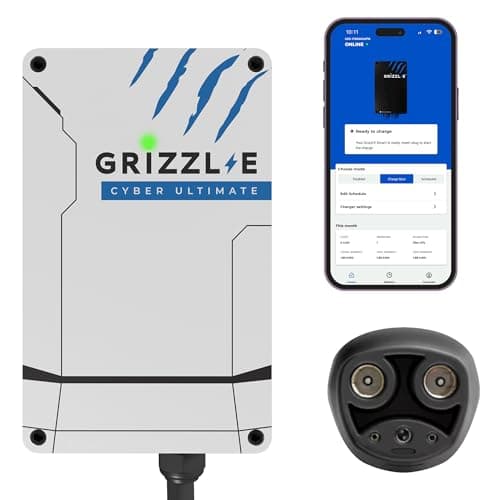
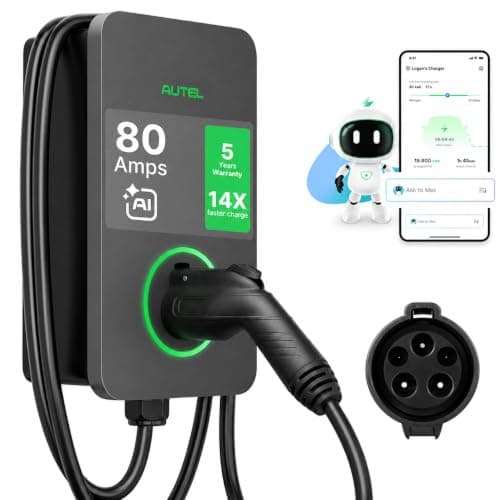
An 80-amp charger is the fastest home charging you can buy — 19.2 kW, up to roughly 70 miles of range per hour — but it only delivers that to a car whose onboard charger can accept it, and it demands a hardwired 100-amp circuit. For the great majority of EVs and homes, that speed is unreachable and an 48-amp charger is the smarter buy. If you genuinely have both the car and the panel for it, there are only two units worth considering: the Autel MaxiCharger 80A for a J1772 car, and the Grizzl-E Ultimate 80A for a NACS one.
This is a small, honest field. Almost every "home" charger on the market tops out at 40 or 48 amps, because that is what a normal house and a normal EV can use. True 80-amp units are a niche — a semi-commercial tier that a few high-onboard-charger vehicles and a few well-supplied panels can actually exploit. We compile published manufacturer specs, verify the safety listings, and do the wiring and speed math; we have not bench-tested these units, and we say so. Before we get to the two picks, read the two rules that decide whether 80 amps does anything for you at all — because for most readers, the honest answer is that it does not.
Rule 1: your car's onboard charger sets the ceiling, not the wall unit
When you charge on AC at home, the current passes through your car's onboard charger, and that component caps the speed — not the box on the wall. The overwhelming majority of EVs have an onboard AC charger rated for 11.5 kW (48 amps). Plug one of those into an 80-amp charger and it still draws 48 amps; the extra capacity simply goes unused. Only a short list of vehicles — the GMC Hummer EV, some Lucid Air trims, certain Rivian and Ford F-150 Lightning configurations — have a 19.2 kW (80-amp)onboard charger that can actually pull the full amount. Check your car's onboard AC charger rating before anything else. If it says 11.5 kW or 48 amps, an 80-amp charger buys you nothing over a 48-amp one, and you should stop here and read the best 48-amp chargers instead. The full speed-versus-amps breakdown is in our kW vs amps explainer.
Rule 2: 80 amps needs a hardwired 100-amp circuit
EV charging is a continuous load, so the circuit must be sized to 125% of the charger's draw. An 80-amp charger therefore needs a 100-amp dedicated circuit(80 × 1.25 = 100), hardwired — there is no plug-in version, because no household receptacle carries that current. That is a serious electrical job: heavy 3 AWG or larger copper, a 100-amp breaker, and a service panel with 100 amps to spare after everything else in the house. Many panels simply do not have it without a costly service upgrade. Work out what your panel can actually give before you buy anything — our wire size and breaker guide has the sizing, and the installation cost guide covers what a 100-amp circuit and a possible panel upgrade really run. Confirm the specifics with a licensed electrician and your local code before any work happens.
The honest takeaway:80 amps pays off only if (a) your car has a 19.2 kW onboard charger and (b) your panel can carry a hardwired 100-amp circuit. If either is a no, an 80-amp charger adds zero speed — a 48-amp unit charges your car at exactly the same rate for roughly half the price and a far easier install. Most people reading this should buy 48 amps.
The picks, in order
1. Autel MaxiCharger 80A — the J1772 pick
If your car uses the J1772connector — most non-Tesla EVs — the Autel MaxiCharger 80A is the one to buy. Hardwired on a 100-amp circuit it delivers the full 80 amps / 19.2 kW, up to about 70 miles of range per hour for a vehicle that can take it, on a 25-foot cable with Wi-Fi and app control. It is indoor/outdoor rated and carries the cloud and OCPP features that suit a power user or a multi-unit setup. The honest caveats are the ones that apply to the whole category: it only reaches its rated speed if your car's onboard charger supports 19.2 kW, it requires that hefty 100-amp circuit, and it costs roughly double a good 48-amp unit while leaning on Wi-Fi and the cloud. For a Hummer EV or a similarly high-onboard-charger J1772 car with the panel to feed it, though, it is the fastest home charging you can install.
2. Grizzl-E Ultimate 80A — the NACS pick
If your car has a native NACS(Tesla-style) port, the Grizzl-E Ultimate 80A is the rugged answer. It hits the same 80 amps / 19.2 kW, hardwired, in the heavy-duty UL Type 4 metal enclosure that is the Grizzl-E signature — made in Canada and built for indoor or outdoor abuse. Its best trait for a fast, unattended charger is that scheduling and energy stats work with or without an internet connection, so it does not go dumb if the cloud does. The same hard limits apply: a 100-amp circuit and a car that can actually accept 19.2 kW. Two stock notes worth knowing — the J1772 version of the Ultimate is frequently out of stock (which is why we point J1772 buyers to the Autel), and the NACS version's stock can run thin, so check the live listing. For the broader native-plug field at saner amperages, see our best NACS home chargers.
Who should actually buy 80 amps
A very specific buyer: someone with a 19.2 kW-capable EV (a Hummer EV is the clearest example), a home service panel that can carry a dedicated 100-amp circuit, and a real need to refill a very large battery fast — a big-pack truck that routinely arrives near empty and has to be full in a few hours. For that person, 80 amps roughly halves the charging time versus 48 amps, and it is worth the wiring. For everyone else — which is almost everyone — the second circuit-and-a-half of copper and the premium price buy nothing, because the car or the panel caps the speed first.
How to choose an 80-amp charger
Once you have confirmed the two rules above — a 19.2 kW car and a 100-amp circuit — the choice is unusually simple, because the field is only two units. Here is how to read them.
Start with the connector
The decision is mostly made by your car's plug. A J1772 car (most non-Teslas) takes the Autel MaxiCharger 80A. A native NACS car (a Tesla, or a 2025-onward NACS-port EV) takes the Grizzl-E Ultimate 80Ain its NACS form. You can bridge a mismatch with an adapter, but at 80 amps you want the native connector rated for the full current — buy the one that matches your port.
Certification is not optional at 80 amps
A charger pushing 80 amps continuously is not a place to gamble on an uncertified box. Both picks carry a real listing — the Grizzl-E Ultimate is UL tested and certified with a UL Type 4 enclosure, and the Autel is a listed, indoor/outdoor unit. Treat a legitimate UL or ETL listing as mandatory on any 80-amp charger you consider; the physics leaves no room for cutting that corner.
Cloud-dependent vs works-offline
This is the clearest split between the two. The Autel leans into connectivity — Wi-Fi, cloud, OCPP, an app — which is powerful for advanced users but means the smart features live partly on a company's servers. The Grizzl-E Ultimate's scheduling and energy tracking work with or without an internet connection, so it keeps functioning if the cloud is down or discontinued. If long-term, low-dependency reliability matters more to you than app polish, that difference favors the Grizzl-E.
Budget for the install, not just the charger
On an 80-amp job the charger is often the smaller line item. A dedicated 100-amp circuit means heavy copper, a 100-amp breaker, and — on a lot of homes — a service panel upgrade to free up the capacity. That can cost as much as or more than the charger itself. Get a licensed electrician to confirm your panel has the headroom before you commit; the full breakdown is in our installation cost guide. Then sanity-check what a full charge will actually cost with the cost-to-charge calculator.
So, which one?
First, make sure you need 80 amps at all: only a 19.2 kW-capable car on a 100-amp circuit gets anything from it, and most readers should buy a 48-amp charger or start from the full home charger roundup instead. If you genuinely qualify, buy the Autel MaxiCharger 80A for a J1772 car or the Grizzl-E Ultimate 80Afor a NACS one — and budget as much attention for the 100-amp circuit as for the charger. Not sure what amperage you actually need? Our what-amp-charger guide walks the whole decision.