HUB 05 · Guides & Buying Advice
Can You Use an Extension Cord to Charge an EV?
The short answer is no — not a normal household cord. Here's why it's a real fire risk, and the safe ways to solve a reach problem instead.
We earn a commission when you buy through our Amazon links, at no extra cost to you. It never affects our rankings, and we say so when the cheaper product is the better buy. How this works.
For everyday purposes the answer is no— do not charge an EV through an ordinary household extension cord. EV charging is a continuous high-current load, and a typical cord is not built for it: it can overheat, melt, and start a fire. If your charger will not reach, the fix is to move the charging or add a proper outlet — never to splice in a cord.
This is a safety page, so we will be blunt where it matters and honest about the narrow exception. The goal is that you never create a fire hazard trying to reach your car.
Why a regular extension cord is dangerous here
Household extension cords are designed for intermittentloads — a drill for a few minutes, holiday lights for an evening. EV charging is the opposite: a continuousdraw, often at 12–40 amps, for hours on end. Undersized conductors carrying that current build heat; a coiled cord traps it; a loose or corroded connection concentrates it. The result can be a melted plug, a scorched outlet, or a fire. This is not theoretical — it is the most common serious mistake in home EV charging, and it is entirely avoidable.
Manufacturers say so too. Most EVs and portable chargers explicitly warn in the manual against extension cords, and many void warranty coverage for damage caused by one. When the people who built the charger tell you not to, that is worth listening to.
The narrow exception — and why it's still a bad idea
You will read that a heavy-gauge, short, outdoor-ratedcord matched to the charger's current canbe used with a Level 1 (120-volt) unit in a pinch. It is true that a properly rated cord is safer than a thin one. But even then you are adding two more connections that can loosen and heat, in a job that tolerates no weak links — and it is essentially never acceptable for a 240-volt Level 2 draw. Treat this as "technically less bad," not "fine." The safe options below are almost always available and worth the small effort.
The safe ways to get more reach
- Move the charger, not the cord.Mount the wall unit closer to where the car parks, or reposition where you park. Cable length is a solvable planning problem — our cable length guide covers measuring the real path.
- Buy a charger with a longer cable.Many units ship with 25 feet; that reach solves most "it won't quite make it" problems without any cord.
- Have an electrician add an outlet where you need it. A properly installed NEMA 14-50 outleton a correctly sized circuit in the right spot is the real fix for a plug-in setup — safe, permanent, and code-compliant.
- Use a portable at a nearer outlet. A portable charger plugged straight into an existing, closer receptacle beats stringing a cord to a far one.
The one-line rule
If the charger will not reach, change the geometry — the charger's position, its cable length, or the outlet's location — never add a household extension cord. Reach is a planning problem with safe solutions; an extension cord turns it into a fire risk.
The gear
Recommended gear for this guide
The products this guide refers to, with prices pulled live from Amazon and dated on each card.
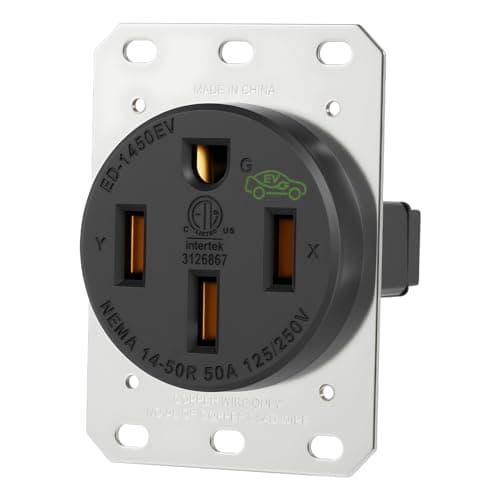
The outlet a plug-in charger needs
Industrial NEMA 14-50 Outlet
The receptacle a plug-in charger actually plugs into — buy the industrial-grade, listed version, because the cheap ones are the part that fails.
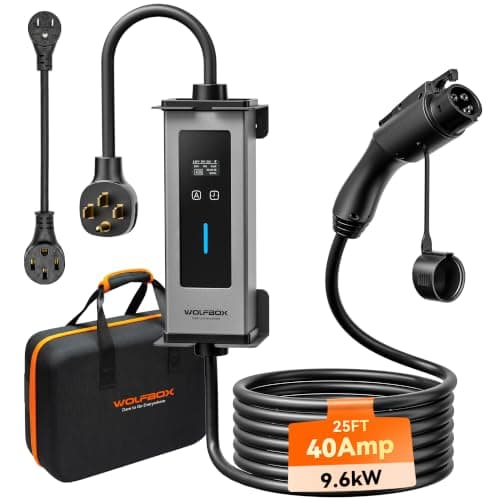
One charger for home and travel
WOLFBOX Portable (Level 1/2)
A dual-level portable that charges on both 120V and 240V, ships with both plug adapters, and adds a delay timer for off-peak charging — a genuine take-anywhere charger.
#ad · As an Amazon Associate we earn from qualifying purchases.
Questions
Frequently asked
Can I use an extension cord to charge my EV?
Is there any safe extension cord for EV charging?
What should I do if my charger cable won't reach?
Why is EV charging different from other extension-cord uses?
Keep reading
Related
- EV Charger Cable LengthSolve reach by measuring the real path.
- Best EV Charger Extension CablesThe car-side J1772 and NACS cables that are a different object from a household cord.
- NEMA 14-50 OutletsAdd a proper outlet where you need it.
- Best Portable EV ChargersPlug into a nearer outlet instead of a cord.
- Can You Use a Regular Outlet?The safe way to use a 120-volt outlet.
- Can I Use a Dryer Outlet?Repurposing an existing 240-volt outlet safely.
Receipts
Sources
We do not run a testing lab, and we do not pretend to. Where a measured number came from someone else's lab, we name them and link them. Where we could not verify something, we say so on the page rather than quietly leaving it out. Read our full method.