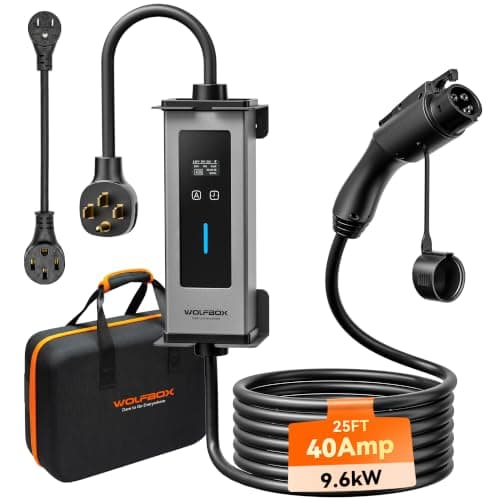
If you want a charger and not a gadget, buy the WOLFBOX Portable. It is an ETL-listed, IP66-rated 40-amp unit that just charges — no app, no Wi-Fi, no account, and nothing in the cloud that can stop working when a company loses interest in the product. That absence of software is the whole point of a "dumb" charger, and the WOLFBOX pairs it with a hardware delay timer for off-peak rates and both a 240V and a 120V plug in the box. If price is everything, the MUSTART is the cheapest capable option here; if you drive a Tesla or another NACS car, the Lectron NACS portable is the app-free pick.
A "dumb" EV charger is a non-smart one: no smartphone app, no Wi-Fi, no cloud account, no firmware to update, no data collected about your car. It does exactly one job — safely hand your EV 240 volts — and it does that job identically to a connected charger costing twice as much, because the core electronics are the same. What you give up is scheduling, energy monitoring and remote control from an app. What you gain is a device with almost nothing that can break, and no dependence on a manufacturer keeping its servers alive years from now. For a single-car household on a flat electricity rate, that is often the smarter buy, not a compromise — a point we make in full in do I need a smart EV charger?
One honest scoping note before the picks. Almost every hardwired, wall-mounted Level 2 charger sold today ships with Wi-Fi and an app, because the app is how brands differentiate and add margin. That leaves the field of genuinely dumb chargers smaller than you might expect, and it is now almost entirely plug-in portables that happen to be app-free by design — the rugged no-app wall units that used to anchor this category, the Grizzl-E Classic among them, have been discontinued or replaced by Wi-Fi versions. We only rank units we can confirm are currently in stock, so if a great dumb charger you have heard of is missing, it is probably because it had no live retail offer when we last checked — we would rather leave it off than send you to a dead listing. We compile published manufacturer specs, verify the safety listings, and do the wiring and cost math; we have not bench-tested these units and we do not pretend to.
The short version
Every charger below is app-free and carries a real safety listing. They split cleanly by how you plan to use them:
- WOLFBOX Portable — best dumb charger overall. An ETL-listed, IP66-rated 40-amp unit with no Wi-Fi to fail, a delay timer for off-peak rates, and both plug adapters in the box.
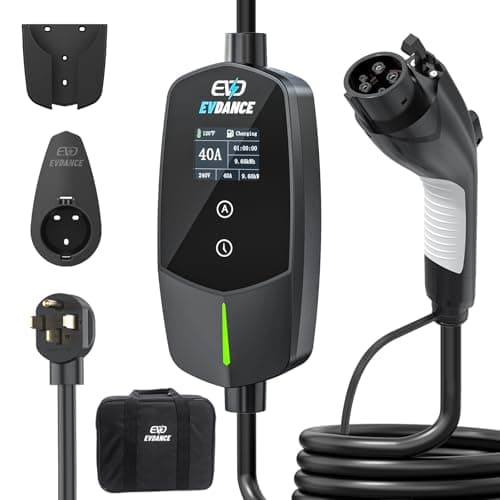
- EVDANCE 40A Portable — the other app-free off-peak option.A built-in delay timer starts the charge on cheaper overnight rates, capturing the one smart feature most people actually use — with no app at all.
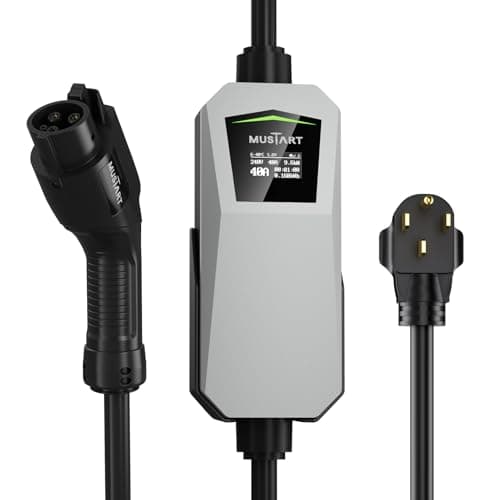
- MUSTART 40A Portable — best budget dumb charger. One of the least expensive true 40-amp chargers on the market, with an LCD status readout and nothing to set up.
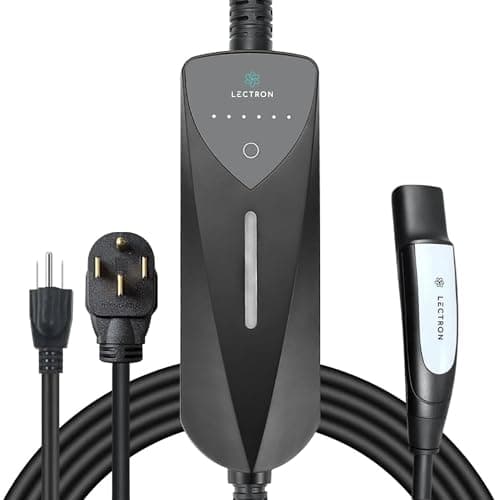
- Lectron NACS Portable — best dumb charger for Tesla & NACS cars.A native Tesla-style plug, adjustable current, and both a 240V and a 120V plug in the box — app-free.
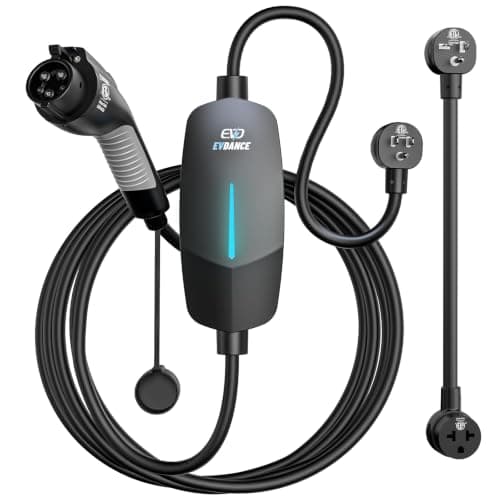
- EVDANCE Level 1&2 — best dumb Level 1 backup. A cheap 120-volt cord for the trunk that plugs into any household outlet in an emergency. Slow, but simple insurance.
The one spec you cannot skip: the safety listing
A home charger pushes 40 amps continuously for hours, often unattended overnight. "Dumb" must never mean "uncertified." The single spec we will not compromise on is a UL or ETLlisting — independent proof the unit was tested to a recognized safety standard. It is the difference between a simple charger and a cheap fire risk, and it is the first thing that separates the picks here from the flood of no-name boxes on the marketplace. The WOLFBOX is ETL certified; the other portables here carry ETL or equivalent listings. Skipping the app is fine. Skipping the listing is not.
The rule that decides your real speed: your panel, not the box
The amperage on the box is a ceiling, not a promise. What you can actually use is set by the circuit your electrical panel can support, and by code — EV charging is a continuous load, so the circuit must be sized to 125% of the charger's current. A 40-amp charger needs a 50-amp breaker (40 × 1.25 = 50) and typically 6 AWG copper wire. Every Level 2 pick here tops out at 40 amps, which is the practical ceiling for a plug-in unit anyway and covers almost everyone's daily driving. If your panel can carry a 60-amp circuit and you want the faster 48-amp tier, that hardware is essentially all smart — see the best home EV chargers roundup instead. For the full sizing math, our wire size and breaker guide has it, and you should confirm the specifics with a licensed electrician and your local code before any work happens.
The picks, in order
1. WOLFBOX Portable — the dumb charger to buy
The WOLFBOX is the dumb charger done right: an ETL-certified, IP66-rated unit with no mandatory app or Wi-Fi. It works the day it arrives and keeps working if the servers go dark — the reason it is the pick for anyone who wants a charger and not a subscription. It runs at up to 40 amps on a NEMA 14-50 cord, so it installs without an electrician if a properly rated outlet already exists, and it ships with a NEMA 5-15 adapter too, so the same unit charges from a household outlet on the road. Its adjustable 6–40A current lets you dial it down for a weaker circuit, and a built-in delay timer starts the charge on cheaper overnight rates — the one genuinely useful smart feature, captured in hardware. The honest cons are the point, not a surprise: it is a portable brick that lives on the floor or a hook rather than a tidy mounted wall unit, there is no per-charge energy data, and a sustained 40-amp draw needs a properly rated 14-50 receptacle. If neither of those is a dealbreaker, this is the buy.
2. EVDANCE 40A Portable — off-peak charging with no app
The EVDANCE solves the one real objection to a dumb charger. Its built-in delay timerlets you start charging on cheaper overnight rates without any app, Wi-Fi or account — which is the single most valuable thing a smart charger does, captured in a hardware button. Add adjustable current (so you can dial it down for a weaker circuit) and a long 25-foot cable, and it is a genuinely flexible unit. Because it is a portable, it also unplugs and comes with you, which suits renters. The cons: the timer is the extent of its scheduling — there is no per-charge energy data, and no remote control — and it is a value brand with a shorter track record than the established names. If you want full energy monitoring, buy a smart charger; if you want cheap overnight charging and nothing else, this is the smart-feeling dumb charger.
3. MUSTART 40A Portable — the budget pick
When the goal is simply 240-volt charging for the least money, the MUSTART is one of the least expensive true 40-amp portables you can buy. It has an LCD readout that shows charging status and faults at a glance, and an outdoor-rated connector and enclosure. The trade-offs are exactly what you would expect at the price: a shorter 21-foot cable than some rivals, no 120-volt plug in the box, and fit and finish that are functional rather than premium. If you need the longer reach of a 25-foot cord, step up to the EVDANCE; if you want a 120V plug for travel, the Lectron has one; if the low price is the whole point, the MUSTART delivers. It also sits alongside our wider best budget EV chargers roundup for anyone weighing simple against cheap.
4. Lectron NACS Portable — the dumb pick for Tesla & NACS cars
If your car has a Tesla-style NACSport — a Tesla, or one of the 2025-onward models that adopted the standard — this is the app-free charger for you. It has a native NACS connector, so there is no adapter to juggle, and it ships with both a 240-volt NEMA 14-50 plug and a 120-volt 5-15 plug, making it a home charger and a road-trip cord in one. Its current adjusts from 8 amps up to 40, so it can be dialed down for an unfamiliar outlet, and it is ETL certified. The cons are the portable's nature: it is a brick on a hook rather than a tidy mounted box, the cable is 20 feet, there is no app or energy monitoring, and 40 amps is the plug-in ceiling. For a NACS household that wants simplicity over a wall install, it is the clear pick; a J1772 car should choose one of the units above.
5. EVDANCE Level 1&2 — the Level 1 backup
The EVDANCE Level 1 cord is not a primary charger and does not pretend to be. It plugs into any ordinary 120-volt household outlet — no special circuit, no install — and it belongs in the trunk as insurance. It earns its place on this page outright: there is no app, no Wi-Fi and no display at all, you plug it in and it charges, and it is ETL listed, which a surprising number of cheap Level 1 cords are not. The honest limit is speed: at 12 amps on 120 volts it adds roughly 3–5 miles of range per hour against the ~25 of a Level 2 unit, so it will not keep up with a daily commute. The included NEMA 6-20 plug does step it to 16 amps if you ever add a 240-volt outlet. Buy it as a backup to keep in the car, or for a plug-in hybrid with a small battery, and keep your expectations calibrated. As your only charger, if you drive daily, it is the wrong tool — a Level 2 portable above is what you want.
What about two EVs, or a permanent wall install?
Two dumb-charger questions come up often enough to answer here. If you charge two EVs and want to skip a second circuit, the dual-cable Grizzl-E Duoused to be the app-free way to do it — but Grizzl-E has replaced it with the Wi-Fi-connected Duo Connect, so there is no longer a genuinely app-free dual-cable unit to point to. To stay app-free with two EVs, the honest route is two single dumb units or swapping one plug between cars. And if you specifically want a hardwired fixture rather than a plug-in unit, note that most hardwired options are smart; our best hardwired EV chargers roundup covers that tier.
How to choose a dumb EV charger
Once you have confirmed what your panel can support, choosing a non-smart charger comes down to four things. Here is how we weighted them and how to read them for your own situation.
Certification comes first, always
We said it above and it is worth repeating because it is the one place a dumb charger can go wrong: buy a UL or ETL listed unit and nothing less. The marketplace is full of cheap uncertified boxes that look like a bargain and are a genuine hazard under a continuous 40-amp load. Every pick here carries a real listing; that is not negotiable, and it should be your first filter on anything you consider outside this list.
Off-peak charging: how to get it without an app
The single most valuable "smart" feature is scheduling a charge into cheap overnight hours on a time-of-use rate. You do not need an app to get it. Two dumb-friendly routes work: a charger with a built-in delay timer(the EVDANCE here), or your car's own charge scheduler, which nearly every modern EV includes in its dashboard. Set either one and you capture almost all the savings a smart charger would, with none of the software. If you are on a flat electricity rate, this does not matter at all and any pick here is fine — more on the savings math in how to save money charging an EV.
Plug-in vs hardwired, and the outlet that matters
Four of the five picks here are plug-in units on a NEMA 14-50 cord, which is the right call for most dumb-charger buyers: no electrician needed if the outlet exists, and you can unplug and take it with you when you move. If you go plug-in, the outlet itself matters more than people expect — buy an industrial-grade, listed NEMA 14-50 receptacle, because the cheap ones are the part that overheats under a sustained 40-amp draw. We cover exactly which to buy in the NEMA 14-50 outlet guide. If you would rather have a permanent fixture, the hardwired roundupcovers that route — though be aware that tier is almost entirely smart units now.
Cable length and build
Measure before you buy. A 25-foot cable, which the EVDANCE and Lectron carry, reaches across a typical two-car garage and lets you park either way around; the MUSTART's 21-foot cord is shorter, so confirm it will reach your port. For build, if the charger lives outside or in a carport, look for a stated weatherproof rating — the WOLFBOX's IP66 rating is built for it. A weather rating doubles as a proxy for how seriously the unit is made, so it is worth having even in a sealed garage.
So, which one?
Buy the WOLFBOX Portableunless you have a specific reason not to — it is the rugged, no-app default, it has the delay timer for off-peak rates, and it will outlive several app redesigns. Want a second app-free option with the same timer trick? The EVDANCE. On the tightest budget? The MUSTART. Driving a Tesla or another NACS-port car? The Lectron NACS Portable. Just need emergency insurance in the trunk? The EVDANCELevel 1 cord. Every one of these does the core job — safe 240-volt (or 120-volt) charging — without a single line of app you have to think about. And if you are still weighing whether you want the software at all, start with do I need a smart EV charger? before you decide.