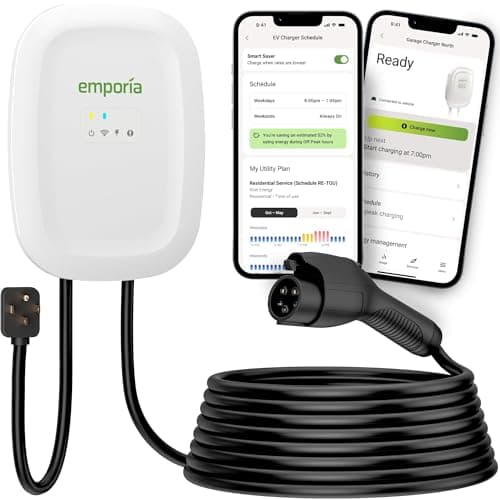
Buy the Emporia Level 2, hardwired on a 60-amp circuit. Every BMW EV sold in the United States — i4, iX, i5, i7 — carries an 11 kW onboard AC charger, which is about 48 amps at 240 volts, so this is one of the few cars where paying for 48-amp capability is not overbuying. The Emporia reaches the full 48 amps hardwired, monitors energy properly, and undercuts most 48-amp rivals. If you want the smallest possible box on the wall at the same speed, the Wallbox Pulsar Plus is the compact alternative. BMWs use J1772 for AC charging in North America, so buy a J1772 charger, not a NACS one.
There is one trap worth stating before the list, because it costs BMW owners more charging speed than any brand choice: a charger sold as "48 amp" delivers 48 amps only when it is hardwired. Plug the same unit into a NEMA 14-50receptacle and the 50-amp circuit caps continuous draw at 40 amps — about 9.6 kW instead of 11.5. The car can take more; the plug cannot give it. Our hardwired charger roundup covers that decision in full.
The short version
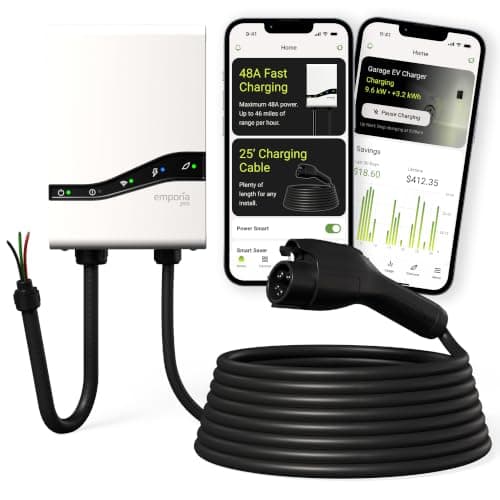
- Emporia Level 2 (48A) — best for a BMW overall. For the owner who wants the car's full 11 kW without paying a brand premium. Full 48 amps hardwired, UL and Energy Star, 25-foot cable, real energy monitoring. Full review.
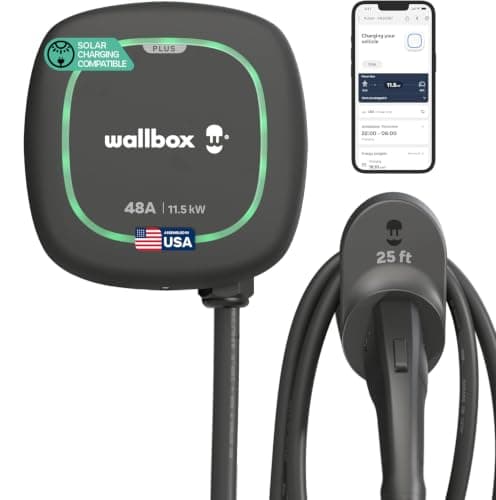
- Wallbox Pulsar Plus (48A) — best compact 48-amp unit. For the garage where the charger needs to be unobtrusive. One of the smallest 48-amp boxes you can buy, Energy Star and UL, hardwired. Full review, or see it against the Emporia in Wallbox Pulsar Plus vs Emporia.
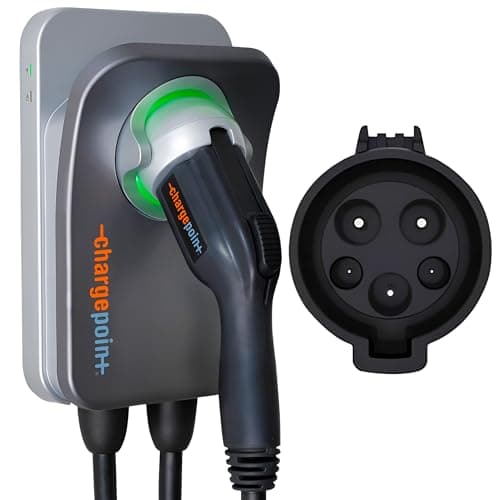
- ChargePoint Home Flex — best if the circuit is uncertain. For the owner who does not yet know what breaker the panel can spare. Selectable 16–50A, so the charger survives whatever the electrician finds. Full review.
- Emporia Pro (48A, PowerSmart) — best for a tight panel. For the BMW owner whose service cannot take a 60-amp circuit on paper. Load management lets the calculation count a capped setpoint instead of the nameplate. See the load-management roundup.
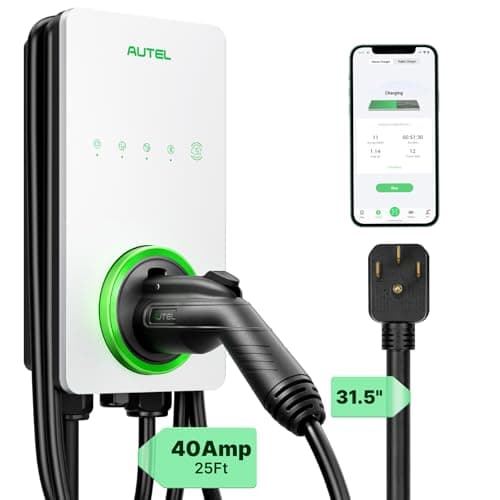
- Autel MaxiCharger (40A) — best plug-in pick. For the owner who wants a receptacle install and a tidy finish. Forty amps is the real ceiling on a 14-50 plug anyway, and this one includes a holster. Full review, or against the Emporia in Autel MaxiCharger vs Emporia.
Why 48 amps is the right number for a BMW
The onboard charger is the part that decides AC charging speed, and BMW has standardised on a generous one. Published figures for the US market:
- BMW iX— 11 kW onboard AC charger, so it accepts up to about 48 amps at 240 volts.
- BMW i4— every trim (eDrive35, eDrive40, xDrive40, M50) uses an 11 kW onboard AC charger on a 400-volt pack.
- BMW i5— fully using the onboard charger calls for an 11.5 kW home station, which is up to 48 amps on a 60-amp circuit.
Put that next to the 40-amp charger most people default to and the gap is real: 9.6 kW against 11.5 kW is about 20% more range per hour, which on a large iX pack is a meaningful number of hours over a week. This is the opposite of the situation on a Jeep 4xe, where the car cannot use the headroom at all.
Connector, clearly. In North America BMW's electric cars use the J1772 inlet for AC home charging, and BMW has announced NACS inlets on future models. A J1772 charger is the correct purchase today for every current US BMW EV; if your household later adds a NACS car, an adapter handles it in that direction. Our J1772-to-Tesla adapter roundup and NACS vs J1772 explainer cover which way each adapter goes.
The per-model detail
The charger choice is the same across the range because the onboard charger is, but the install details are not — port location, pack size and how long a full charge takes all differ. We have worked both popular models through separately: charging a BMW i4 at home and charging a BMW iX at home each cover the pack, the realistic overnight gain and the circuit to ask for. If you are comparing across brands, the Mach-E guide is the closest analogue for a 48-amp-capable crossover.
How the picks compare on paper
Published figures from the live listings, with live prices. The column to read first is whether the 48 amps needs hardwiring — that, not the badge, is what decides whether your BMW charges at 11.5 kW or 9.6.
| Charger | Best for | Published specs | Price |
|---|
| Emporia Level 2 (48A) | Most people who want the smart features too | Up to 48A / 11.5kW · J1772 · 25ft cable · Wi-Fi + app | Not verified today |
| Wallbox Pulsar Plus (48A) | A compact, fast, hardwired install | Hardwired 48A / 11.5kW · J1772 · 25ft cable · Energy Star + UL | $699.00 |
| ChargePoint Home Flex | Buyers who want the established brand and app | Adjustable to 50A · J1772 · NEMA 14-50 plug · Energy Star | $599.00 |
| Emporia Pro (48A, PowerSmart) | A 100-amp service you would rather not upgrade | Up to 48A hardwired · J1772 · PowerSmart + Vue monitor · UL · ENERGY STAR · NEMA 4 | $599.00 |
| Autel MaxiCharger (40A) | Feature-maximalists who want a tidy install | 40A / 9.6kW · J1772 · 25ft cable + holster · Wi-Fi + Bluetooth | $375.99 |
#ad Prices read live from the Amazon Product API as of October 16, 2026, and they move. Specs are the manufacturer's published claims from the live listing — we have not bench-measured them. Where we have no verified price we print none rather than a number that has gone stale.
What to look for in a charger for a BMW
Forty-eight amps, hardwired, on a 60-amp circuit. That is the configuration that uses the car. NEC 625.42 treats charging as a continuous load and requires 125% of output, so 48 amps needs a 60-amp breaker and the wire to match — see the wire size and breaker guide. If your panel cannot spare it, the honest options are load management or accepting 40 amps, not pretending a plug-in unit delivers 48.
A J1772 connector. Not NACS. The adapter you would need to make a NACS charger work on a J1772 car is the less common and more awkward direction, and you would be buying hardware to undo a purchasing mistake.
Cable length against the port position. BMW puts the charge port on the rear quarter panel on most of the range, which often means the cable has to travel further than owners expect. Twenty-five feet is the spec to want. Measure before you choose a mounting spot.
Scheduling you will actually use. A large pack and a time-of-use utility rate is the one combination where charger scheduling pays real money, and BMW owners are disproportionately in it. The Emporia's energy monitoring is the strongest value here; if you would rather schedule in the car than in an app, a dumb charger is a legitimate choice and cheaper.
Outdoor rating if the car parks outside. NEMA 3R, NEMA 4 or IP66, named on the listing — the outdoor roundup ranks on exactly this.