HUB 04 · Cable Management & Accessories
NEMA 14-30 vs NEMA 14-50 for EV Charging
One is your dryer outlet, one is the EV default. The real difference in charging speed — and when the smaller one is genuinely enough.
We earn a commission when you buy through our Amazon links, at no extra cost to you. It never affects our rankings, and we say so when the cheaper product is the better buy. How this works.
The difference is amperage. A NEMA 14-30 is a 30-amp outlet (the common dryer plug) that supports about 24 amps / 7.2 kW of continuous EV charging. A NEMA 14-50 is a 50-amp outlet supporting 40 amps / up to ~9.6 kW. The 14-50 is the EV default and charges faster; the 14-30 is often already in your laundry room and is enough for a lot of drivers.
Both are 240-volt, four-wire outlets that look similar, and both can charge an EV safely with the right equipment. Choosing between them is really a question of how fast you need to charge versus what you already have.
NEMA 14-50: the EV standard
A NEMA 14-50delivers a full 40 amps of continuous Level 2 charging — roughly 30 miles of range per hour on a car that can accept it. It is what most plug-in chargers and every unit in our portable roundup are built around, which is why it became the default. If you are adding an outlet specifically for EV charging, the 14-50 is almost always the right call.
NEMA 14-30: the dryer outlet
A 14-30is the 30-amp outlet many homes already have for an electric dryer. On it, an EV charger is limited to about 24 amps continuous — roughly 7.2 kW, or about 18–24 miles of range per hour. That is slower than a 14-50 but still solidly Level 2, and if the outlet already exists it can save the cost of a new circuit. Many chargers offer a 14-30 plug or an adapter; the charger must be set to 24 amps so it does not overload the 30-amp circuit.
Which should you use?
Install a 14-50 if you are running a new circuit anyway, drive a lot, or own a big-battery car that benefits from the faster rate. Use an existing 14-30if it is already there and your daily mileage is moderate — 7.2 kW overnight is plenty for most drivers. See what amp charger do I need to match the rate to your car and driving.
The safety rules that matter
Never put a bigger plug on a smaller circuit. A 14-30 lives on a 30-amp breaker and must never be "adapted" to run a charger at 40 amps — that overloads the wiring. Do not share the dryer circuit for simultaneous use, use only listed adapters, and have any new outlet installed by a licensed electrician on a correctly sized breaker (our wire size and breaker guide shows the sizing). Using a dryer outlet you already have is covered further in our dryer-outlet guide.
The gear
Recommended gear for this guide
The products this guide refers to, with prices pulled live from Amazon and dated on each card.
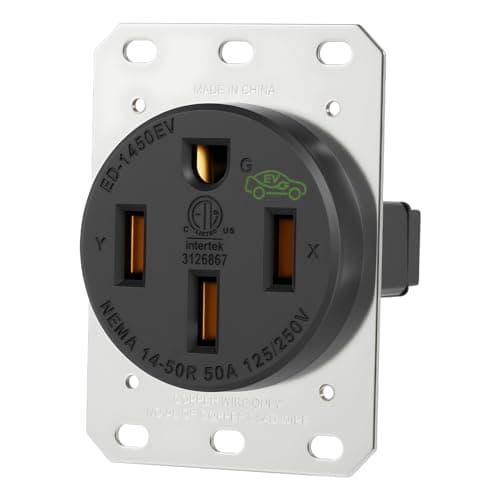
The outlet a plug-in charger needs
Industrial NEMA 14-50 Outlet
The receptacle a plug-in charger actually plugs into — buy the industrial-grade, listed version, because the cheap ones are the part that fails.
#ad · As an Amazon Associate we earn from qualifying purchases.
Questions
Frequently asked
Is a NEMA 14-30 outlet good enough for EV charging?
What's the difference between NEMA 14-30 and 14-50?
Can I use a 14-30 to 14-50 adapter to charge faster?
Should I install a 14-30 or a 14-50 for a new EV outlet?
Keep reading
Related
- EV Outlet Types ExplainedThe full NEMA outlet lineup decoded.
- NEMA 14-50 OutletsThe EV-standard outlet, done right.
- Use a Dryer Outlet?Charging from an existing 14-30.
- What Amp Charger Do I Need?Match the rate to your car.
- Wire Size & BreakerSizing each circuit correctly.
- Best EV Charger Outlet AdaptersThe 14-30 to 14-50 adapters worth buying, and the 24-amp rule.
Receipts
Sources
We do not run a testing lab, and we do not pretend to. Where a measured number came from someone else's lab, we name them and link them. Where we could not verify something, we say so on the page rather than quietly leaving it out. Read our full method.