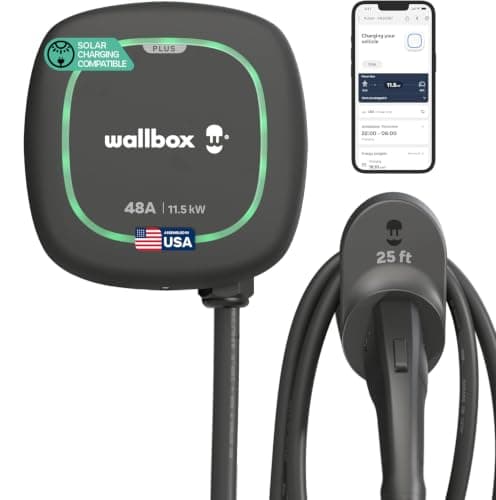
The Wallbox Pulsar Plus is the charger to buy when wall space is the constraint. It delivers a full 48 amps — the fastest speed a home Level 2 unit offers — from one of the smallest enclosures in the category, and it is Energy Star and UL certified. The catch is that the app has historically been the weak point, and you only get the full 48 amps by hardwiring it.
In our best home EV chargers roundupthe fastest smart units all top out at 48 amps, and they are mostly big boxes. The Pulsar Plus matches that speed in a noticeably smaller package, which is the whole reason to consider it. This is the closer look. We compile published specs, safety listings and owner reports and do the math — we have not bench-tested the unit — so treat this as documented research on a well-known charger, not a lab report.
Who it is for
This is the charger for the buyer with a specific problem: a wall that is already crowded, a narrow space beside the panel, or simply a preference for hardware that does not announce itself. If you want 48-amp speed but every other fast unit looks like a small microwave bolted to the drywall, the Pulsar Plus is the answer. It is also a fair pick if you want app scheduling and energy monitoring and are comfortable with a companion app that leans on Bluetooth for setup. If you do not care about size, or you rent and might take the charger with you, it is the wrong tool — a plug-in unit or a portable EVSE serves you better.
The specs that matter
Wallbox rates the Pulsar Plus at up to 48 amps / 11.5 kW hardwired, with a J1772 connector, a roughly 25-foot cable, and both Energy Star and UL certification. Two things define it:
- Size versus speed.Almost nothing else charges at 48 amps in a box this small. That is the entire pitch, and it is a real one — on a shared garage wall or a tight utility corner, the footprint is the spec you will notice every day. The 25-foot cable also reaches across a two-car bay without a fight.
- 48 amps means hardwiring.A plug-in unit on a NEMA 14-50 outlet is capped at 40 amps by code, so the Pulsar Plus only reaches its full 48 amps as a hardwired fixture on a 60-amp circuit (48 × 1.25 = 60). If your panel cannot support a 60-amp circuit, you are buying speed you cannot use — a 40-amp charger would be the honest call. The full sizing detail is in our wire and breaker guide.
What is good
The Pulsar Plus does the hard part well: it is genuinely fast and genuinely small, and it does not make you choose between the two. The build is tidy, the Energy Star and UL listings are real reassurance on a device pulling high current for hours unattended, and the smart side covers what most owners want — scheduling a charge for off-peak hours, watching energy use, and, on a shared circuit, splitting power between two chargers so you do not trip a breaker. For a household that wants the fastest charge, the smallest box, and enough software to automate cheap overnight charging, it hits every note.
The app question
Here is the honest weak point. Across owner reviews, the recurring complaint is not the charger — it is the app. Setup leans on Bluetooth pairing that can be finicky, Wi-Fi reconnection after a router change or outage is a common gripe, and firmware updates occasionally need a second attempt. The hardware itself charges reliably; the friction lives in the software layer. If your idea of a good charger is one you configure once and never open an app for again, that is a real strike against this unit, and a sealed, no-app box like the Grizzl-E Classic will make you happier. If you will tolerate an occasional app wrestle in exchange for scheduling and the compact size, it is a trade many owners make gladly.
Where it falls short
Beyond the app, the trade-offs are straightforward. It is hardwired for full speed, so it is a fixture, not something you unplug and take when you move — renters and anyone who might relocate should skip it. It sits in the upper price bracketfor a home charger; you are paying partly for the compact engineering, and a larger 48-amp unit or a 40-amp charger can cost less for the same daily charge. And like every smart charger, its long-term usefulness depends on the company keeping its app and cloud alive — a risk a dumb charger simply does not carry. None of these is a defect; they are the shape of what this charger is.
Installation notes
To use all 48 amps, the Pulsar Plus is hardwired to a 60-amp circuit— EV charging is a continuous load, so the breaker is sized to 125% of the charger's current (48 × 1.25 = 60), typically on 6 AWG copper for a short run. That is a job for a licensed electrician, who should confirm your panel has the headroom before any charger is chosen; a service-panel upgrade is the line item that turns a cheap install expensive. If your panel tops out lower, Wallbox and others sell units you can dial back, but at that point a purpose-built 40-amp charger is usually the cleaner buy. See our installation-cost guide for the ranges and what drives them.
How it compares
Against the smart 48-amp field, the Pulsar Plus trades on size. The Emporia matches its speed and built-in energy monitoring for less money in a larger box; the ChargePoint Home Flex brings a more mature app and network at a similar price. If you want both a NACS and a J1772 plug in one unit, the Tesla Universal Wall Connector is the comparison to read. The Pulsar Plus wins on exactly one axis — how little wall it takes to charge this fast — and for the buyer who needs that, it wins convincingly.
Bottom line
The Wallbox Pulsar Plus is a specialist, and it is very good at its specialty: full 48-amp charging in the smallest footprint you can practically buy. If your wall space is tight and you want the fastest home charge, it earns its place. If you do not care about size, a larger 48-amp unit gives you the same speed for less, and if you want to never touch an app, buy a sealed box instead. Put it next to the value leaders in our home charger roundup before you decide.