HUB 04 · Cable Management & Accessories
NEMA 6-50 vs 14-50 for EV Charging
Two common 240-volt outlets a plug-in charger can use — the difference is one wire, and it decides which charger plugs in.
We earn a commission when you buy through our Amazon links, at no extra cost to you. It never affects our rankings, and we say so when the cheaper product is the better buy. How this works.
NEMA 6-50 and 14-50 are both 240-volt, 50-amp outlets that many plug-in EV chargers can use. The key difference is one wire: the 14-50 has a neutral (four wires total), while the 6-50 does not (three wires). That single difference decides which charger's plug fits, so match the outlet to your charger — not the other way around.
Both deliver the same 240 volts and support the same charging speed, so neither is "faster." The choice is about the plug on your charger and the wiring in your wall.
The difference in one sentence
The 14-50 is the four-prong outlet you see in RV parks and behind electric ranges; it carries two hots, a neutral and a ground. The 6-50is a three-prong outlet common for welders; it carries two hots and a ground, no neutral. An EV charger uses the two hots for 240-volt power either way — the neutral only matters for a charger plug that expects it, or if you want a 120-volt capability at that location.
Which one to install
- Match your charger's plug. Most plug-in EV chargers ship with a 14-50 plug, which makes the NEMA 14-50 outlet the default. Some units, or those set up for a welder circuit, use a 6-50.
- Consider the wiring.A 6-50 needs one fewer conductor, which can be marginally cheaper on a new run — but the difference is small, and a 14-50 leaves you the flexibility of a neutral.
- Do not improvise an adapter.Adapting between outlet types to force a plug to fit is how connections overheat. Install the outlet your charger's plug is made for.
What matters more than the outlet type
For either outlet, the quality of the receptacle and the circuit behind it matters far more than 6-50 versus 14-50. A continuous 40-amp EV load punishes a cheap outlet, so buy an industrial-grade unit and have it installed on a correctly sized circuit — the wire size and breaker guide explains the NEC math, and EV outlet types explained decodes the rest of the family. If you are choosing between a dryer-style 14-30 and a 14-50, see NEMA 14-30 vs 14-50.
The gear
Recommended gear for this guide
The products this guide refers to, with prices pulled live from Amazon and dated on each card.
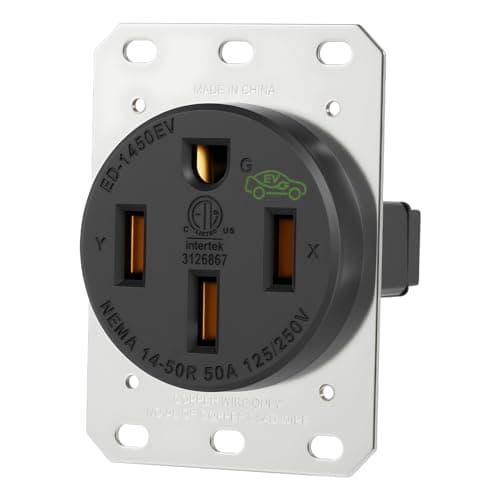
The outlet a plug-in charger needs
Industrial NEMA 14-50 Outlet
The receptacle a plug-in charger actually plugs into — buy the industrial-grade, listed version, because the cheap ones are the part that fails.
#ad · As an Amazon Associate we earn from qualifying purchases.
Questions
Frequently asked
Is a NEMA 6-50 or 14-50 better for EV charging?
What is the difference between a 6-50 and a 14-50 outlet?
Can I use an adapter to plug a 14-50 charger into a 6-50 outlet?
Keep reading
Related
- NEMA 14-50 OutletsThe default outlet most plug-in chargers use.
- EV Outlet Types ExplainedThe whole family of outlets, decoded.
- NEMA 14-30 vs 14-50The dryer-outlet comparison, if that is your choice.
- Wire Size & BreakerThe circuit that matters more than the outlet type.
- NEMA 14-50 ChargersPlug-in chargers built for a 14-50 outlet.
Receipts
Sources
We do not run a testing lab, and we do not pretend to. Where a measured number came from someone else's lab, we name them and link them. Where we could not verify something, we say so on the page rather than quietly leaving it out. Read our full method.