HUB 05 · Guides & Buying Advice
Do I Need a Smart EV Charger?
Wi-Fi and an app sound essential and often are not. Here's exactly when smart features pay off, and when a sealed dumb charger is the smarter buy.
We earn a commission when you buy through our Amazon links, at no extra cost to you. It never affects our rankings, and we say so when the cheaper product is the better buy. How this works.
You need a smart EV charger if you are on a time-of-use electricity rate and want automatic off-peak charging, if you have two EVs and need to share one circuit, or if you genuinely want per-charge energy data. If none of those apply — a single car on a flat rate — a simple "dumb" charger does the identical core job for less, with nothing in the cloud to fail. Smart is a feature, not a requirement.
Almost every charger for sale markets its app first, which makes buyers assume Wi-Fi is essential. It is not. A charger's core job — safely hand your car 240 volts — is done identically by a $350 sealed box and a $700 connected one. The question is whether the specific things the software adds are worth the price and the dependency for you. Here is how to tell.
When a smart charger is worth it
Smart features earn their keep in three concrete situations:
- You are on a time-of-use rate. If your utility charges less overnight, scheduling the charge into that cheap window saves real money on every fill. A smart charger automates it (though note a few cars, and even some cheap portables with a delay timer, can schedule too). If you are on a flat rate, this benefit disappears entirely.
- You have two EVs on one circuit. Smart load sharing splits the available current between two cars so you do not trip a breaker or pay to run a second line. That coordination genuinely needs the software.
- You want energy data. If you like seeing exactly what each charge used and cost, the app gives you that. Some people value it; many never open it after the first week.
When a simple charger is the smarter buy
For a large number of owners — one car, a flat electricity rate, no interest in dashboards — a sealed charger with no app is the better decision. It is cheaper, and it removes an entire category of failure: no Wi-Fi to drop, no app to lose support, no cloud account to depend on, nothing to update. A charger like the Grizzl-E Classic charges the day it arrives and keeps working long after some smart units have outlived their app support. The absence of software is a feature here, not a gap. If that describes you, our best dumb EV chargers roundup ranks the app-free field with live prices.
The honest tension:a smart charger is only as reliable long-term as the company keeping its app and servers alive. A dumb charger is reliable as long as electricity flows. If set-and-forget longevity is what you want, simplicity is a real advantage — not a compromise.
The middle ground
You do not always have to choose extremes. The value smart chargers — our top pick, the Emporia, is the example — bundle real scheduling and energy monitoring at a price close to a dumb charger, so the "smart tax" is small if you might use the features. And on the portable side, a unit with a simple built-in delay timer captures the single most valuable smart feature (off-peak charging) with no app at all. You can get most of the benefit without a full smart-home dependency.
How to decide in one question
Ask: will I actually use scheduling, load sharing, or energy data?If yes to any, buy a smart charger — and lean toward a value one so you are not overpaying for the software. If honestly no, buy a simple, well-certified charger and enjoy having nothing to troubleshoot. Either way, the deciding specs are the same as any charger: a UL or ETL listing, the right amperage for your panel and car, and a cable that reaches. The full ranked field, smart and simple, is our home charger roundup.
The gear
Recommended gear for this guide
The products this guide refers to, with prices pulled live from Amazon and dated on each card.
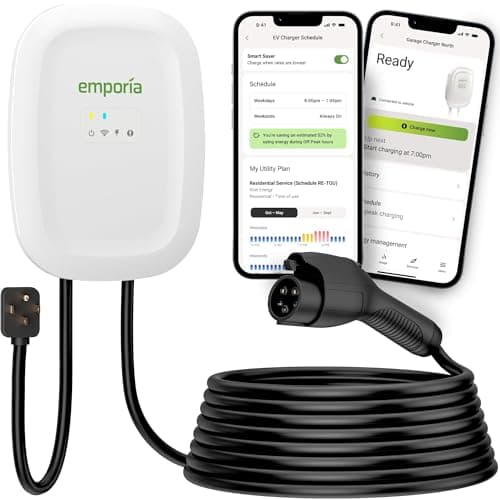
Most people who want the smart features too
Emporia Level 2 (48A)
The smart charger that does not charge a smart-charger premium — 48-amp capability and real energy monitoring for the price of a dumb one.
#ad · As an Amazon Associate we earn from qualifying purchases.
Questions
Frequently asked
Do I really need a Wi-Fi (smart) EV charger?
What can a smart EV charger do that a simple one can't?
Are simple (non-smart) EV chargers less safe?
Is there a cheap way to get off-peak charging without a smart charger?
Keep reading
Related
- Best Smart EV ChargersIf you decided you want the app, the Wi-Fi, connected field ranked.
- Best Dumb EV ChargersIf you decided against the app, the app-free field ranked.
- Best Home EV ChargersThe full field, smart and simple, ranked.
- Grizzl-E Classic ReviewThe no-app durability pick, in detail.
- Emporia Level 2 ReviewA value smart charger with a small smart tax.
- How to Save Money ChargingWhy off-peak scheduling is the feature that pays.
- The Best EV Charger BrandsThe smart-vs-simple split, brand by brand.
Receipts
Sources
- US DOE / fueleconomy.gov — EV charging basics
- US DOE Alternative Fuels Data Center — charging at home
We do not run a testing lab, and we do not pretend to. Where a measured number came from someone else's lab, we name them and link them. Where we could not verify something, we say so on the page rather than quietly leaving it out. Read our full method.