HUB 05 · Guides & Buying Advice
Why Is My EV Charging So Slow?
Slow charging almost always has a findable cause. Here are the eight usual suspects and how to tell which one is yours.
We earn a commission when you buy through our Amazon links, at no extra cost to you. It never affects our rankings, and we say so when the cheaper product is the better buy. How this works.
Slow charging almost always traces to one of a handful of causes: the weather is cold, the circuit or charger is set to a lower amperage than you think, the car's onboard charger caps the rate, a fast charger is tapering near full, or the outlet and wiring are marginal. Work through the list below and you will usually find which one is yours.
"Slow" is relative, so start by knowing what to expect: Level 1 adds ~3–5 miles of range per hour, Level 2 about ~25, and DC fast charging hundreds — but only up to your car's and circuit's limits. If you are below the expected number for your setup, here is why.
The eight usual causes
- Cold weather.A cold battery charges more slowly while it warms, and heating the cabin and pack draws from the same power. Winter genuinely slows charging — see EV charging in cold weather.
- The circuit is smaller than you think.A plug-in charger on a NEMA 14-50 is capped at 40 amps; on a smaller breaker it is capped lower still. The charger's label rating is a ceiling, not a guarantee — the circuit sets the real number.
- The charger's amperage is dialed down. Many adjustable chargers ship set to a conservative current, or were set low for a weaker outlet and never turned back up. Check the app or the DIP switch.
- The car's onboard charger is the limit.Every EV has a maximum AC rate. A car that accepts only 32 amps will not go faster on a 48-amp charger — the car, not the charger, sets the pace on AC.
- You're on Level 1 without realizing. If the car is plugged into a 120-volt outlet (or a dual-level portable on its 120-volt plug), it is charging at Level 1 speed. Confirm you are on a 240-volt outlet for Level 2.
- A shared or weak circuit. If the charging circuit shares a breaker with other loads, or the outlet is a worn builder-grade one, voltage sag can reduce the delivered rate. A proper industrial-grade outlet on a dedicated circuit helps.
- DC fast-charger taper.At a fast charger, the rate drops sharply as the battery fills, especially past 80%. That is normal battery protection, not a fault — see DC fast charging explained.
- A battery-preservation or scheduling setting.Some cars slow or delay charging for battery health, off-peak schedules, or a charge-limit setting. Check the car's charging menu before assuming hardware.
How to diagnose it quickly
Note the actual power (kW) the car or charger reports, then compare it with what your setup should deliver. If it is a fraction of expected on Level 2, suspect the circuit, the charger's amperage setting, or the car's onboard cap. If it is fine when warm but poor in the cold, it is weather. If it started fast and slowed near full at a DC charger, that is the taper. A charger whose speed varies wildly or that trips the breaker is a different problem — see EV charger troubleshooting and why a charger trips the breaker.
When the fix is a better charger
If your car can accept more than your current charger or circuit delivers, upgrading pays off: a 48-amp-capable unit like the Emporia Level 2 on the right circuit, or a proper 240-volt portableif you have been limping along on Level 1. But confirm the bottleneck first — there is no point buying a faster charger if the car or the panel is the real cap.
The gear
Recommended gear for this guide
The products this guide refers to, with prices pulled live from Amazon and dated on each card.
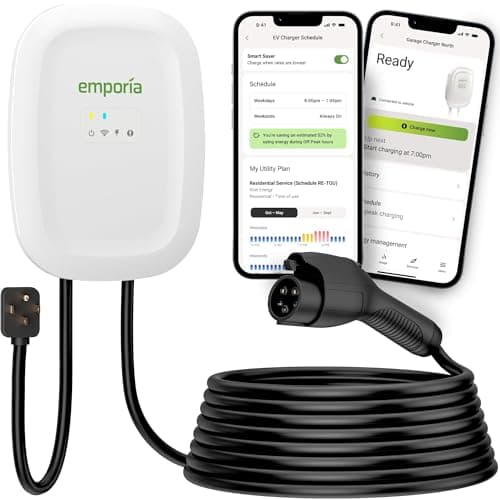
Most people who want the smart features too
Emporia Level 2 (48A)
The smart charger that does not charge a smart-charger premium — 48-amp capability and real energy monitoring for the price of a dumb one.
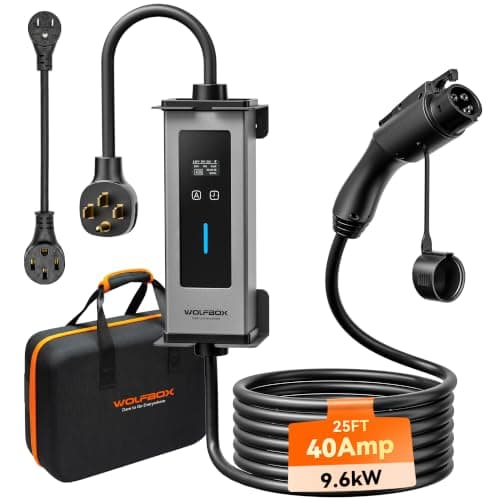
One charger for home and travel
WOLFBOX Portable (Level 1/2)
A dual-level portable that charges on both 120V and 240V, ships with both plug adapters, and adds a delay timer for off-peak charging — a genuine take-anywhere charger.
#ad · As an Amazon Associate we earn from qualifying purchases.
Questions
Frequently asked
Why is my EV charging slower than the charger's rating?
Does cold weather slow down EV charging?
Why does fast charging slow down when the battery is nearly full?
Could a bad outlet be making my EV charge slowly?
Keep reading
Related
- EV Charger TroubleshootingWhen it's not just slow but misbehaving.
- Why a Charger Trips the BreakerThe circuit-side failure to rule out.
- How Long to Charge an EVWhat speed you should actually expect.
- EV Charging in Cold WeatherThe seasonal cause of slow charging.
- What Amp Charger Do I Need?Matching charger, circuit and car.
Receipts
Sources
We do not run a testing lab, and we do not pretend to. Where a measured number came from someone else's lab, we name them and link them. Where we could not verify something, we say so on the page rather than quietly leaving it out. Read our full method.