HUB 05 · Guides & Buying Advice
EV Charger vs 240V Outlet
These are not two versions of the same purchase. One is wiring, one is equipment, and you need the wiring either way — so the real question is whether you need the box on the wall as well.
We earn a commission when you buy through our Amazon links, at no extra cost to you. It never affects our rankings, and we say so when the cheaper product is the better buy. How this works.
If you want the cheapest Level 2 charging that works, install a 240-volt outlet — normally a NEMA 14-50— and plug a dual-level portable EVSE into it. If you want the tidiest, fastest, most permanent setup, install a hardwired wall charger and skip the receptacle. What you cannot do is plug a car into a 240-volt outlet directly: the outlet carries power, but something has to perform the safety handshake with the car, and that something is the charger. You are paying for the circuit in both cases; the only question is what you hang on the end of it.
The confusion in this query comes from the word "charger," which the industry uses wrongly. The real charger — the thing that converts AC into battery charge — lives inside the car. The box on your wall is electric vehicle supply equipment: a switch, a ground-fault detector and a communication pilot that tells the car how much current it may draw. That is why there is no such thing as plugging a car straight into a dryer socket.
What each one actually is
- A 240-volt outlet is a receptacle on a dedicated 240-volt branch circuit. It is electrical work: a breaker, a cable run, a box, a permit and an inspection. It supplies power and makes no decisions.
- A charger (EVSE) is the equipment that connects to the car. It verifies the ground, advertises the available current over the J1772 or NACS pilot, energises the cable only once the car has answered, and shuts down on a fault. It is a listed appliance, not wiring.
- A portable EVSEis the same equipment with a plug on its supply end instead of hardwired leads — which is exactly what lets a receptacle substitute for a wall unit.
The cost comparison, honestly
Both routes need the circuit, so the circuit cancels out of the comparison — and the circuit is usually the dominant cost. What differs is the small end:
- Outlet route: circuit + an industrial-grade receptacle + a portable EVSE. The receptacle is cheap; the portable is typically the least expensive way to get Level 2.
- Hardwired route: circuit + a wall charger, with no receptacle to buy, but with slightly more install labor at the charger end and no plug to unplug.
- The hidden cost on the outlet routeis a cheap receptacle. A 240-volt plug carrying 32–40 amps for eight hours a night is the component most likely to overheat if it is a bargain part, which is why our pick is an ETL-listed industrial one and why heat at the connection is worth understanding.
Our installation cost guide breaks down the circuit itself, which is where almost all the variation lives: panel distance, wall construction, and whether the service has capacity at all.
Where the outlet route is better
- You rent, or you might move. A receptacle is an improvement to the property; the charger goes in the trunk with you. See best charger for renters.
- You want a travel charger anyway. One portable covers the garage and the holiday rental. Buying a wall unit and a travel cable is paying twice for the same function.
- Your car cannot use more than 32–40 amps. A Jeep 4xe, a Chevy Bolt or any plug-in hybrid tops out below what a 14-50 circuit supplies, so the hardwired route's one real advantage — 48 amps — buys you nothing.
- You already have a usable 240-volt receptacle. A properly installed, code-compliant dryer or welder outlet in the right place can be the whole project. Read can I use a dryer outlet first, because "in the right place" and "code-compliant" do a lot of work in that sentence.
Where the wall charger is better
- Your car can take 48 amps. This is the decisive case. A 50-amp receptacle caps continuous draw at 40 amps, so a 48-amp-capable car — a BMW, a large-pack crossover — can only reach its full AC rate on a hardwired unit on a 60-amp circuit.
- You want it to look finished. A wall unit with a holster reads as part of the house. A portable hanging from a receptacle reads as a temporary fix, and in a garage you show people that matters to some owners.
- Outdoors. A weather-rated hardwired unit has one fewer connection exposed to water than a plug in an outdoor receptacle. See best outdoor chargers.
- You want load management. The chargers that can throttle against your whole panel are hardwired wall units — the load-management roundup covers them.
The thing both routes share. A dedicated circuit, sized at 125% of the charger's continuous output per NEC 625.42, with a permit and an inspection. Neither route is the "no electrician" option. The only genuinely no-electrician path to 240-volt charging is sharing an existing circuit, which caps you well below Level 2 speeds — see do I need a dedicated circuit.
The two routes side by side
The published specs on the components each route actually needs, with live prices.
| Component | Best for | Published specs | Price |
|---|---|---|---|
| Industrial NEMA 14-50 Outlet | The outlet a plug-in charger needs | NEMA 14-50R · 50A · 125/250V · 3-pole 4-wire · ETL listed | $17.99 |
| WOLFBOX Portable (Level 1/2) | One charger for home and travel | 6–40A · 9.6kW · J1772 · Level 1/2 · NEMA 14-50 + 5-15 · ETL · IP66 · 25ft | $299.99 |
| Emporia Level 2 (48A) | Most people who want the smart features too | Up to 48A / 11.5kW · J1772 · 25ft cable · Wi-Fi + app | Not verified today |
#ad Prices read live from the Amazon Product API as of October 16, 2026, and they move. Specs are the manufacturer's published claims from the live listing — we have not bench-measured them. Where we have no verified price we print none rather than a number that has gone stale.
What to look for, whichever route you pick
An industrial-grade receptacle, if you go the outlet route. This is the one place not to economise. A continuous 40-amp draw through flimsy contacts is how receptacles char. Buy an ETL- or UL-listed industrial 14-50, and have it torqued to specification — loose terminations, not current, are what cause heat.
The right receptacle for the breaker. A 14-50 belongs on a 50-amp circuit. If your panel can only spare 40 amps, the receptacle is a 6-50 or you hardwire — putting a 14-50 on a 40-amp breaker is a mismatch an inspector will catch. Our outlet types explainer maps each receptacle to its circuit.
A dual-level portable, not a Level 1 cable. If the plan is a receptacle plus a portable, the portable has to support 240 volts and the amperage you want. The cable that came with the car is usually 120-volt only.
GFCI awareness. Code treatment of ground-fault protection on EV receptacles has tightened, and a receptacle install may need a GFCI breaker where a hardwired unit does not — the charger has its own protection built in. That can swing the cost comparison; read do I need a GFCI breaker before you decide.
Cable reach measured, not guessed. Both routes live or die on whether the cable reaches the port with slack. Measure the actual path around obstacles — see the cable length guide.
The gear
Recommended gear for this guide
The products this guide refers to, with prices pulled live from Amazon and dated on each card.
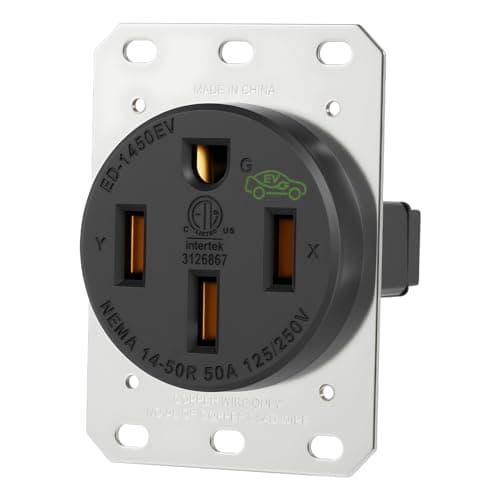
The outlet a plug-in charger needs
Industrial NEMA 14-50 Outlet
The receptacle a plug-in charger actually plugs into — buy the industrial-grade, listed version, because the cheap ones are the part that fails.
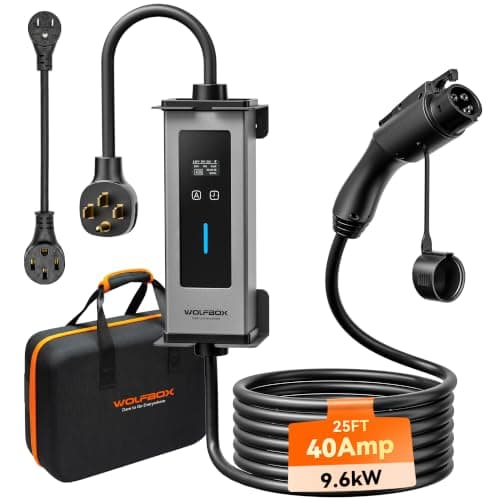
One charger for home and travel
WOLFBOX Portable (Level 1/2)
A dual-level portable that charges on both 120V and 240V, ships with both plug adapters, and adds a delay timer for off-peak charging — a genuine take-anywhere charger.
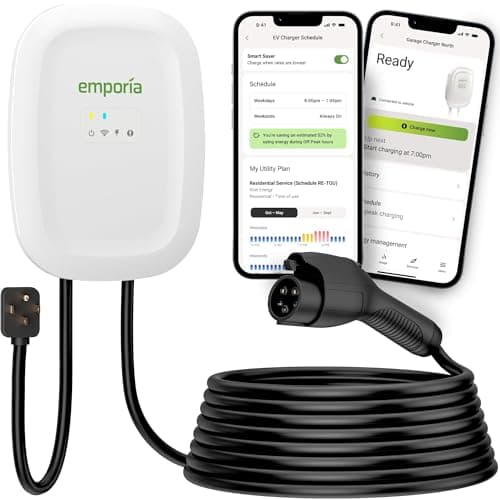
Most people who want the smart features too
Emporia Level 2 (48A)
The smart charger that does not charge a smart-charger premium — 48-amp capability and real energy monitoring for the price of a dumb one.
#ad · As an Amazon Associate we earn from qualifying purchases.
Questions
Frequently asked
Can I plug my EV straight into a 240V outlet?
Is a 240V outlet cheaper than a wall charger?
Does a plug-in charger charge slower than a hardwired one?
Can I install the 240V outlet myself and skip the electrician?
Keep reading
Related
- EV Outlet Types ExplainedWhich receptacle goes with which breaker, if you take the outlet route.
- Portable vs HardwiredThe same decision from the charger side rather than the wiring side.
- Do I Need a Dedicated Circuit?Why both routes need one, and the one case that does not.
- Charging a VW ID.4 at HomeA worked example of matching the circuit to what the car accepts.
- NEMA 14-50 OutletsThe receptacle the outlet route is usually built around.
Receipts
Sources
- US DOE AFDC — EV charging levels, connectors and typical power
- EC&M — NEC Article 625, Electric Vehicle Charging Systems
We do not run a testing lab, and we do not pretend to. Where a measured number came from someone else's lab, we name them and link them. Where we could not verify something, we say so on the page rather than quietly leaving it out. Read our full method.