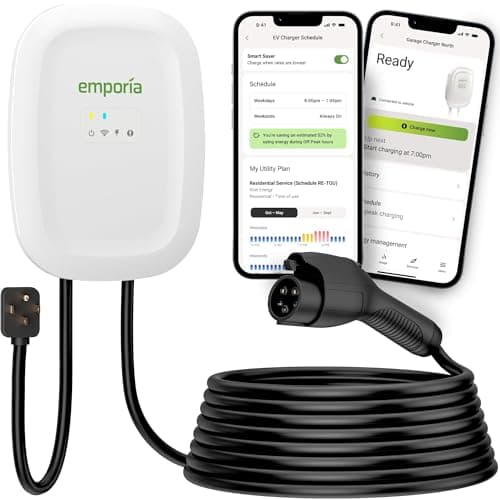
Twenty-five feet is as long as mainstream home chargers come, and our pick among them is the Emporia Level 2 — 25 feet of cable, up to 48 amps when hardwired, and real energy monitoring, for about what a basic charger costs. If you want the reach plus a holster so the slack has somewhere to live, take the Autel MaxiCharger instead. And if 25 feet still will not reach, stop shopping for chargers — the answer is an extension, not a different wall unit.
Cable length is the spec people check last and regret first. Amperage you can change with a setting; an app you can ignore; a cable that stops three feet short of the charge port makes the charger useless, and no firmware update fixes it. The frustrating part is that the category tops out: essentially every serious home charger ships either 18 or 25 feet, so "buy a longer one" runs out of road quickly, and after that the honest answer becomes mounting position or an extension.
Nothing on this page was bench-tested. The lengths below are the manufacturers' published figures from their live listings, the reach arithmetic is ordinary geometry you can repeat with a tape measure, and the scores are judgments against our published rubric. Prices render live and date-stamped; none is written into this page.
The short version
- Emporia Level 2 — best long-cable charger overall. For the buyer who wants maximum reach without paying a premium for it. 25 feet, up to 48A hardwired, energy monitoring included. Full review.
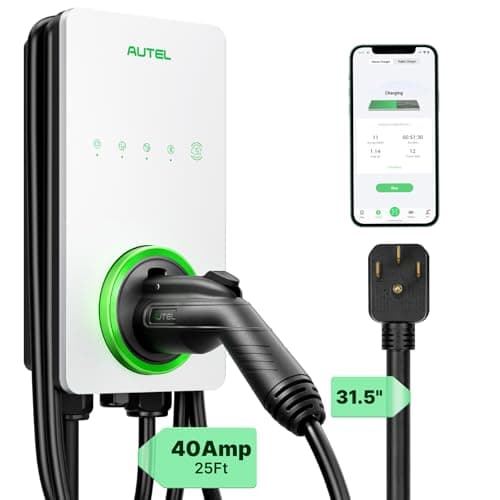
- Autel MaxiCharger — best long cable with somewhere to put it. For the garage where 25 feet of loose cable would end up on the floor. Same reach, holster in the box. Full review.
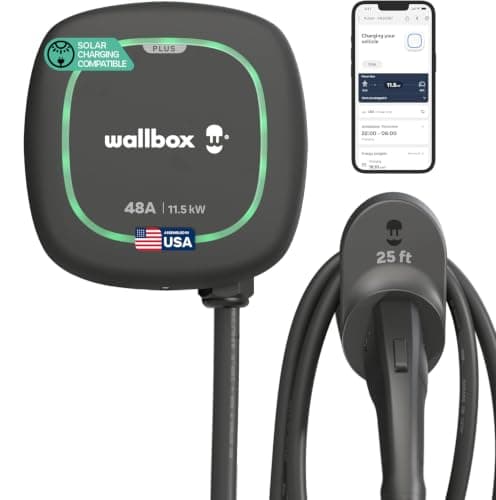
- Wallbox Pulsar Plus — best for a tight mounting spot. For the install where the wall unit itself has to be small. 25 feet of cable on one of the most compact 48-amp bodies available. Full review.
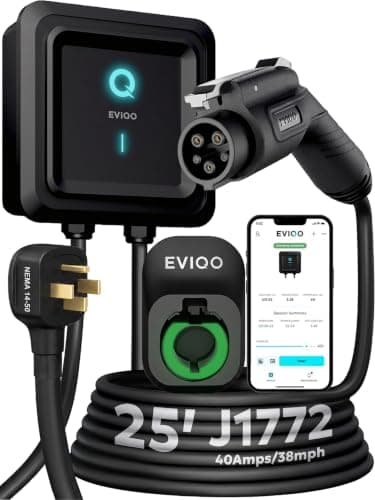
- EVIQO Level 2 — best budget long cable. For the buyer who wants the 25 feet and nothing else. 40 amps, IP66/NEMA 4 outdoor rating, lowest price of the five. Full review.
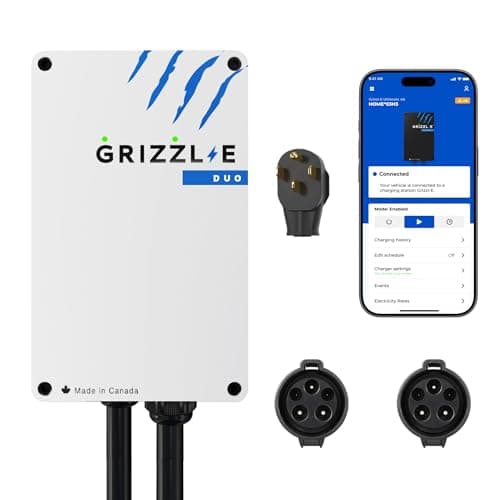
- Grizzl-E Duo Connect — best reach for two cars. For the two-bay garage that needs to reach both. Two 25-foot cables from one unit on one circuit. Full review.
Twenty-five feet of cable is not 25 feet of reach
This is the measurement everybody gets wrong, and it is why people buy a 25-foot charger and still come up short. The cable does not travel in a straight line from the box to the port. Subtract, in order:
- The drop from the charger to the ground. The connector has to be stored off the floor — NEC 625.50 wants it at least 18 inches up indoors, 24 inches above grade outdoors — and a charger mounted at chest height spends roughly 3 to 4 feet of cable just getting down and back up again.
- The bend radius at both ends. A heavy 40-amp cable will not turn a sharp corner. Call it 1 to 2 feet lost to curves you cannot straighten.
- Slack so the connector is not under tension. A cable pulled taut into the port strains the latch and the car's inlet. At least 1 foot, in practice more.
So a 25-foot cable is realistically 18 to 20 feet of usable reach from the wall plate. Measure the actual path — wall to the ground, along the floor, up to the charge port, with the car parked the way you really park it — and compare that to 20 feet, not 25. Then check which corner of the car the port is on: a port on the far side from the charger can add 15 feet to the path, which is the single most common reason a correctly-specified charger does not reach. Our cable length guide walks the measurement in detail.
Before you buy more cable, move the charger. Shifting the wall unit six feet closer to where the car's port ends up is usually cheaper than any other fix and costs nothing but a longer conduit run during the install. Reach is a mounting-position problem at least as often as it is a cable-length problem — decide where the box goes after you have parked the car and looked at the port, not before.
How the picks compare on cable and current
Published specs from the live listings, with the live price alongside. Note that every unit here lands at the same 25 feet — which is the point. Once you are at the top of the range, the tie-breakers are amperage, enclosure rating and whether a holster is included.
| Charger | Best for | Key specs (manufacturer) | Price |
|---|
| Emporia Level 2 (48A) | Most people who want the smart features too | Up to 48A / 11.5kW · J1772 · 25ft cable · Wi-Fi + app | Not verified today |
| Autel MaxiCharger (40A) | Feature-maximalists who want a tidy install | 40A / 9.6kW · J1772 · 25ft cable + holster · Wi-Fi + Bluetooth | $375.99 |
| Wallbox Pulsar Plus (48A) | A compact, fast, hardwired install | Hardwired 48A / 11.5kW · J1772 · 25ft cable · Energy Star + UL | $699.00 |
| EVIQO Level 2 (40A) | Budget-conscious buyers who still want smart features | 40A / 9.6kW · J1772 · 25ft cable · UL & ETL, IP66/NEMA 4 | $449.99 |
| Grizzl-E Duo Connect (dual 40A) | Two EVs on one circuit | Dual J1772 · Up to 40A shared · Two 25ft cables · NEMA 14-50 plug | $899.99 |
#ad Prices read live from the Amazon Product API as of October 16, 2026, and they move. Specs are the manufacturer's published claims from the live listing — we have not bench-measured them. Where we have no verified price we print none rather than a number that has gone stale.
What to look for when reach is the deciding spec
The published length, not the marketing length. Listings sometimes quote the cable plus the body, or round 24 feet up. Every length on this page is the figure the manufacturer publishes for the cable itself. If a listing will not state it plainly, treat that as the answer.
Somewhere for the slack to live. Twenty-five feet of cable is a lot of cable, and on a garage floor it is a trip hazard and a slow way to wreck the jacket. Either buy a unit with a holster included or add a holster and J-hook at the same time — it is the cheapest part of the project and the one that keeps the expensive part intact.
Cable stiffness in your climate. A long cable that goes rigid at 10°F is harder to handle than a short flexible one, and stiff-in-the-cold is among the most common owner complaints in this category. If you park outside in a cold climate, read cold weather charging before you choose on length alone.
Whether an extension is the better buy. If you need more than about 20 feet of usable reach, a properly rated J1772 extension added to a shorter charger reaches further than any charger sold today, and you can take it with you. The caveat is real: an extension is another set of contacts in a high-current path, so it must be rated at or above your charging current and it is not a licence to daisy-chain.
Amperage, once reach is solved. Do not trade a working cable length for a higher amperage number you cannot use anyway — the breaker, not the charger, sets your real speed. The wire size and breaker guide has the arithmetic, and the 32-amp roundup covers the case where the breaker is the limit.