HUB 05 · Guides & Buying Advice
Charging a Nissan Leaf at Home
The Leaf's onboard charger is modest by design, which is good news: a value 32-amp Level 2 unit is all the car can actually use.
We earn a commission when you buy through our Amazon links, at no extra cost to you. It never affects our rankings, and we say so when the cheaper product is the better buy. How this works.
The Nissan Leaf charges at home through a J1772 plug, and its onboard charger tops out near 6.6 kW(about 32 amps) on most cars — earlier ones are slower still. That is the useful part: a value 32-amp Level 2 charger is all the Leaf can use, so there is no reason to pay for a 48-amp unit or the bigger circuit it needs.
The Leaf is one of the cheapest EVs to set up at home precisely because it asks so little of the hardware. The complication is not the home charger — it is the car's DC fast-charging port, which is the aging CHAdeMO standard. That affects road trips, not your garage, but it is worth understanding before you buy anything.
The connector: J1772 at home, CHAdeMO for fast charging
Every North American Leaf uses J1772 for Level 1 and Level 2 AC charging, so home charging needs no adapter at all. Its fast-charging port is CHAdeMO— a standard now being wound down across US networks — which is a road-trip consideration, not a home one. Our CHAdeMO guide explains what Leaf owners should know, and the NACS-to-J1772 adapter page covers using Tesla AC chargers away from home (AC only — it does not touch DC).
How much charger the Leaf can actually use
This is where Leaf owners save money. Because the onboard charger caps at roughly 6.6 kW, a 32-amp charger delivers the car's full AC speed; a 40-amp unit gives a little headroom, and a 48-amp unit is simply wasted on this car. A well-certified value unit like the EVIQO Level 2 is an ideal match, and our best budget EV chargersroundup lists the cheapest units that still carry a real safety listing. Confirm your own Leaf's AC rating — the very earliest cars charge at only about 3.3 kW.
The outlet, or skip it with a portable
A plug-in charger needs a NEMA 14-50 outlet installed by a licensed electrician. For a budget car like the Leaf, a portable chargeris an especially sensible fit — it plugs into that outlet, costs less than a mounted smart unit, and travels with you. Because the Leaf's appetite is modest, you do not even need a 40-amp portable to hit its ceiling.
Can I just use the wall outlet?
The Leaf ships with a Level 1/Level 2 occasional-use cord, and on a standard 120-volt outlet it adds only about 3–5 miles of range per hour. For a short-commute, around-town Leaf that can genuinely be enough — the Leaf's modest battery is one of the few that Level 1 can keep up with. Our regular-outlet guide shows when 120-volt charging is and is not enough.
The gear
Recommended gear for this guide
The products this guide refers to, with prices pulled live from Amazon and dated on each card.
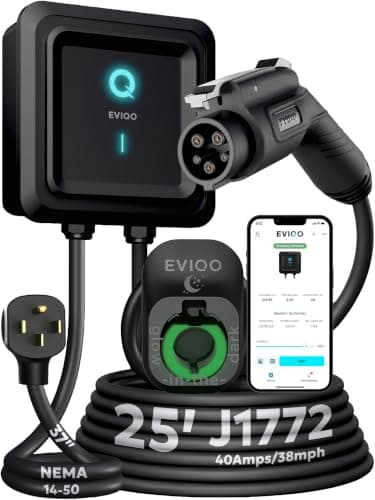
Budget-conscious buyers who still want smart features
EVIQO Level 2 (40A)
A weatherproof, UL-and-ETL-listed smart charger that regularly sits at the bottom of the price band — a lot of charger for the money.
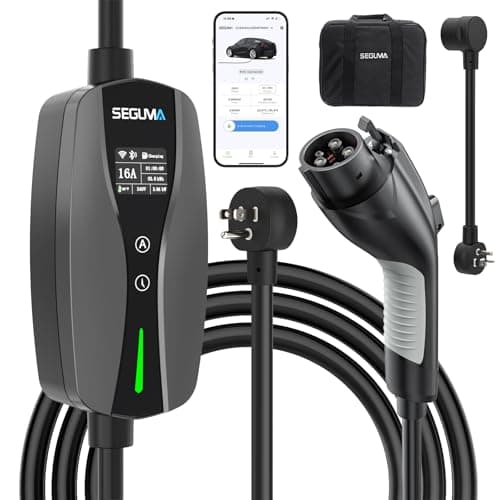
A 120V backup that is not dumb
SEGUMA Wi-Fi Level 1/2 (12A/16A)
A 120-volt cord that plugs into any household outlet and lives in the trunk — with app scheduling, a live display, and 16 amps on 240 volts if you have the outlet.
#ad · As an Amazon Associate we earn from qualifying purchases.
Questions
Frequently asked
What charger does a Nissan Leaf need?
Does the Nissan Leaf use CHAdeMO or CCS?
Can I charge a Leaf on a regular household outlet?
Is a portable charger enough for a Leaf?
Keep reading
Related
- Best Budget EV ChargersThe cheapest units that still carry a safety listing.
- Is CHAdeMO Dead?What Leaf owners should know about the DC port.
- What Amp Charger Do I Need?Why 32 amps is the Leaf's real ceiling.
- Best Portable EV ChargersA value plug-in that suits the Leaf.
- Can You Use a Regular Outlet?When Level 1 is enough for a low-mileage Leaf.
- Charging a Nissan Ariya at HomeNissan's newer EV that dropped CHAdeMO for J1772.
Receipts
Sources
We do not run a testing lab, and we do not pretend to. Where a measured number came from someone else's lab, we name them and link them. Where we could not verify something, we say so on the page rather than quietly leaving it out. Read our full method.