HUB 05 · Guides & Buying Advice
The Best EV Charging Apps
You don't need a dozen apps. Here are the few that matter — one to find chargers, one to plan trips, and the network apps to actually pay.
We earn a commission when you buy through our Amazon links, at no extra cost to you. It never affects our rankings, and we say so when the cheaper product is the better buy. How this works.
For finding chargers, PlugShareis the map to keep — it covers every major network with real driver check-ins. For planning a trip, A Better Route Planner (ABRP) models your car's energy use and picks the stops. Add the one or two network appsyou actually pay with, and you are set — you do not need a phone full of them.
Most EV owners charge at home for the vast majority of their miles, so the apps that matter are the ones for the occasional public stop and the road trip. Here is the short list that does the job.
PlugShare — find and vet any charger
PlugShare is a free, community-built map of public chargers across essentially every network: Tesla Superchargers (where open to other EVs), Electrify America, EVgo, ChargePoint, plus obscure municipal and destination chargers the network apps miss. Its real value is the check-ins: recent driver reports, photos and reliability notes that tell you whether a stall actually works before you drive to it. Filter by connector type — NACS, J1772, CCS — so you only see chargers your car can use.
A Better Route Planner (ABRP) — plan the trip
ABRP is a simulation engine, not just a map. Tell it your car and it models energy use over the route's terrain, speed and weather, then plans charging stops and how long to sit at each. It is the tool to use before a long drive or an unfamiliar route with sparse charging. Many drivers plan in ABRP, then send the route to Google or Apple Maps for turn-by-turn. Our road-trip guide walks through the workflow.
The network apps — how you pay
You still need the operator's app to start and pay for a session on most stations — ChargePoint, Electrify America, EVgo, Tesla. Install the ones for networks near you and along your routes; skip the rest until you need them. See how to pay for EV charging for every payment method and why a backup matters, and networks explained for who runs what.
Your car's built-in planner (don't ignore it)
Many EVs now include a native trip planner that routes you through compatible fast chargers and pre-conditions the battery for faster charging. For drivers of those cars, the built-in planner plus PlugShare for spot-checks is often all you need. Whatever you use, keep a NACS-to-J1772 or the right adapter in the car so a found charger is a usable one.
The gear
Recommended gear for this guide
The products this guide refers to, with prices pulled live from Amazon and dated on each card.

A J1772 car using NACS chargers
Lectron NACS → J1772 Adapter
The default adapter for a J1772 car to use a Tesla-style (NACS) home or destination charger — rated for the full 48 amps.
The cheapest capable portable
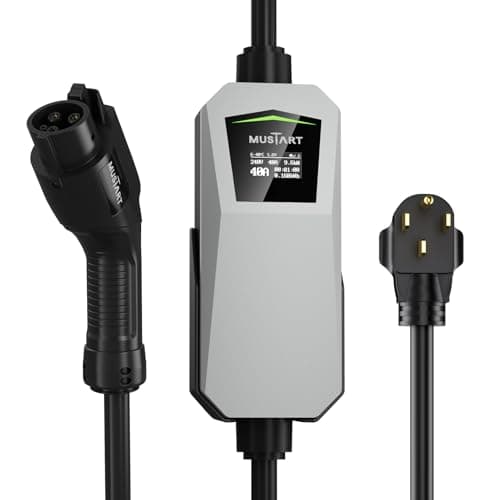
MUSTART 40A Portable
A budget 40-amp portable with an LCD readout — the value pick when you just need 240V charging that moves.
#ad · As an Amazon Associate we earn from qualifying purchases.
Questions
Frequently asked
What is the best app to find EV chargers?
What is the difference between PlugShare and ABRP?
Do I need a separate app for every charging network?
Are EV charging apps free?
Keep reading
Related
- How to Find Charging StationsEvery way to locate a working charger.
- How to Pay for EV ChargingThe payment side of the network apps.
- EV Charging on a Road TripPutting PlugShare and ABRP to work.
- Charging Networks ExplainedWho runs the stations these apps map.
- Which Adapter Do I Need?Carry the right one so a found charger works.
Receipts
Sources
We do not run a testing lab, and we do not pretend to. Where a measured number came from someone else's lab, we name them and link them. Where we could not verify something, we say so on the page rather than quietly leaving it out. Read our full method.