HUB 05 · Guides & Buying Advice
DC Fast Charging Explained
Level 3 charging is the road-trip tool — fast, public, and nothing you install at home. Here's how it works and why the last 20% is slow.
We earn a commission when you buy through our Amazon links, at no extra cost to you. It never affects our rankings, and we say so when the cheaper product is the better buy. How this works.
DC fast charging (also called Level 3) delivers direct current straight to the battery at high power, adding a large chunk of range in 20–40 minutes at public stations. It is a road-trip tool, not home equipment — you cannot install it in a garage, and you rarely need to. Its speed deliberately tapers as the battery fills, which is why the last 20% is slow and you unplug early on a trip.
Most day-to-day charging happens slowly and overnight on Level 2. DC fast charging is the other end of the spectrum — the thing that makes long drives practical. Here is what it is doing.
AC vs DC: where the conversion happens
Your battery stores DC, but the grid and home outlets supply AC. On Level 1 and Level 2, the car's onboard charger converts AC to DC, and that converter is the bottleneck — it caps home charging at roughly 11–19 kW. A DC fast charger does the conversion in the station, using industrial hardware far larger than anything that fits in a car, and feeds DC straight to the battery. That is why it can deliver 50 kW to 350 kW where a home charger tops out around 11.
How fast is it, really?
Real-world DC speed depends on the station's power, the car's maximum charge rate, the battery's state of charge, and temperature. A capable car on a strong charger can add a couple hundred miles of range in around 20–30 minutes — enough for a meal stop. Cars with 800-volt systems (like some Hyundai and Kia models) charge fastest. But a slow car on a fast charger is still slow: the car's ceiling, not the station's, usually sets the pace.
Why the last 20% is slow: the taper
Charging speed is highest when the battery is fairly empty and drops steadily as it fills, especially past about 80%. This taper is deliberate battery protection, not a fault. On a road trip the efficient move is to charge to roughly 80% and drive on, rather than waiting out the slow crawl to 100% — a habit that also happens to be gentle on the battery, as our charge to 100% guide explains.
Connectors: CCS and NACS
DC fast charging uses CCS or NACS connectors, not the J1772 AC plug. Which one your car uses is covered in CCS vs NACS. Crucially, the passive AC adapters sold for Level 2 charging do notenable DC fast charging — DC compatibility is handled by the car's port and automaker-supplied DC adapters, never a cheap pocket adapter.
Is DC fast charging bad for the battery?
Occasional fast charging is fine; relying on it as your only method, every day, adds more stress and heat than slow home charging. The healthy pattern for most owners is slow Level 2 at home for daily needs and DC fast charging saved for trips. If your situation forces frequent fast charging, it is workable — but a home or portable Level 2 setup is easier on both the battery and your wallet.
The gear
Recommended gear for this guide
The products this guide refers to, with prices pulled live from Amazon and dated on each card.
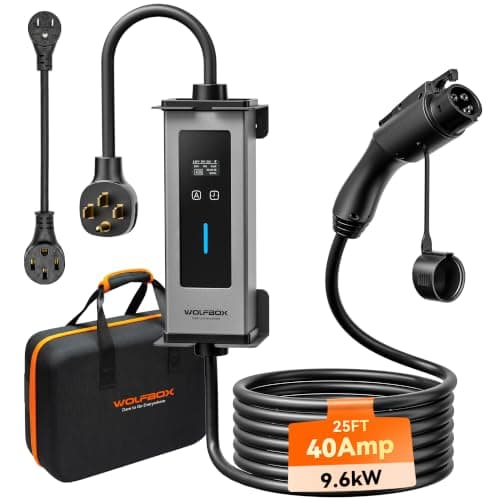
One charger for home and travel
WOLFBOX Portable (Level 1/2)
A dual-level portable that charges on both 120V and 240V, ships with both plug adapters, and adds a delay timer for off-peak charging — a genuine take-anywhere charger.
#ad · As an Amazon Associate we earn from qualifying purchases.
Questions
Frequently asked
Can I install a DC fast charger at home?
Why does DC fast charging slow down after 80%?
Does a charging adapter enable DC fast charging?
Is DC fast charging bad for my EV battery?
Keep reading
Related
- Types of EV ChargersWhere DC sits against Level 1 and Level 2.
- CCS vs NACSThe connectors DC fast charging uses.
- EV Charging on a Road TripUsing DC fast charging on a longer drive.
- Should I Charge to 100%?Why 80% is the road-trip sweet spot.
- How Long to Charge an EVThe time math across charging levels.
- Battery PreconditioningWarm the pack so it accepts full DC power.
- NACS-to-CCS AdapterReaching a Supercharger with a CCS car.
- Why EVs Charge 10 to 80%The charging curve behind fast-charge times.
- What Is a CCS Connector?The plug most non-Teslas fast-charge on.
Receipts
Sources
We do not run a testing lab, and we do not pretend to. Where a measured number came from someone else's lab, we name them and link them. Where we could not verify something, we say so on the page rather than quietly leaving it out. Read our full method.