HUB 05 · Guides & Buying Advice
Can You Charge an EV With a Regular Outlet?
Yes — every EV can charge from a normal wall outlet. The real question is whether that trickle keeps up with how you drive.
We earn a commission when you buy through our Amazon links, at no extra cost to you. It never affects our rankings, and we say so when the cheaper product is the better buy. How this works.
Yes — any EV can charge from a standard 120-volt household outlet using a Level 1 cord, and most cars come with one. The catch is speed: a regular outlet adds only about 3–5 miles of range per hour. For a light-driving household that plugs in every night, that is genuinely enough. For a daily commuter, it falls behind.
"Can I just use a normal outlet?" is one of the first questions new EV owners ask, and the honest answer is a useful yes-but. Here is the real math and when a plain outlet is fine.
How slow is Level 1, actually?
A standard 120-volt outlet with the included cord charges at roughly 1.2–1.4 kW, which works out to about 3–5 miles of range added per hour — call it 30–50 miles over a long overnight plug-in. Compare that with a Level 2 charger's ~25 miles per hour and the gap is roughly five to one. Nothing about a regular outlet is unsafe for charging at this low rate — it is simply slow.
When a regular outlet is genuinely enough
Do the arithmetic on your own driving. If you cover, say, 30–40 miles a day and can plug in for 10–12 hours overnight, Level 1 replaces what you used and then some — you may never need anything faster. Plug-in hybrids, with their small batteries, are almost always fine on Level 1 (see charging a plug-in hybrid). A low-mileage second car, or a car that sits most days, is another good Level 1 candidate.
When it isn't
If you drive a lot, have an irregular schedule that does not allow long overnight sessions, or run a big battery you sometimes need to refill quickly, Level 1 will fall behind and leave you short. That is when a Level 2 charger — or a portableon a 240-volt outlet — pays for itself in convenience.
Doing Level 1 safely
A few rules keep 120-volt charging trouble-free:
- Plug directly into the wall outlet— never through a household extension cord or power strip. Those are not rated for continuous EV current and are a fire risk. If you need reach, that is a reason to relocate the charging, not to add a cord (see our extension-cord guide).
- Use a dedicated circuit if you can. A 120-volt EV charge draws steadily for hours; sharing the circuit with a space heater or a fridge can trip the breaker or overheat old wiring. If the outlet or breaker ever feels warm, stop and have it checked.
- Keep the car's cord and a cheap backup handy. A featherweight Level 1 unit like the SEGUMA lives in the trunk as insurance, and a dual-level portable like the WOLFBOX Portable gives you Level 1 now and Level 2 the day you add a 240-volt outlet.
The gear
Recommended gear for this guide
The products this guide refers to, with prices pulled live from Amazon and dated on each card.
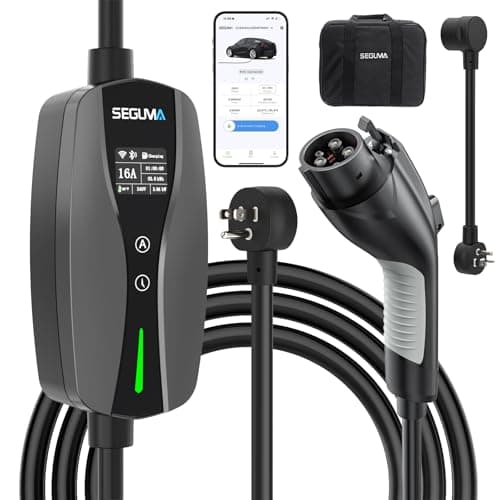
A 120V backup that is not dumb
SEGUMA Wi-Fi Level 1/2 (12A/16A)
A 120-volt cord that plugs into any household outlet and lives in the trunk — with app scheduling, a live display, and 16 amps on 240 volts if you have the outlet.
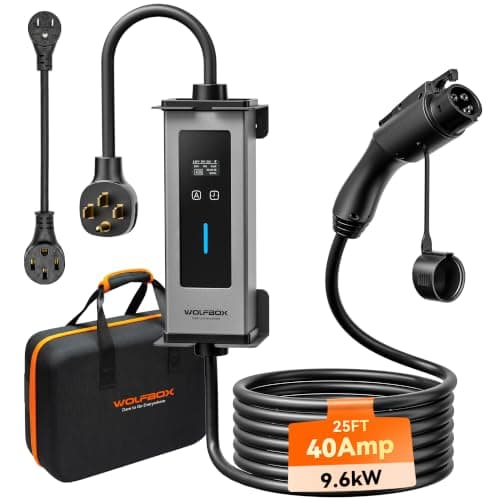
One charger for home and travel
WOLFBOX Portable (Level 1/2)
A dual-level portable that charges on both 120V and 240V, ships with both plug adapters, and adds a delay timer for off-peak charging — a genuine take-anywhere charger.
#ad · As an Amazon Associate we earn from qualifying purchases.
Questions
Frequently asked
Can you charge an electric car with a normal household outlet?
Is charging from a regular outlet enough?
Is it safe to charge an EV from a 120V outlet overnight?
How long to fully charge an EV on a regular outlet?
Keep reading
Related
- Types of EV ChargersLevel 1 vs 2 vs 3, with real speeds.
- Charging a Plug-In HybridWhy a PHEV rarely needs more than Level 1.
- Best 110V EV ChargersWhich cord to buy for that regular outlet, ranked.
- SEGUMA Level 1 ReviewA cheap 120-volt backup cord.
- Can You Use an Extension Cord?Why never to add a cord for reach.
- Best Home EV ChargersThe upgrade when Level 1 falls behind.
Receipts
Sources
We do not run a testing lab, and we do not pretend to. Where a measured number came from someone else's lab, we name them and link them. Where we could not verify something, we say so on the page rather than quietly leaving it out. Read our full method.