HUB 05 · Guides & Buying Advice
How Long Does It Take to Charge an EV?
One formula, three charging levels, and the real-world factors that stretch the estimate — so you can work out your own number instead of guessing.
We earn a commission when you buy through our Amazon links, at no extra cost to you. It never affects our rankings, and we say so when the cheaper product is the better buy. How this works.
Charging time is one simple idea: the energy you need to add divided by how fast it goes in. At home on Level 2, the practical answer is "overnight" — roughly 25 miles of range per hour, so a near-empty car is full by morning. Level 1 adds only ~5 miles per hour (a backup, not a daily plan), and DC fast charging on the road adds 100–200+ miles in about 30 minutes. Here is the math so you can find your own number.
"How long does it take to charge an EV?" has no single answer for the same reason "how long to fill a tank?" would not if fuel pumps ran at wildly different speeds. It depends on how much you are adding and which of the three charging levels you are using. But the formula is short, and once you have it, every estimate is yours to make.
The formula
Charging time (hours) = energy to add (kWh) ÷ charging power (kW).If you need to add 40 kWh and your Level 2 charger delivers about 9.6 kW, that is 40 ÷ 9.6 ≈ 4 hours. That is the whole calculation. The two inputs are how much energy you want back (your battery size, or the portion of it you are refilling) and the power your setup actually delivers — which, crucially, is the lowest of the charger, your car's onboard charger, and your circuit.
You rarely charge from empty.Most people top up from, say, 20% to 80% overnight, not 0 to 100%. So the "energy to add" is usually a fraction of the full battery, and real charge times are shorter than a full-battery estimate suggests.
Real numbers by charging level
Rather than hours (which depend on battery size), it is easier to think in range added per hour, using typical US Department of Energy figures:
| Level | Power | Range added | Full charge (~60 kWh car) |
|---|---|---|---|
| Level 1 (120V) | ~1.4 kW | ~5 miles per hour | Days — backup only |
| Level 2 (240V) | ~7–11.5 kW | ~25 miles per hour (up to ~40) | Overnight (~6–8 hours) |
| DC fast (Level 3) | 50–350 kW | ~100–200+ miles per 30 min | ~20–40 min to 80% |
The takeaway: Level 2 is the one that matters at home, because it turns charging into an overnight non-event. Level 1 is a trickle for plug-in hybrids and very light drivers; DC fast is a road-trip tool you do not install at home. The full breakdown is in types of EV chargers.
Why the last 20% takes so long
One quirk trips people up, especially at fast chargers: charging slows down as the battery fills. A car might add 150 miles in the first 20 minutes and then crawl through the last 20% of the battery, because the battery-management system tapers the rate to protect the pack near full. That is why the road-trip advice is to charge to ~80% and go, not to wait for 100%. At home overnight it does not matter — you are asleep — but on the road it is the difference between an efficient stop and a wasted half hour.
What else slows a charge
- Your car's onboard charger.On Level 1 and 2, the car's built-in charger caps the AC rate. A 48-amp wall unit cannot outrun a car that accepts 32 amps — see what amp charger you need.
- Cold weather.A cold battery accepts a charge more slowly by design. Winter sessions run longer — details in EV charging in cold weather.
- A high starting charge. Topping up from 70% is slower per kWh than from 20%, especially on DC fast charging.
- Sharing a circuit. A dual charger or a load-managed setup may split current between two cars, slowing each.
So what should you expect?
For the everyday reality: install a Level 2 charger, plug in at night, and stop thinking about charge times — the car is full each morning regardless of how empty it arrived. The only time the clock matters is a road trip, where you plan around 20-to-40-minute DC fast stops. If you want the running-cost side of the equation rather than the time side, that math is in our cost to charge guide, and the units that deliver the overnight speed are in the home charger roundup.
The gear
Recommended gear for this guide
The products this guide refers to, with prices pulled live from Amazon and dated on each card.
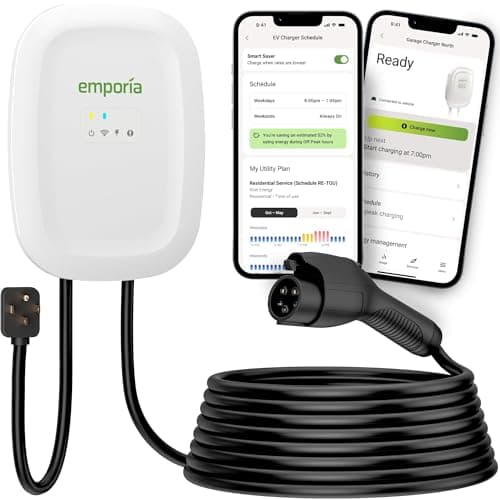
Most people who want the smart features too
Emporia Level 2 (48A)
The smart charger that does not charge a smart-charger premium — 48-amp capability and real energy monitoring for the price of a dumb one.
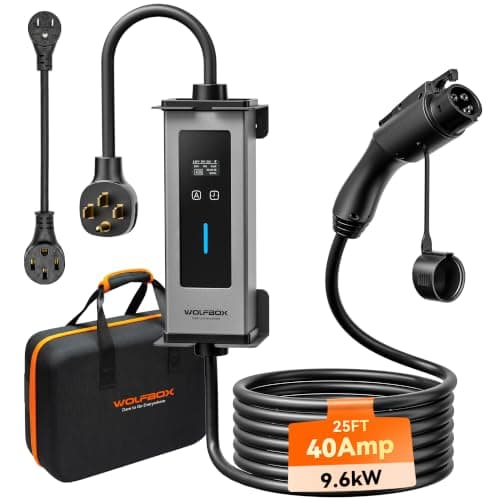
One charger for home and travel
WOLFBOX Portable (Level 1/2)
A dual-level portable that charges on both 120V and 240V, ships with both plug adapters, and adds a delay timer for off-peak charging — a genuine take-anywhere charger.
#ad · As an Amazon Associate we earn from qualifying purchases.
Questions
Frequently asked
How long does it take to charge an EV at home?
How do I calculate my EV charging time?
Why does the last 20% of charging take so long?
How long does DC fast charging take?
Keep reading
Related
- Types of EV ChargersThe three levels and how fast each adds range.
- What Amp Charger Do I Need?Why your car's onboard charger caps the speed.
- Best Home EV ChargersThe Level 2 units that deliver the overnight speed.
- EV Charging in Cold WeatherWhy winter sessions run longer.
- Should I Charge to 100%?Why the top of the battery is the slowest to fill.
Receipts
Sources
- US DOE / fueleconomy.gov — EV charging basics
- US DOE Alternative Fuels Data Center — charging at home
We do not run a testing lab, and we do not pretend to. Where a measured number came from someone else's lab, we name them and link them. Where we could not verify something, we say so on the page rather than quietly leaving it out. Read our full method.