HUB 04 · Cable Management & Accessories
How High Should You Mount an EV Charger?
The code sets a floor, not a target: 18 inches indoors, 24 outdoors. Above that, every inch you go up costs you cable reach — so most installs are mounted too high.
We earn a commission when you buy through our Amazon links, at no extra cost to you. It never affects our rankings, and we say so when the cheaper product is the better buy. How this works.
Mount the charger so the connector, when docked, sits somewhere between roughly 36 and 48 inches off the ground — comfortable to reach without bending, and low enough that you are not spending cable getting down to the charge port. The code minimum is lower than most people assume: NEC 625.50 requires the stored coupling means to be at least 18 inches above the floor indoors and 24 inches above grade outdoors, unless the equipment is specifically listed and marked for a lower location. That is a floor to clear, not a height to aim for — and the common mistake is mounting far too high.
Mounting height looks like a detail and behaves like a specification. Get it wrong high and a 25-foot cable stops reaching the car; get it wrong low and the connector drags, collects grit and sits in whatever is on the floor. Because it is decided in five minutes during an install that then becomes permanent, it is worth thinking about before the drill comes out.
What the code actually requires
NEC Article 625 governs EV charging equipment, and 625.50 addresses location. The requirement is about where the coupling means — the connector — is stored, not where the box is screwed to the wall:
- Indoors: not less than 18 inches above floor level.
- Outdoors: not less than 24 inches above grade level.
- Unless listed and marked otherwise. Some equipment is specifically listed for a lower location; the marking governs.
The reasoning is straightforward: keep the connector out of standing water, snow and whatever washes across a floor or driveway. A connector lying on concrete is in the worst place it could be. Note that the outdoor figure is higher for exactly that reason. Your local adopted code edition and inspector have the final say, as always — and this is one of the items an inspector does check, which is another reason to get a permit.
Why higher is not better: the reach arithmetic
Every inch of mounting height is paid for twice, because the cable has to come down from the charger and then go back up to the car's charge port. Work it:
- A charger mounted with the connector docked at 60 inches (five feet, a common "eye level" choice) sits 5 feet up.
- Most charge ports are roughly 24 to 36 inches off the ground. So the cable descends and climbs again — call it 3 to 4 feet of cable consumed by height alone, before it has traveled an inch horizontally.
- Add bend radius at both ends and slack so the connector is not under tension, and a 25-foot cable delivers about 18 to 20 feet of usable reach.
- Dropping the dock to 40 inches gives back a meaningful fraction of that — often the difference between reaching the far side of the car and not.
That is the whole trade. If your parking is tight to the wall and the port is on the near side, height is a free choice and you should pick what is comfortable. If you are reaching across or around the car, mount low. Our cable length guide walks the full measurement, and the long-cable roundup covers which units ship the most cable to work with.
Park the car first, then mark the wall. Pull in exactly the way you actually park, get out, and look at where the charge port is. Hold the connector there and walk the cable path back to the wall. Mark the spot with the cable in your hand — not from a diagram, and not before the car is in the space. Five minutes here prevents the single most common installation regret in this category.
The other heights worth getting right
- The receptacle, if the charger is plug-in. A NEMA 14-50 is commonly set somewhere around 18 to 48 inches for an EV install so the charger can hang near it with a short cord run. The practical constraint is that the charger body and the outlet should not fight each other for the same wall space.
- The cable hook, slightly below the charger. A J-hook mounted a foot or so under and to the side of the unit lets the cable hang in a loose loop rather than a tight coil. Tight winding is what cracks jackets, especially in cold weather.
- Clear of the vehicle, in a tight garage. Check that a door can open fully without hitting the charger, and that the unit is not where a bumper or mirror lands. In a narrow garage this sometimes decides the height more than anything else.
The parts that set the height
Published specifications from the live listings, with live prices. The code requirement is about where the connector is stored, so the holster is the part that actually satisfies it:
| Part | Best for | Published specs | Price |
|---|---|---|---|
| Lectron J1772 Holster + J-Hook | Docking a J1772 connector | J1772 holster · J-hook included · Wall mount · Universal fit | $19.99 |
| Nexoroot Steel J-Hook Wall Mount | Looping the cable, any connector | Steel J-hook · Wall mount · Indoor/outdoor · Connector-agnostic | $8.99 |
| Industrial NEMA 14-50 Outlet | The outlet a plug-in charger needs | NEMA 14-50R · 50A · 125/250V · 3-pole 4-wire · ETL listed | $17.99 |
#ad Prices read live from the Amazon Product API as of October 16, 2026, and they move. Specs are the manufacturer's published claims from the live listing — we have not bench-measured them. Where we have no verified price we print none rather than a number that has gone stale.
What to look for, and the parts that fix the height
A holster, mounted at the height you actually chose. The code requirement is about where the connector is stored, which means a holster is the part that satisfies it. Docking the connector in a holster rather than hanging it over the unit is also what keeps the contacts clean and out of water.
A J-hook for the cable, separate from the connector dock. These are two jobs and two parts: the holster holds the handle, the hook carries the weight of the cable in a loose loop. Both together cost very little and prevent the failure mode that actually ends a charger's life.
A pedestal, when there is no wall. Carports and open parking pads sometimes have nowhere suitable to mount. A pedestal sets its own height and brings the outdoor 24-inch minimum with it. See wall mount vs pedestal.
Know the cable length before you fix the height. An 18-foot charger mounted high in a two-car garage will not reach; the same unit mounted low might. If reach is tight, resolve the mounting position before you consider an extension — moving the box is cheaper.
For an outdoor install, go above the minimum. Twenty-four inches is the code floor; in a snowy climate, mounting the dock well clear of plowed or drifting snow is simple sense. Pair it with the right enclosure rating — see outdoor charger setup.
The gear
Recommended gear for this guide
The products this guide refers to, with prices pulled live from Amazon and dated on each card.
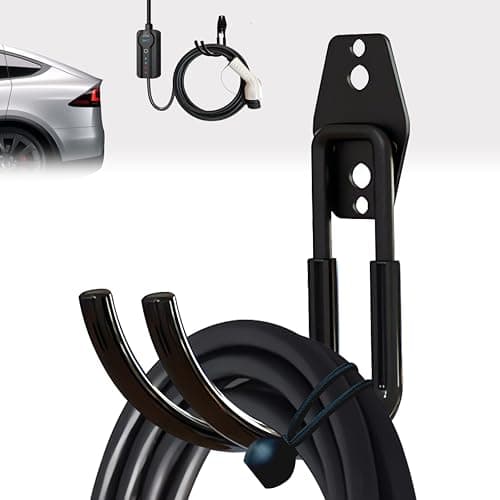
Looping the cable, any connector
Nexoroot Steel J-Hook Wall Mount
A heavy-duty steel hook for looping a charging cable — the single cheapest thing you can do to stop wrecking a cable on the floor.
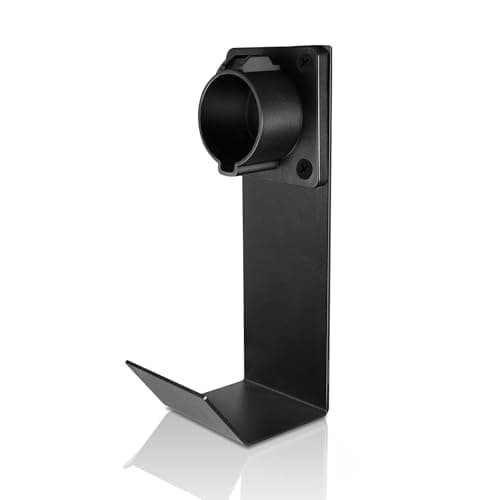
Docking a J1772 connector
Lectron J1772 Holster + J-Hook
A connector dock and cable hook in one — the tidiest, cheapest fix for a J1772 plug that otherwise sits on the floor.
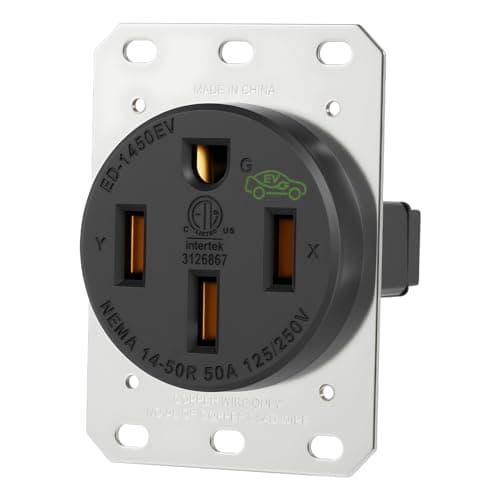
The outlet a plug-in charger needs
Industrial NEMA 14-50 Outlet
The receptacle a plug-in charger actually plugs into — buy the industrial-grade, listed version, because the cheap ones are the part that fails.
#ad · As an Amazon Associate we earn from qualifying purchases.
Questions
Frequently asked
What is the code height for an EV charger?
How high should I mount my EV charger in practice?
Does mounting height affect charging speed?
Can I mount an EV charger outside at 18 inches?
Keep reading
Related
- How Much Cable Do You Need?The reach measurement that mounting height feeds into.
- Best Cable OrganizersThe holster that satisfies the stored-connector rule.
- Wall Mount vs PedestalWhen there is no wall to set a height on.
- Best Long-Cable ChargersMore cable to spend on height, if you need it.
- Outdoor Charger SetupThe 24-inch outdoor minimum in its wider context.
- Do I Need a Permit?Mounting height is one of the items an inspector checks.
Receipts
Sources
- EC&M — Mounting height requirement for the EV coupler (NEC 625.50)
- EC&M — NEC Article 625, Electric Vehicle Charging Systems
- Hubbell — EVSE installation instructions
We do not run a testing lab, and we do not pretend to. Where a measured number came from someone else's lab, we name them and link them. Where we could not verify something, we say so on the page rather than quietly leaving it out. Read our full method.