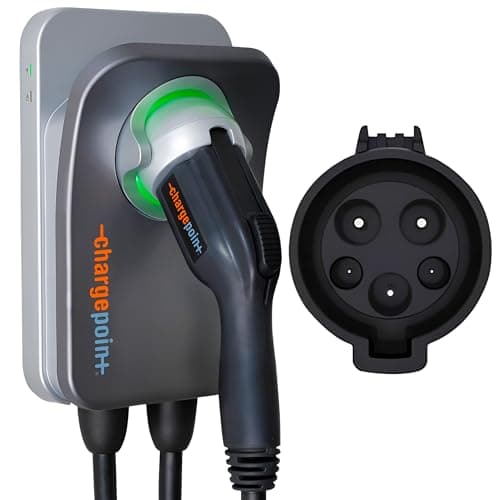
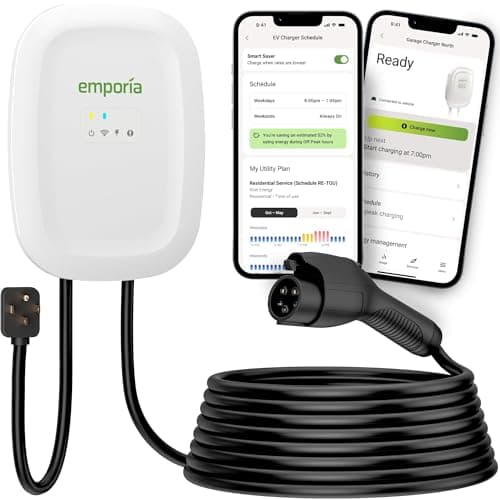
For most homes, the Emporia Level 2 is the better buy: it delivers 48-amp speed and genuine smart features at a price that undercuts the ChargePoint, so you get the software almost for free. Choose the ChargePoint Home Flex when you want the established brand behind you — a long track record, responsive support, amperage you can dial in up to 50, and one app that covers both your garage and the public network on a road trip.
These are two of the strongest picks in our best home EV chargers roundup, and they are the two buyers most often cross-shop: the value-forward smart charger against the polished, well-supported incumbent. Both are capable J1772 units in the same speed class, which is exactly why the decision comes down to price, app ecosystem and brand rather than raw charging rate. As with every comparison on this site, we compile published specs and do the math rather than bench-testing either unit.
Where each one pulls ahead
- The Emporia wins on price and value— 48-amp capability and the full smart-feature set for less than the ChargePoint costs.
- The ChargePoint wins on ecosystem and brand— amperage adjustable up to 50, a long support track record, and one app that also runs a huge public charging network.
- They tie on the things that decide daily charging— both are 48-amp-class J1772 chargers with Wi-Fi, scheduling and energy monitoring, so neither is meaningfully faster or smarter in day-to-day use.
Speed
On paper the ChargePoint edges ahead: it is adjustable up to 50 amps, against the Emporia's 48-ampceiling. In practice that two-amp gap is close to meaningless — both are 48-amp-class chargers that add range at effectively the same rate, and both only reach their top figure hardwired on a circuit big enough to back it up. A 48-amp charger needs a 60-amp breaker under the NEC continuous-load rule, and a 50-amp setting needs heavier wiring still. Install either as a plug-in NEMA 14-50 unit and both are capped at 40 amps, because a 14-50 plug lives on a 50-amp circuit — so if you are going plug-in, they charge identically. Whether you can use the top end at all is a question about your panel, not the charger; our wire and breaker guide walks through which circuit each amperage needs. The bottom line: do not choose between these two on speed, because they land in the same place.
Smart features and the app ecosystem
Both are fully smart chargers — Wi-Fi, an app, scheduling and energy monitoring are on both units, so neither wins on the feature checklist. The real difference is the ecosystem each one plugs into. The ChargePoint Home Flexreports into the same ChargePoint account that maps and pays for one of the largest public charging networks in North America, so your home charger and your road-trip charging live in one app — a genuine convenience if that is already how you charge away from home. The Emporiainstead slots into Emporia's broader home-energy platform; if you already use their monitoring products, it keeps your charging data alongside the rest of your household energy.
So ask which ecosystem you actually live in. If you lean on ChargePoint's public network, the Home Flex's unified app is worth real money to you. If you do not, that integration does nothing, and the Emporia's smart features cover the same day-to-day jobs — scheduling to cheaper off-peak hours, seeing what each charge costs — for less. On a time-of-use electricity plan, either charger's scheduling can pay back its own cost over a dumb unit by shifting charging to overnight rates; the running-cost math is in our cost to charge an EV at home guide.
Build, support and the brand premium
This is where the ChargePoint earns its higher price. It carries an Energy Star certification and, more to the point, a long track record and responsive support — the intangibles a newer brand cannot fake. On a device that pushes 40 to 48 amps for hours, unattended overnight, the reassurance of an established company behind it is worth something. The Emporia is well-made and widely owned, but it is the younger name, and part of what you are not paying for is a decade of brand history. Certification is the one spec we would never skip on a high-current charger: look for a UL or ETL listing or an Energy Star mark on whichever unit you choose, and confirm it on the live product listing before you buy.
Value
For most buyers this is the deciding axis, and it favors the Emporia. It delivers 48-amp capability and the full smart-feature set at a price that typically undercuts the ChargePoint — the reason it wins our roundup outright. The ChargePoint is not overpriced; its premium buys brand maturity, support and the unified public-network app, all of which are real. But if you strip the decision back to delivering Level 2 power to your car, the Emporia does that just as well for less. Pay the ChargePoint premium deliberately, for the ecosystem and the support — not by default.
Installation: the same rules for both
Both offer a plug-in NEMA 14-50 configuration and a hardwired option. Plug-in is capped at 40 amps and lets you unplug and take the charger with you; hardwiring unlocks the full 48 amps on the Emporia or up to 50 on the ChargePoint, but makes the unit a permanent fixture. Either way, have a licensed electrician confirm your panel can support the circuit, and if you go plug-in, spend on an industrial-grade, listed NEMA 14-50 outlet— the cheap ones are the part that overheats under a continuous 40-amp draw. For what the whole job costs, from labor to a possible panel upgrade, see our installation cost guide.
The tie-breaker:do you use ChargePoint's public network? If yes, the Home Flex's one-app-for-everything is a genuine reason to pay more. If no, the Emporia matches it on the features you will actually touch and leaves money in your pocket.
The verdict
For most people, the Emporia Level 2wins — it is fast, fully smart, and priced below the ChargePoint, which is why it is our top overall pick. Choose the ChargePoint Home Flex when the brand, the support and the unified home-and-public app are worth a premium to you, or when you want the flexibility of dialing amperage up to 50. Both are genuinely good chargers in the same speed class; the decision is about ecosystem and price, not capability. Read the full Emporia review and ChargePoint Home Flex review for the complete picture on each.