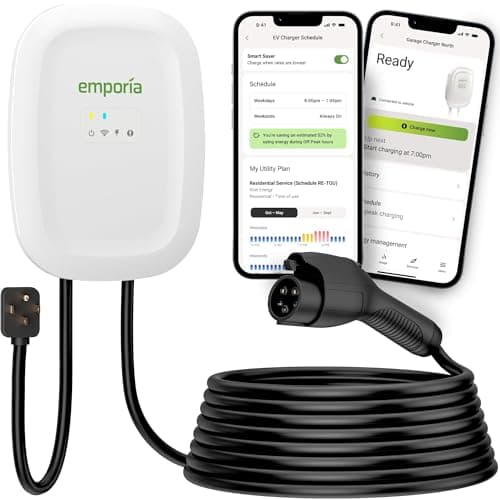
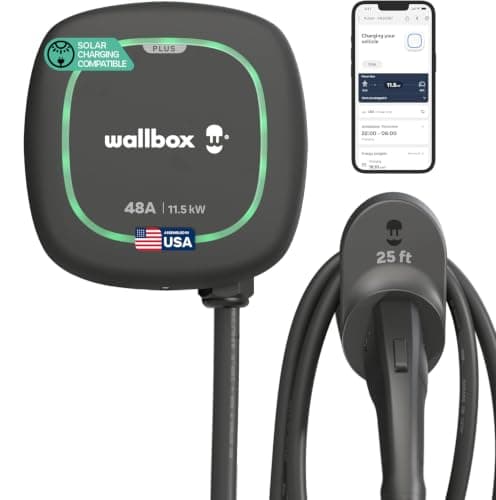
These two charge at the same speed, so the decision is not about performance — it is about what you value. Buy the Wallbox Pulsar Plus if wall space is tight and you want the smallest possible 48-amp box. Buy the Emporia Level 2— the better value and our top overall pick — if you want the same speed and better energy monitoring for less, and you have room for a larger enclosure.
Both are 48-amp-capable J1772 smart chargers with Wi-Fi apps, so on paper they look interchangeable. In practice they pull in opposite directions: one is engineered around being small, the other around being affordable. We compile published specs and owner reports and do the math here rather than bench-testing.
Speed: a genuine tie
Both reach 48 amps / 11.5 kW when hardwiredon a 60-amp circuit, and both are capped at 40 amps if you install them as plug-in NEMA 14-50 units instead. That means charge rate should not decide this: whatever your circuit and your car's onboard charger allow, these two deliver the same. Pick on size, price and app — not speed.
Size: the Wallbox's whole argument
The Wallbox is one of the smallest 48-amp chargers made — noticeably more compact than the Emporia, whose enclosure is a normal, larger smart-charger box. On a crowded garage wall, beside the panel, or in a tight utility corner, that footprint is something you notice every day. If the wall is open, it does not matter at all. The Wallbox exists for the buyer for whom it does.
Price and value: the Emporia's answer
The Emporia is our value benchmark in the whole category: it bundles 48-amp capability and genuine energy monitoring at a price that undercuts most smart rivals, the Wallbox included. The Wallbox sits in a higher bracket, and a good part of what you pay extra buys the compact engineering rather than more speed or features. If your priority is the most charger per dollar, the Emporia wins this cleanly; if it is the smallest charger for a tight wall, you accept the Wallbox's premium for a reason.
Smart features and the app
Both run a phone app with scheduling; the difference is in emphasis and polish. The Emporia's energy monitoring is a genuine strength — it is a company that started in home energy tracking — and it is central to the value story. The Wallbox app covers scheduling and power sharing but has historically drawn more owner complaints than its hardware, with fussy Bluetooth setup and Wi-Fi reconnection gripes. Neither is a dealbreaker, but on software the Emporia is the smoother experience for most owners.
Installation
To get the full 48 amps, both are hardwired to a 60-amp circuit — a licensed-electrician job, and a panel-capacity question to answer before you buy. The Emporia also offers a plug-in version (capped at 40 amps) for flexibility; the Wallbox's pitch is squarely the hardwired, tidy, compact install. Either way, size the circuit with our wire and breaker guide and price the job with the installation cost guide.
The one-line split: same speed, different priority. The Wallbox is the small-wall premium pick; the Emporia is the best-value pick that happens to be a bigger box. Decide which of those two constraints is real for you and the winner is obvious.
The verdict
For most buyers, the Emporiais the smarter purchase — the same 48-amp speed, stronger energy monitoring, and a lower price, which is exactly why it tops our home charger roundup. Choose the Wallbox Pulsar Plus when a compact footprint genuinely matters and you will pay a premium to get 48 amps in the smallest box on the wall. Both are capable, well-certified chargers; the deciding factor is space versus value, not performance.