HUB 04 · Cable Management & Accessories
Do I Need a Dedicated Circuit for an EV Charger?
Yes — and it is not optional. Here is why an EV charger must have its own circuit, and what that means for your panel.
We earn a commission when you buy through our Amazon links, at no extra cost to you. It never affects our rankings, and we say so when the cheaper product is the better buy. How this works.
Yes — an EV charger needs its own dedicated circuit, and this is not a preference but a code and safety requirement. You cannot safely run a charger on a circuit shared with other outlets or appliances, because a car draws its maximum current continuously for hours.
Why sharing a circuit is unsafe
An EV pulls a steady, near-maximum load for a long time — unlike a toaster or a phone charger that draws briefly. The National Electrical Code treats this as a continuous load and requires the circuit and breaker to be sized to 125% of it (the flip side of the 80% rule). If you shared the circuit with, say, a fridge or lights, the combined draw would overload the wiring and trip the breaker — or worse, overheat.
What a dedicated circuit means for your panel
It means a new breaker in your panel and a home run of correctly-sized wire to the charger or its outlet. A 40-amp charger needs a 50-amp circuit; a 48-amp charger needs a 60-amp circuit — the full sizing is in our wire size and breaker guide. If your panel is full or low on capacity, that is where a panel upgrade cost can come in; see the installation cost guide.
Plug-in and hardwired both need it
A dedicated circuit is required whether you hardwire the charger or plug it into a NEMA 14-50 outlet— the outlet itself must be on its own circuit. This is licensed-electrician work; our DIY-install guide explains where the line is between what you can and cannot safely do yourself.
The gear
Recommended gear for this guide
The products this guide refers to, with prices pulled live from Amazon and dated on each card.
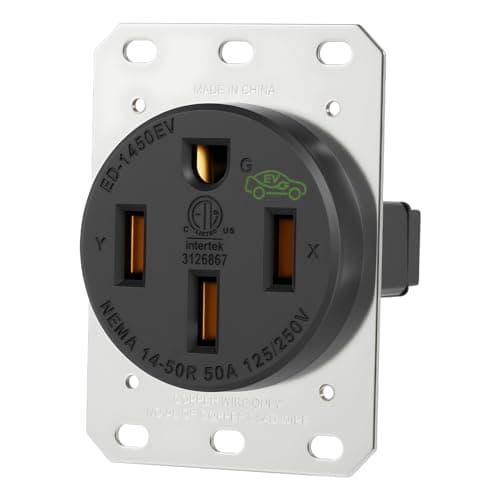
The outlet a plug-in charger needs
Industrial NEMA 14-50 Outlet
The receptacle a plug-in charger actually plugs into — buy the industrial-grade, listed version, because the cheap ones are the part that fails.
#ad · As an Amazon Associate we earn from qualifying purchases.
Questions
Frequently asked
Can I plug an EV charger into an existing outlet?
Why does an EV charger need its own circuit?
Does a plug-in charger still need a dedicated circuit?
Keep reading
Related
Receipts
Sources
We do not run a testing lab, and we do not pretend to. Where a measured number came from someone else's lab, we name them and link them. Where we could not verify something, we say so on the page rather than quietly leaving it out. Read our full method.