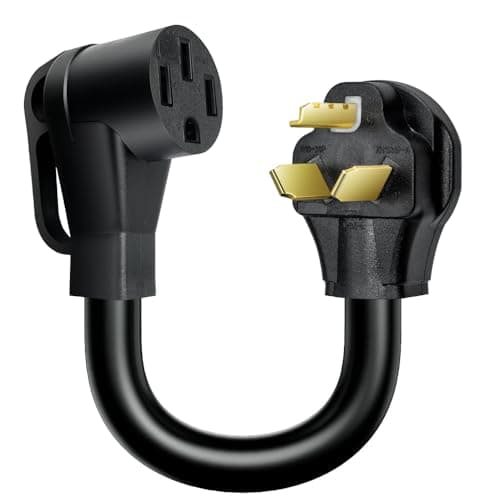
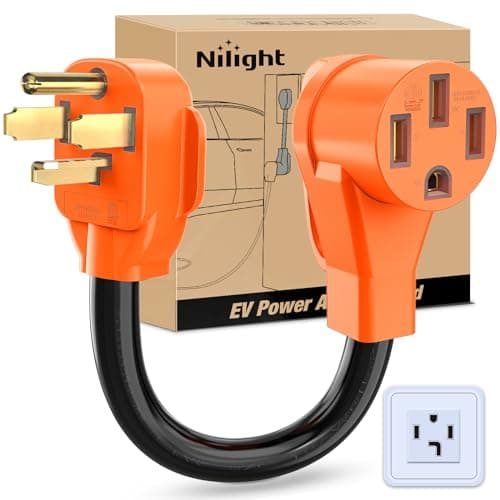
The best EV charger outlet adapter for most people is the Nilight NEMA 14-30P to 14-50R— it fits the four-prong dryer receptacle most American homes already have, and it is the only one in its price band that publishes the conductor gauge inside it. If your 240-volt outlet is a welder socket, the Suplevel 6-50P to 14-50R is the pick — 6-gauge wire and a named ETL listing, on the one circuit here big enough to beat a dryer outlet on speed. If you drive a Tesla and use the Mobile Connector, buy an adapter that clips to the connector — not a wall pigtail — and the WenStorm NEMA 14-30 is the reason why.
Before any of that, the sentence this entire page is built on: an adapter changes the shape of the plug and nothing else.It does not make the circuit bigger, it does not make the wire thicker, and on almost every product here it does not tell your charger anything at all. Get that wrong and you are running a 40-amp continuous load on a 30-amp circuit, which is how people cook a receptacle inside a wall. Get it right and a $20 part saves you a four-figure electrician's bill. We compile published manufacturer specs, quote what the sellers actually claim, and verify every product is genuinely in stock before we list it — our research method spells out what our scores are and are not. We do not have a test lab and we do not pretend to.
First: this is not the same thing as a charging adapter
Two completely different products share the word "adapter," and mixing them up is the most common confusion in EV charging.
A connector adapter lives on the car side. It sits between the charging handle and your vehicle's port, and it converts between connector standards — NACS to J1772, or J1772 to Tesla. Those are covered in our adapters and connectors hub, and if that is what you are shopping for, which adapter do I need sorts it out in two questions.
An outlet adapter — what this page ranks — lives on the wall side. It sits between a 240-volt receptacle and the plug on your charger, and it converts between NEMA receptacle patterns: a dryer outlet to a 14-50, a welder outlet to a 14-50. It has nothing to do with your car, your connector standard or your brand of EV. It exists because nearly every plug-in Level 2 charger ships with a NEMA 14-50 plug, and very few houses have a NEMA 14-50 outlet.
The one-line version: a connector adapter changes what your car can plug into. An outlet adapter changes what your charger can plug into. This page is about the second one, and the safety rules are entirely different.
Rule 1: the adapter never makes the circuit bigger
Your charger came with a 14-50 plug because a NEMA 14-50 sits on a 50-amp circuit and lets the charger pull 40 amps. Your dryer outlet is a NEMA 14-30 on a 30-amp circuit. Bolt an adapter between them and the charger sees a 14-50 socket and assumes it has 50 amps behind it. It does not. The breaker, the wire in the wall and the receptacle are all still 30 amps.
The number that governs this is not a rule of thumb. NEC 625.42states that "electric vehicle charging loads shall be considered to be continuous loads," and NEC 625.41 requires overcurrent protection sized at not less than 125 percent of the maximum load. Run that backwards and a 30-amp breaker supports a continuous draw of 24 amps(30 ÷ 1.25, or equivalently 30 × 0.8). That is the ceiling on a dryer circuit, and no adapter changes it.
Twenty-four amps at 240 volts is about 5.8 kW — roughly 20 to 25 miles of range an hour for a typical EV. That is real Level 2 charging and it fills almost any car overnight. It is simply not the 40 amps your charger would take if you let it. Our amperage guide covers how much you actually need, and the wire size and breaker guide explains why the circuit behind the outlet is the part that decides.
Never leave a 40- or 48-amp charger at its default setting behind a 30-amp outlet. Set the charger to 24 amps before the first charge, in the app for a smart unit or on the DIP switches for a dumb one. This is the single most important thing on this page, and our dryer outlet guide says the same thing in more detail.
Rule 2: nothing in a passive adapter tells the charger the truth
This is the part almost no listing explains, and it is the difference between the picks on this page.
A plain pigtail — two molded ends and a foot of cable — has no electronics in it. It presents a 14-50 socket, your charger reads a 14-50 socket, and if you never touch the amperage setting, your charger will happily try to pull 40 amps through a 30-amp circuit until the breaker trips. If the breaker is old, tired or slightly oversized for the wire, it may not trip quickly at all. That is the failure mode.
Compare that with how Tesla built the Mobile Connector. Its NEMA adapters are keyed and identified: the connector knows which adapter is attached and limits current to what that outlet supports, which is why Tesla's own 14-30 and 10-30 adapters bring the charge rate down to 24 amps automatically. Put a generic wall pigtail in front of a Mobile Connector instead and you lose that entirely — NeoCharge, which sells adapters for a living, warns in its own support documentation that it does not recommend using a NEMA adapter with the Tesla Mobile Connector "as that will automatically set the charge amperage to 32A, possibly tripping the breaker if it's used with a NEMA adapter on a 30A breaker."
So the honest hierarchy for a smaller circuit goes: an adapter that signals the limit to the charger is best; a charger you can lock to 24 amps is next; and a dumb pigtail in front of a charger you forget to adjust is the one to avoid. That is why an adapter that attaches to the charger, like our Tesla pick, earns its higher price for the people it fits.
Rule 3: match the wire to the current, not to the plug
Every adapter here wears a 50-amp socket on one end. That tells you nothing about what is inside it.
Ten-gauge copper is a 30-amp conductor, which makes it the right choice behind a 30-amp dryer circuit and the wrong choice behind a 50-amp welder circuit — and yet several 6-50 adapters on Amazon are built from exactly that, with listings advertising 50 amps and 12,500 watts over 10 AWG wire. Our welder pick is built from 6 AWGand its own listing says the heavy wire is there for "solving the problem of excessive heat generation of other 8/10AWG products." That is a seller criticizing the rest of its category, and on this particular point it happens to be right.
Two more things worth knowing. Flexible cord carries less current than the same gauge stapled inside a wall, because it has no way to shed heat, so a 10 AWG cord at 24 amps continuously is adequate rather than generous. And most listings in this category never publish the gauge at all — "100% pure copper" is a material, not a size. Given two adapters at the same price, buy the one that tells you what is inside.
Rule 4: an adapter is a plug, not a cord
The picks here are between one foot and about a foot and a half long. That is deliberate. Search the same terms and you will also find 20-foot and 25-foot "adapter cords" for three to five times the money, and what those actually are is a household extension cord with EV branding — on the supply side of the charger, which is precisely the arrangement our extension cord guidetells you never to create. Tesla's Mobile Connector manual makes the same point from the manufacturer's side, instructing owners not to plug the connector into an extension cord, multi-outlet adapter, multi-plug or power strip.
If the problem is that the charger cannot reach the car, the fix belongs on the car side, not the wall side: a purpose-built J1772 or NACS extension carries the control pilot and is built for a continuous EV load. Our extension cable roundup ranks those and is honest about when not to buy one either.
The three-prong problem: NEMA 10-30 and the missing ground
If your dryer outlet has three prongs rather than four, you have a NEMA 10-30, and it deserves a section of its own because it is not simply an older shape.
A 10-30 carries two hot conductors and a neutral. It has no separate equipment grounding conductor— the neutral does double duty. That was acceptable for a dryer under old code and is why these outlets survive in houses wired before the mid-1990s. It is a genuine problem for EV charging: an EVSE expects a true equipment ground to clear a fault quickly, and where a neutral is used as the ground path, a fault or a loose neutral can put a potential on the vehicle chassis — the thing you touch. New 10-30 installations are not permitted for EV charging under current code, and adapting one does not change the wiring behind it.
We list a 10-30 adapter, last, because people with these outlets are going to buy one and an ETL-listed version is better than a no-name. But the recommendation stands: get the receptacle converted. If the cable in the wall already includes a ground, swapping a 10-30 for a 14-30 is a short visit from an electrician and it fixes the actual defect. Our NEMA 10-30 vs 14-50 explainer covers what to check, and what installation actually costs is usually less than people expect.
The picks, in order
1. Nilight NEMA 14-30P to 14-50R — best overall
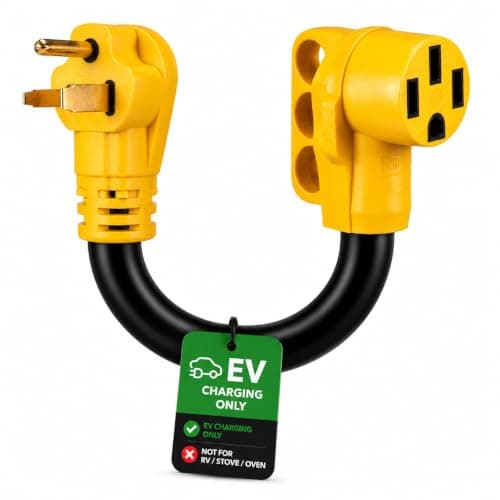
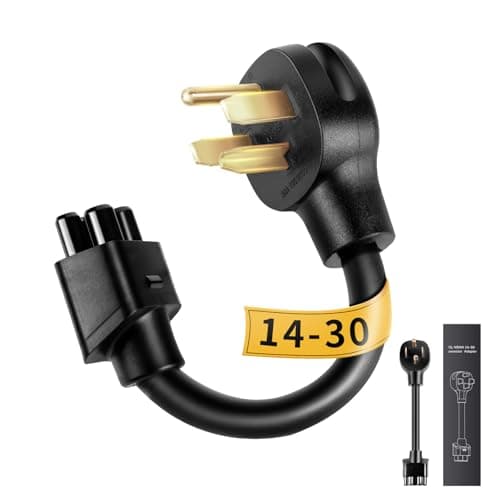
The four-prong NEMA 14-30 dryer receptacle is the most common 240-volt outlet in American homes that is not already committed to a range, which makes this the adapter most readers of this page actually need. The Nilight wins it on the one spec that matters and that nobody else in the price band publishes: four 10 AWG stranded copper conductors, in a heavy STW jacket, twelve inches long. Ten-gauge is the correct conductor for a 30-amp circuit, and knowing that is worth more than any marketing bullet.
It is a foot long, which keeps it honest — a plug adapter rather than a cord pretending to be one — and the jacket is rated by the seller for outdoor exposure, which matters if your dryer outlet is in a garage that gets cold and damp.
The honest cons. No UL or ETL listing is claimed anywhere in the listing, so there is no named certification to look up. It is a dumb pigtail, so it tells your charger nothing — the 24-amp setting is entirely on you, every time. And the listing's own charging advice, "preferably not more than 30 AMP," is above the continuous limit a 30-amp circuit allows; we would ignore that sentence and set 24. Ten-gauge flexible cord at 24 amps continuously is adequate rather than comfortable, so keep it uncoiled and put a hand on the plug face after the first long session.
2. Suplevel NEMA 6-50P to 14-50R — best for a welder outlet
If your 240-volt outlet is a three-prong welder socket rather than a dryer socket, this is the pick. A NEMA 6-50 sits on a 50-amp circuit rather than a 30-amp one, and that is the whole reason this slot exists: even after the limit this seller specifies, you charge appreciably faster here than any dryer-outlet adapter on this page can manage.
What earns it the ranking is the wire and the paperwork. Six-gauge, three-conductor STW is genuinely sized for a 50-amp circuit, and the listing is direct about why that matters — the heavy wire is there for "solving the problem of excessive heat generation of other 8/10AWG products." That is a seller criticizing the rest of its own category, and on this particular point it happens to be right. It also states ETL Listed in its electrical-rating bullet, naming a real certification body, which most adapters in this space never do. Add molded ends that face opposite directions so the thing seats without twisting, and a stated 18-month warranty.
The cons are worth reading. The big one: the same bullet that names the ETL listing also instructs you to "set the charging current to no more than 32A before charging the EV." That is conservative for 6-gauge cord on a 50-amp circuit, and it is a hedge you will find across this category — but it is the manufacturer's own instruction, so follow it, and understand that the cord rather than the circuit is what costs you the last 8 amps. Beyond that: "ETL Listed" is stated flatly, with no indication of whether it describes the cable, the connectors or the finished assembly, so treat it as a claim rather than a verified end-product listing. No IP or weather rating is published at all, so keep the coupling out of standing water — see our outdoor setup guidebefore you leave anything exposed. And the listing never mentions that the 14-50R's neutral pin is unconnected: a 6-50 gives you two hots and a ground and no neutral, which every Level 2 charger we know of is perfectly happy with, but it means nothing plugged into that socket will see 120 volts. Our 6-50 vs 14-50 explainer covers the difference between the two sockets in full.
3. Splitvolt Splitter Switch — the alternative to an adapter
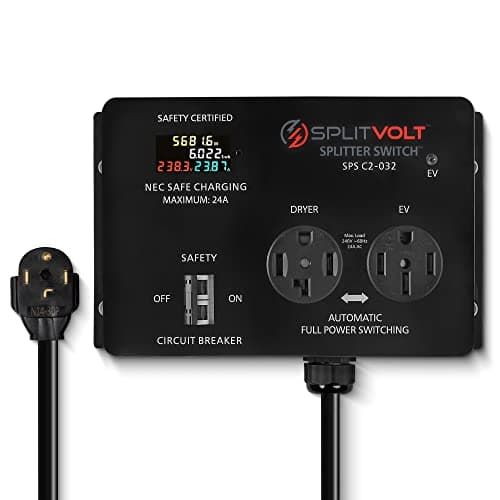
This is the pick for the reader whose real situation is "the dryer outlet is my only 240-volt outlet, and I would like to stop unplugging things." It is not a pigtail. It plugs into an existing NEMA 14-30 receptacle and gives you a dryer outlet and an EV outlet, switches the circuit between them automatically, and — the part that matters — an internal safety breaker holds EV charging to 24 amps. It is cETLus certified, a named safety listing that almost nothing else in this space carries.
In other words it enforces the rule that every adapter on this page leaves to your memory. If you are going to charge from a dryer circuit every night for years, that is worth paying for.
And it is a lot to pay: it costs roughly what a decent Level 2 charger costs, so the saving is measured against an electrician's bill for a new circuit, not against a $20 pigtail. Twenty-four amps is still the ceiling, because the circuit has not changed. Only one device draws at a time, so a long overnight charge and a load of laundry still compete. And it depends on your dryer outlet being somewhere you can actually park near. If you have spare breaker space, a dedicated circuit is faster, permanent and the better spend — the installation cost guide has the real numbers.
4. WenStorm NEMA 14-30 Tesla Adapter — best for a Mobile Connector
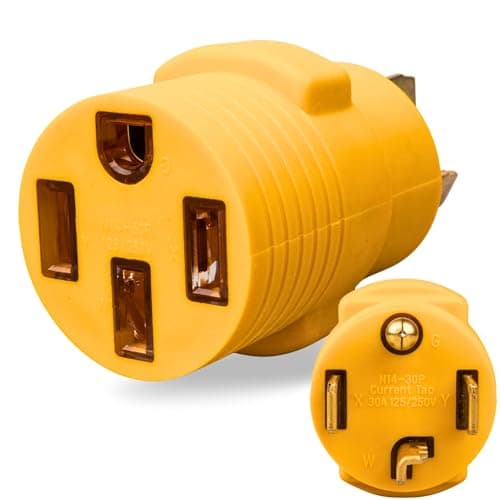
If your charger is a Tesla Mobile Connector, do not buy a wall pigtail. Buy an adapter that attaches to the connector, because that is the mechanism by which the connector learns what circuit it is on. A generic 14-30-to-14-50 pigtail leaves the Mobile Connector assuming a 14-50 and defaulting to 32 amps on a 30-amp breaker. This adapter takes the place of the connector's own NEMA adapter and holds it to 24 amps.
The listing claims an ETL listing and nickel-plated corrosion-resistant pins, and — genuinely useful — it spells out the visual check that tells a 14-30 from a 14-50: one round pin on top, one L-shaped pin at the bottom. That is the mis-order this category generates most.
The cons: it is roughly double the price of a pigtail, and it is useless with any charger that is not a Tesla Mobile Connector. The listing states Gen 2 only and explicitly not Gen 1, so confirm with the seller if you have a Gen 3. It will not fit a 14-50 outlet, making it a single-purpose part rather than a travel kit. And the conservative option is Tesla's own first-party NEMA adapters, sold through Tesla's shop rather than Amazon — if you can wait for one, buying the adapter from the company that built the connector is the safer call, and we would rather say that than sell you something. If you are weighing the Mobile Connector against a wall unit at all, our Tesla Wall Connector comparison is the place to start.
5. MECMO NEMA 14-30P to 14-50R — the clearest label, the thinnest documentation
The MECMO is the only product in this roundup that puts the correct number where you cannot miss it: "Max 24Amp 240V," in the product title. Its listing is equally emphatic about fitment — four-prong 14-30 only, not the three-prong 10-30, not for RV use — and it states the realistic outcome rather than overselling it, at roughly 20 to 25 miles of range per hour. For an inexperienced buyer, that labeling is a real safety feature. It is also the cheapest dryer-outlet pigtail here.
It sits at five rather than one because the documentation falls apart under inspection. The conductor gauge appears nowhere — not in the title, not in a single feature bullet — which for a cord carrying 24 amps continuously is the one number you would most like to have. The listing instructs you that it "MUST NOT" be used for more than eight hours continuously, which is odd advice for a product whose entire purpose is charging overnight. One feature bullet contradicts the title and two other bullets by mentioning "existing 3-prong dryer sockets (10-30P)"; the physical plug is a four-prong 14-30 and the warning bullets agree, but a listing that argues with itself is not confidence inspiring. And its own arithmetic is wrong: it calls 24 amps "7,500 Watts," when 24 amps at 240 volts is about 5,760.
6. air2yun NEMA 10-30P to 14-50R — only if your outlet is a three-prong
Everything in the 10-30 section above applies here, so read it before you buy this. If you have a three-prong dryer outlet, no other adapter on this page will physically seat, and this one at least states an ETL listing in its title rather than leaving certification unmentioned. Molded ends, a flame-resistant and UV-resistant STW jacket, and an explicit instruction from the seller to stay within 240 volts and 30 amps.
This is the pick we would most like to talk you out of. The 10-30 receptacle has no separate equipment grounding conductor, chargers expect one, and adapting the plug does not create a ground that is not there. Current code does not permit new 10-30 installations for EV charging. The gauge is not published. And like every pigtail here it tells the charger nothing, so 24 amps is on you. If an electrician can convert that outlet to a 14-30, spend the money there instead and buy the Nilight afterwards.
What not to buy
- A TT-30 to 14-50 adapter. A NEMA TT-30 is an RV pedestal outlet: 30 amps at 120 volts, one hot conductor. These adapters are sold with titles like "30A Level 2" and bullets that describe adapting "a NEMA TT-30P (30A, 125V) plug to a NEMA 14-50R (50A, 240V) receptacle" — a passive lump of copper cannot do that. You get 120 volts into a socket your charger reads as 240, which is a fault at best. If you are charging at a campground, use a Level 1 cord or a portable set for the outlet you actually have; our portable charger roundup covers the units that handle both levels.
- Long "adapter cords." A 20- or 25-foot version of any of these is a supply-side extension cord, whatever the listing calls it. Buy a one-foot adapter and solve reach on the car side.
- Stacked adapters. A 10-30 to 14-30 into a 14-30 to 14-50 is two extra connections in a path carrying 24 amps for hours, and each junction is somewhere heat can concentrate. One adapter, or none.
- Unlisted splitters.Automatic dryer splitters now sell for well under half the Splitvolt's price, but read the certification wording closely — "tested to ETL standard" is not the same claim as a listing, and this is a device left energized and unattended in your garage.
- An adapter, if you have spare breaker space. A dedicated 240-volt circuit is faster, permanent and not competing with the laundry. Adapters are for panels that are full, outlets that cannot move, and homes you do not own. Our 100-amp panel roundup covers the chargers built for tight electrical service.
How to choose an EV charger outlet adapter
Four steps, in this order. The first two are the whole job; the rest is picking between similar products.
Step 1: identify the receptacle, by counting prongs
Go and look at the outlet before you order anything. Four prongs in a round-ish pattern with one L-shaped slot is a NEMA 14-30 dryer outlet on a 30-amp circuit. Three prongs, two angled and one L-shaped, is the older NEMA 10-30. Three prongs, two flat blades and a round ground, is a NEMA 6-50 welder outlet on a 50-amp circuit. Four prongs with a straight flat bottom pin is a NEMA 14-50— and if that is what you have, you need no adapter at all. Then check the breaker it runs from, because that number, not the socket, is what limits you. Our EV outlet types explained has photos of each pattern, and 14-30 vs 14-50 covers the two that get confused most.
Step 2: set the charger's amperage before the first charge
On a 30-amp circuit, set 24 amps. On a 50-amp circuit, 40 amps is fine. Do it in the app for a smart charger, or on the DIP switches or rotary selector for a dumb one, and do it beforeyou plug the car in the first time rather than after the breaker tells you. If your charger cannot be adjusted at all, an adapter onto a smaller circuit is not a safe plan and you should not buy one — pick a charger that can be limited, or add the circuit.
Step 3: prefer the adapter that publishes its gauge, and the listing that names its certification
Between two adapters at similar prices, the tiebreakers are simple. Does the listing state a conductor gauge, and is that gauge right for the circuit — 10 AWG behind 30 amps, 6 AWG behind 50? Does it name a real certification body, ETL or UL, rather than a vague reference to standards? Is it a foot long rather than twenty? A listing that answers all three is telling you something about the manufacturer as well as the part.
Step 4: decide whether an adapter is the right answer at all
Adapters are the correct tool in three situations: your panel is full and a new circuit means a service upgrade, the only 240-volt outlet is somewhere you cannot move, or you rent and cannot alter the wiring. In those cases a $20 part is an excellent trade. If none of those apply, price the dedicated circuit first — it removes the amperage ceiling, removes the shared-circuit conflict, and removes the human step of remembering to dial the charger down. Our installation cost guide and dedicated circuit explainer cover what that involves.
How to use one without creating a problem
Plug the adapter into the wall first, then the charger into the adapter, then the car — and unplug in the reverse order, always with the charge stopped. Do not hang the weight of a charger's plug off an adapter unsupported; the leverage works on the receptacle contacts. After the first full session, put a hand on the wall plate and on both plug faces: warm is normal, uncomfortably hot is not, and a discolored or loose receptacle means stop and call an electrician. And check the outlet itself is in good condition before you start — these are often decades-old dryer receptacles that have been plugged and unplugged a handful of times in their lives. Our breaker tripping guide covers what it means if the circuit will not hold.
What an outlet adapter will not do
It will not increase your charging speed, add smart features, convert between connector standards or make an undersized circuit safe. It will not create a ground where the wiring has none. And it will not tell your charger anything — unless it is one of the charger-side adapters that keys to the equipment, that job stays with you. If what you actually want is faster charging, the answer is a bigger circuit and the right unit: start with what amperage you need and the home charger roundup.